
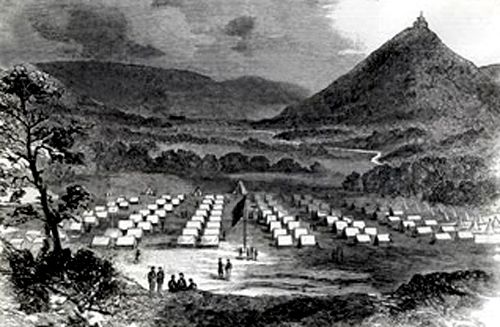
Fort Davidson, Missouri.
A Civil War fortification, Fort Davidson, Missouri, was built by Union forces about 300 yards from the base of Pilot Knob Mountain. The hexagonal earthwork fortress was the target of the Battle of Pilot Knob in 1864 during General Sterling Price’s Expedition through Missouri.
In September 1864, Major General Sterling Price led his troops into Missouri, intending to capture St. Louis. Leading some 12,000 troops from Camden, Arkansas, Price began his Missouri Expedition, moving north toward Ironton, near the terminus of the Iron Mountain Railroad from St. Louis. On September 27th, the troops and seven large cannons arrived just outside Pilot Knob, Missouri.
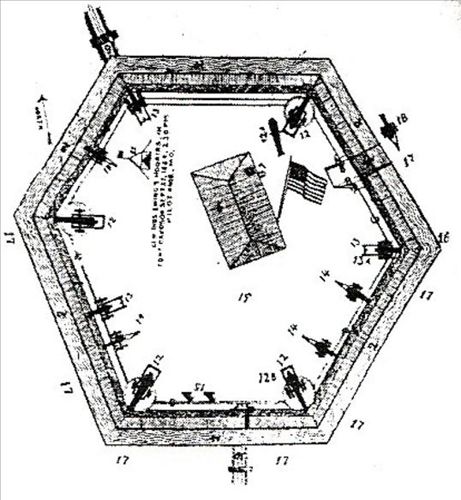
Fort Davidson, Missouri.
Fort Davidson was a tempting target, and the troops began to bombard the fortress. Led by Union Brigadier General Thomas Ewing, the Union troops, though outnumbered by more than ten-to-one, managed to repulse repeated Confederate assaults on their earthwork fortress. The fort occupied a strong defensive position, with hexagonal walls nine feet high and ten feet thick, surrounded by a dry moat nine feet deep. Two long rifle pits ran out from the walls while a reinforced board fence topped the earthworks. Access could only be had through a drawbridge on the structure’s southeastern corner.
Price’s attack came as a massive assault from several directions. Though his troops engulfed the small Union force stationed within the town of Pilot Knob and another attacked and took control of Shepherd’s Mountain, southwest of the fort, they would be unsuccessful in taking the troops at the fort itself. The guns at Fort Davidson were directed at the Confederate forces, but, under fire and finding the earthworks too steep to climb, they were forced to retreat. The Confederates then made preparations to attack again the next day, building scaling ladders. In the meantime, General Ewing began to assemble his troops for an escape, and the soldiers slipped away during the night by exploiting a gap in the Southern siege lines.
The next day, the soldiers were furious to find that the Union troops had gone and demanded that Price pursue them. However, the General had already lost over ten percent of his army and three precious days in this fruitless exercise. The Confederates took possession of the fort, but the attack resulted in a useless waste of men and ammunition and ended Price’s dream of seizing St. Louis for the Confederacy. Although the exact number of Confederate casualties is unknown, historians estimate that total Southern losses at the Battle of Fort Davidson were approximately 1,200, while Union losses were about 200.
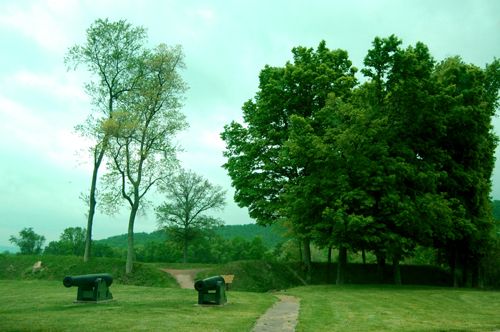
Fort Davidson, Missouri, today.
The Rebel troops then advanced northward to Jefferson City, the state capital, but when they found it too heavily fortified, they moved west, fighting their way toward Kansas City. They eventually suffered a crushing defeat at Westport. They then moved southward into Kansas, defeated once again at the Battle of Mine Creek, before finally returning to Arkansas, having lost half of their troops.
Today, the battle is commemorated at the Fort Davidson State Historic Site in Pilot Knob, Missouri. The earthworks of the fort are still generally intact, surrounding a huge hole that was caused by a powder explosion. The dead were buried in a rifle pit in a mass grave, which is marked by a granite monument. A visitor’s Center at the site provides detailed information and artifacts from the battle.
A re-enactment of the Battle of Pilot Knob is conducted annually.
Fort Davidson State Historic Site is located in Pilot Knob, Missouri, off Highway 21 on Highway 221 in Iron County.
More Information:
Fort Davidson State Historic Site
P.O. Box 509
Pilot Knob, Missouri 63663
573-546-3454

Fort Davidson, Missouri Visitor Center.
© Kathy Alexander/Legends of America, updated May 2025.
Also See:
Forts & Presidios Across America
See Sources.