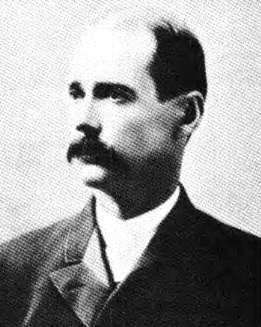
Sheriff Johnny Behan.
John Harris Behan was a lawman and politician who served as Sheriff of Cochise County, Arizona, during the O.K. Corral gunfight and was known for his opposition to the Earps.
Hailing from Westport (now Kansas City), Missouri, Behan came to California as a young man, working as a freighter and miner. He later joined the California Column and fought with them at Apache Pass near Fort Bowie, Arizona, on July 15, 1862.
In 1863, he settled in Arizona and worked as a freighter at Fort Lowell and then at the Cerro Colorado Mine in Pima County before moving to the Prescott area, where he worked in various jobs. While prospecting along the Verde River, he and about five other men were attacked by Indians but successfully fought them off on February 28, 1866.
That same year, he became the undersheriff of John P. Bourke in Yavapai County, Arizona, where he gained a reputation as a brave and honest lawman.
During this time, he joined civilian groups to investigate Indian attacks and married Victoria Zaff in 1869. The couple would have two children.
By 1871, he became sheriff of Yavapai County, a position he held for two years. In 1873, he served as Prescott’s representative in the Seventh State Assembly. In 1875, he and his wife divorced, and Behan moved to Mohave County, where he was again a state assembly representative, this time for Mohave County in 1879.
When mining began in Tombstone, he moved South and, in 1880, became a deputy under Sheriff Charles A. Shibell of Pima County. When Cochise County, which included Tombstone, was organized in 1881, Behan became its first sheriff. Frank Stilwell, William Breakenridge, Harry Woods, W.I. Perry, Bill Soule, H.L. Goodman, and others served as his deputies.
Shortly after Behan became sheriff, Virgil Earp became the city marshal of Tombstone and recruited brothers Wyatt and Morgan as “special deputy policemen.” The Earps almost immediately clashed with the Clantons and the McLaurys, whom Behan advocated for. This naturally pitted him against the Earps. Adding further fuel to the fire was Behan’s interest in Josephine Sarah Marcus, who was quickly becoming enamored with Wyatt Earp.
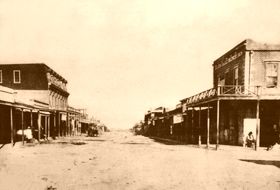
Allen Street, Tombstone, Arizona, 1882.
After the gunfight at the O.K. Corral on October 26, 1881, Behan arrested Virgil, Wyatt, and Morgan Earp, and Doc Holliday for the murder of Billy Clanton, Tom McLaury, and Frank McLaury. However, the judge ruled that the Earps and Holliday were justified in their actions.
In September 1882, after the Earp Vendetta Ride, Behan feuded with his deputy, William Breakenridge, which made him unpopular with Cochise County citizens. At the same time, investigations discovered that Behan had somehow banked some $5,000 during his tenure as sheriff. Where the money came from was never discovered.
In the end, public criticism of Behan resulted in his showing last on the ballot of possible sheriff nominees for his party, an unusual result for a seated sheriff. Losing the nomination, he was forced out of office in November 1882. He would never serve as a peace officer again.
In 1888, Behan became deputy superintendent of the Territorial State Prison at Yuma. This prompted former Tombstone resident and writer George Parsons to suggest Behan was on the wrong side of the bars. Later, he served as a U.S. agent in El Paso, Texas, tasked with controlling smuggling in the area.
John Harrison Behan died of Bright’s Disease in Tucson on June 7, 1912, and was buried at a now-lost site in Tucson’s Holy Hope Cemetery.
©Kathy Alexander/Legends of America, updated October 2026.
Also See:
Adventures in the American West
Tombstone – The Town Too Tough To Die
See Sources.