
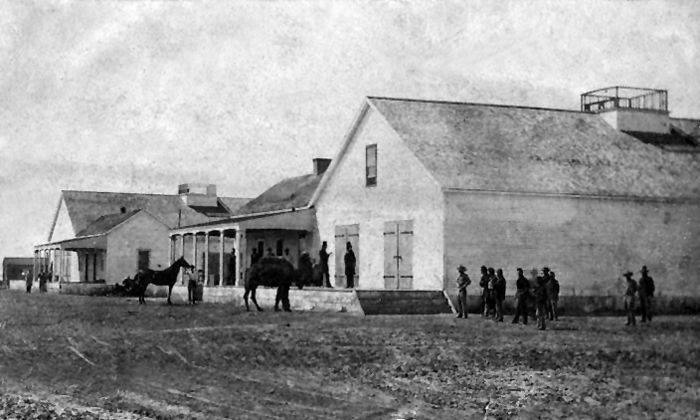
Drum Barracks in California.
Although many do not realize that California was involved in the Civil War, the Drum Barracks played a significant role in the conflict. Initially, the Drum Barracks, a five-company post, was established in January 1862 and was known as Camp San Pedro. In December 1863, the post’s name was changed to Camp Drum in honor of Lieutenant Colonel Richard Drum, assistant adjutant general of the Department of California. It soon took on the name of the Drum Barracks.
At the time, the government was unsure whether California would declare itself for the North or the South, as the state was about equally divided in its sympathies. In particular, the southern half of the state, especially around Los Angeles, was pro-secession, leading the government to establish a presence in the area.
The post was ostensibly built to have his troops fight the Indians, but there weren’t any Indians to fight in the area. Spending more than a million dollars to build the post, a considerable amount at the time, the buildings, completed in 1863, were exquisite, and area locals were very impressed. Situated on 60 acres of land with an additional 37 acres located near the harbor, the post was built to house some 500 soldiers and stables for up to 300 horses. The hospital, barracks, and laundress’ quarters were situated around a large central parade ground.
The post quickly became the central staging, training, and supply base for military operations in the Southwest. Throughout the Civil War, some 17,000 Californians came through the barracks on their way back east to fight for the Union.
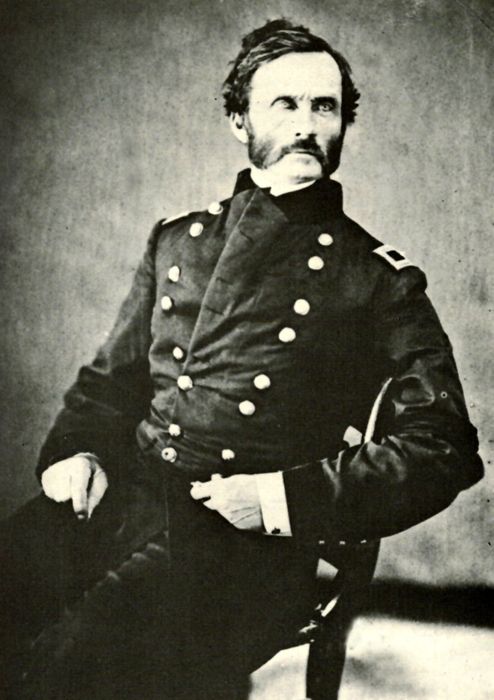
General James Henry Carleton.
On April 13, 1862, Colonel James Henry Carleton led some 2,300 California Volunteers through Arizona and New Mexico to the Rio Grande Valley, which was being invaded by Confederate armed forces from Texas. It was the longest and most difficult march of the Civil War. In the end, the troops from California secured the territory that is now Arizona and New Mexico for the Union.
After the Union won the Civil War, Camp Drum continued to maintain a presence, sending soldiers to fight in the Southwest during the Indian Wars.
The post was finally decommissioned in November 1871, but the hospital, which was then considered the best-equipped medical facility west of the Mississippi River, continued to serve wounded soldiers for another two years.
After the hospital closed, the land reverted to the original owner, and the buildings were auctioned off for $6,357.00. Though some were moved, others stayed in place, including the junior officer’s quarters, which were used as a high school, a private residence, and a boarding house throughout the years.
By the early 1960s, the only remaining buildings were the powder magazine and the junior officers’ quarters, which were slated for demolition in 1962. However, through the efforts of community groups, they were saved.
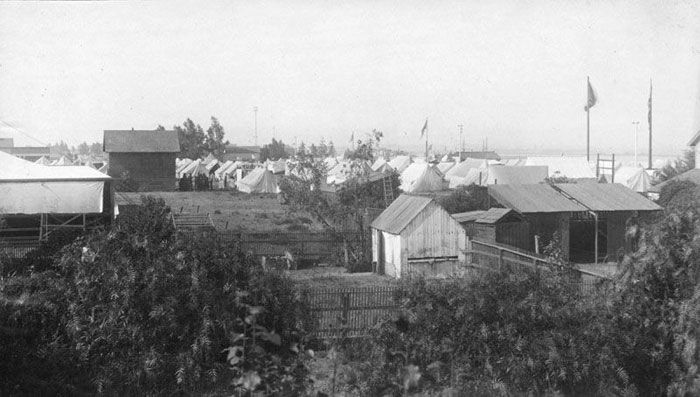
Fort Drum Barracks, California, 1889.
In 1987, the restored building was opened to the public as the Drum Barracks Civil War Museum. The building, located in Wilmington, California, a district of Los Angeles near the Port of Los Angeles, is the only major American Civil War landmark in Southern California. Today, the museum commemorates California’s role in the Civil War and hosts several reenactments and events throughout the year. The old powder magazine also stands at the corner of Opp and Eubank streets.
If the Drum Barracks’ history is not exciting enough, legend has it that the old building is the site of repeated paranormal activity. Over the years, museum staff and visitors have frequently reported hearing unexplained noises, including the sounds of chains being dragged and footsteps, throughout the building when no one is present.
More reports claim to have seen a woman, whom they call “Maria,” often appearing in a Hoop Skirt and smelling strongly of lavender and violet perfume. Others claim to have seen the apparition of a man dressed in an 1800s officer’s uniform, who evidently smokes a pipe, as the smell of pipe smoke is often detected throughout the museum.
The most active room is the Model Room, where many have encountered tobacco and perfume odors, heard items being moved around, and heard footsteps approaching them from behind.
The Drum Barracks’ hauntings have been featured in books and television shows.
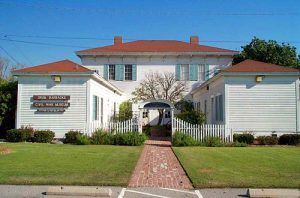
The Drum Barracks today, courtesy of Drum Barracks Civil War Museum.
Contact Information:
Drum Barracks Civil War Museum
1052 Banning Blvd.
Wilmington, California 90744
310-548-7509
©Kathy Alexander/Legends of America, updated May 2025.
Also See:
Forts & Presidios Photo Gallery
See Sources.