
By James Harvey McClintock in 1913
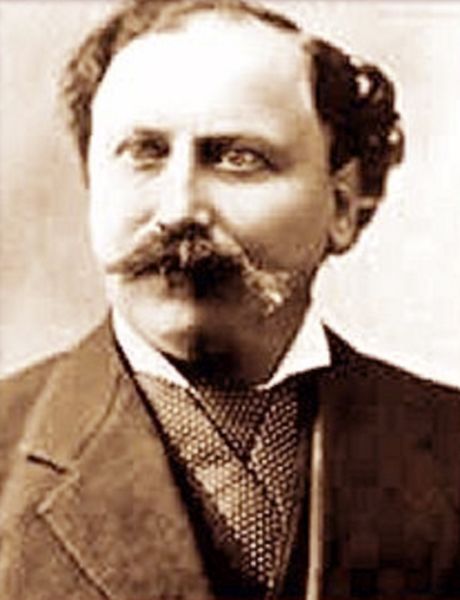
Henry Garfias.
Arizonans appreciated Henry Garfias as one of the bravest men ever known in this region of brave men. He came in 1874 from Anaheim, California, and was a native of the Golden State. In 1876, he was elected constable of Phoenix and, since then, had continued till his death to be a peace officer in some capacity. For seven or eight years, he was the city marshal.
A desperado named Oviedo, known as the Saber Slasher, was arrested. As he and Garfias were personal enemies, the latter was unwilling to undertake the arrest but did his duty. Oviedo had threatened to kill Garfias on sight.
As the officer walked toward him, Oviedo snatched up a shotgun and fired point-blank. Garfias was one of the quickest men with a revolver and probably beat the record on this occasion, for when a load of buckshot whistled over his head, he had put two deadly bullets into Oviedo’s body.
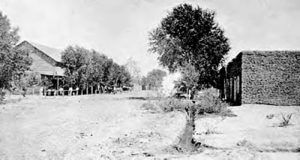
Phoenix, Arizona, 1970.
When Garfias was city marshal, several Texas cowboys fresh from their native heath mistook the character of Phoenix and started to shoot it up. They were not acquainted with the reputation of the marshal. As the first joyful yell came to his ears and the sound of pistol shots opened the ball after the fashion of the Panhandle, Henry was on his horse. When called upon by the lone Marshal to surrender, the four cowboys were gaily curveting down Washington Street eastward, occasionally taking a shot at a promising-looking door, sign, or hanging lamp. They did not and opened fire. The Marshal was unharmed despite a hail of lead and was fortunate to wing two of the cowpunchers, one of them fatally. Then he rounded them up and put them in jail.
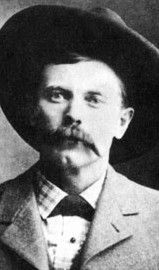
George Scarborough.
One of the most notable peace officers in the Southwest was George Scarborough of Deming, New Mexico. He had killed several men but always in the discharge of his duty. There was nothing of the bully about him. He was probably feared by the cattle rustlers as had been no other man. In April 1900, Scarborough and Deputy Sheriff Walter Birchfield of Cochise County started from San Simon to investigate a case of cattle rustling. When fired upon from ambush, they rode up to a couple of saddled horses in the Chiricahuas Mountains. The two officers, revolvers in hand, galloped into the rocks under a hailstorm of bullets. Both officers were wounded, Scarborough so severely that he died two days later. His companion dismounted and built up a rock fortification, behind which, when darkness fell, he left Scarborough and, finding his horse, dashed away for help. Before daylight, he was back from San Simon with a force of cowboys, but the outlaws had left, headed for Mexico.
The outlaw band, which had five members, was met by two officers unexpectedly. It had come from the mountains near Saint Johns, Apache County, where on March 27, Frank Lesueur and Gus Gibbons, two young cowboys, were ambushed and killed. The next day, the five bandits successfully resisted an attempt toward arrest by Sheriff Beeler and several stockmen. Four murderers were known, namely, John Hunter, Ben Johnson, John Wilson, and John Coley.
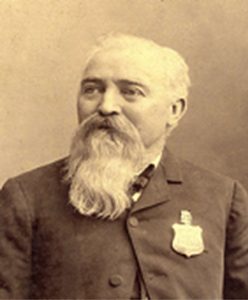
Jim Dodson
For about 15 years, the peace of Prescott was kept by Jim Dodson, an officer typical in all respects of the accepted melodrama type of the city marshal. Jim handled matters after his ideas, and petty misdemeanors interested him very little. He was always looking for large game, and the carrying of a huge revolver in a belt where his hand could reach it quickest was not for ornament, for upon a silver-mounted belt that had been presented to him by the citizens of Prescott, he had carefully cut eight nicks, the number standing for the men he had killed. Possibly because of Jim Dodson, Prescott was never a disorderly town; however, many cowboys and miners might flock in from the hills. It was told that he had been a member of the Quantrill guerrilla band in the Civil War. Over time, he retired from the office of Marshal. He served as a guard on the wall of the penitentiary at Yuma when his skill as a rifle proved valuable in at least one desperate attempt made by prisoners to escape. The latter part of his life was spent in Phoenix, where he died on May 10, 1907, at 67.
One of the historic shooting scrapes in Arizona was that between Peter Gabriel and Joe Phy on the main street of Florence in June 1888. Each was considered worthy of a high place among the gunman of the day. Gabriel had been Sheriff and had done good work as a U.S. Deputy Marshal. Phy had long served as an officer of the law and had been Deputy Sheriff under Gabriel. Bad blood had been developed between the two when Phy failed to succeed his chief in office. For weeks, it had been known that a meeting between the two would mean deadly work. The meeting came accidentally in Keating’s Saloon. There was a quick exchange of shots, each man claiming that the other had fired first, and then the battle was continued outside. Each man emptied his revolver, and every shot told.
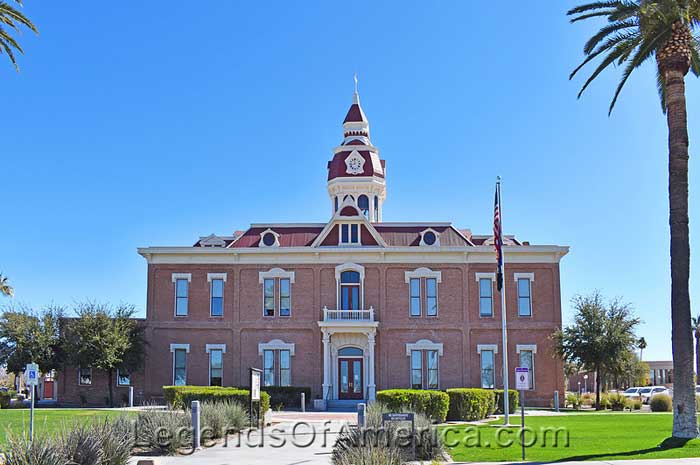
Florence, Arizona, Pinal County Courthouse. Photo by Kathy Alexander.
Phy finally went down with a broken hip bone. Gabriel weakly stood above to receive a fierce summons from his foe, “Damn you. I can’t get up. Get down here, and we’ll finish it up with knives.” Gabriel shot through the kidneys, answered, “I guess we both have plenty,” and tried to cross the street, reeled, and fell. The only surgical attendance at hand was given to Phy, who died in the night. Gabriel lay for hours in the office of Steven’s Corral till a surgeon could be brought from Sacaton. He recovered and later moved his residence to Yuma. Gabriel was a higher type of the two, yet he was a hard drinker, while Phy was an abstainer. Phy had gone to Florence from Phoenix where, while serving as a peace officer, he had been ambushed by Mexicans in an alleyway just north of the present site of the Adams Hotel, repeatedly stabbed, and left for dead. A few minutes later, he was found with his head underwater in a large ditch. When he could travel, he left Phoenix, which he said was a bit too tough a town for him.
The wildest time ever known to Saint John’s was San Juan’s Day, June 24, 1882, when Nat Greet and a band of Texas cowpunchers thought to provide a little entertainment by shooting up the sleepy Mexican town. On the border, they had been accustomed to seeing Mexicans run whenever the fusillade started. They were mistaken in the character of the population of Saint Johns, for the Mexicans there refused to be intimidated and returned the fire with interest, especially from an improvised fortress in the loft of Sol Barth’s home. The defense was under the charge of Perez Tomas, a Mexican Deputy Sheriff, who, according to Charlie Banta, was as fine a man as ever lived. Only one Mexican was wounded, Tafolla, whose son afterward was killed while serving in the Arizona Rangers. Father Nathan C. Tenney, an elderly and beloved Mormon resident, was accidentally killed while acting as a peacemaker. One of the attacking parties, named Vaughn, was killed, and Harris Greer was wounded. The Texans were finally repulsed and rode away. Later, they were arrested and brought back to Saint John’s for trial. There was grave danger of lynching, and the Mexican population even organized to storm the jail for a time. Summary action of this sort was avoided through the influence of Sheriff E.S. Stover and Barth, and the raiders, in the end, escaped with a light punishment.
By James Harvey McClintock, 1913. Compiled and edited by Kathy Alexander/Legends of America, updated March 2025.

Western manhunt by John W. Newton appeared in The Story of the Outlaw.
Also See:
Lawmen and Gunfighters Photo Gallery
Notes and Author: James Harvey McClintock was born in Sacramento in 1864 and moved to Arizona at 15, working for his brother at the Salt River Herald (later known as the Arizona Republic). When McClintock was 22, he attended the Territorial Normal School in Tempe, earning a teaching certificate. Later, he served as Theodore Roosevelt’s right-hand man in the Rough Riders during the Spanish-American War and became an Arizona State Representative. Between 1913 and 1916, McClintock published a three-volume history of Arizona called Arizona: The Youngest State (now in the public domain) in which this article appeared. McClintock continued to live in Arizona until his poor health forced him to return to California, where he died on May 10, 1934, at the age of 70. Note: The article is not verbatim, as spelling errors and minor grammatical changes have been made.