
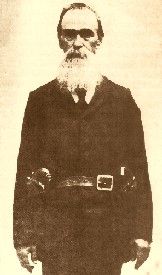
George Maledon, the Prince of Hangmen
George Maledon earned the moniker of the Prince of Hangmen while serving as Judge Isaac Parker’s chief executioner during the lawless days when Parker served as judge of the Federal Court for the Western District of Arkansas.
Born in Germany on June 10, 1830, Maledon migrated with his parents to Detroit, Michigan, when he was still a child. When he grew up, he headed westward, where he worked as a Fort Smith, Arkansas, police officer. When the Civil War broke out, he enlisted in the Arkansas Light Artillery, serving in its 1st Battalion.
Maledon, a diminutive man standing at just about five and a half feet, was described as a “whispy” little fellow with dark eyes and hair, a fair complexion, and a long beard. Quiet in nature, he rarely smiled and was almost always dressed in black, an “appearance” that would soon seem appropriate to his new profession.
After the war, Maledon returned to Fort Smith, where he worked as a deputy sheriff before being hired as a turnkey at the federal jail in May 1871. The next year, he was appointed as a “special deputy” in charge of executing the condemned prisoners.
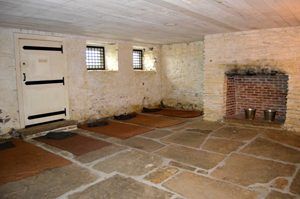
Prisoners’ Quarters at Fort Smith, Arkansas.
For the next 22 years, he would execute more than 60 criminals and be forced to shoot five prisoners during escape attempts, two of which were killed. In no time, he was given the title of the “Prince of the Hangmen” by the local newspaper – the Fort Smith Elevator, which was only too happy to publish every morbid detail of Maledon’s handiwork for the “entertainment” of its readers.
For three years, between 1873 and 1876, these executions upon the gallows were made public, drawing thousands of people from the surrounding areas and sometimes from across the nation. During this time, a total of 22 men were hanged in seven different public displays. As the morbid gawkers gathered around the 20-foot-wide scaffold, where many as 12 men could be hanged at one time, the question was not “who was going to be hanged first,” but rather, “would they be executed at the same time?”
On September 3, 1875, the largest group ever to be executed at once occurred when Maledon hanged six men. The scheduled event had been widely publicized in the media, and a week before the execution, the city began to fill with strangers from all over the country. Reporters from Little Rock, St. Louis, and Kansas City flocked to Fort Smith, as well as newspapermen who traveled far from eastern and northern cities to catch the “scoop.” By the time the event took place, more than 5,000 people watched as the six men were marched from the jail to the gallows.

Fort Smith Hanging.
Of the six felons, three were white, two were Native American, and one was black. Seated along the back of the gallows, their death warrants were read to them, and each was asked if they had any last words. When the preliminaries were over, the six were lined up on the scaffold while executioner George Maledon adjusted the nooses around their necks. The trap was sprung all six died at once at the end of the ropes.
The Fort Smith Independent was the first newspaper to report the event on September 3, 1875, with the large column heading reading: “Execution Day!!”
Other newspapers around the country reported the event a day later. These press reports shocked people throughout the nation. “Cool Destruction of Six Human Lives by Legal Process” screamed the headlines.
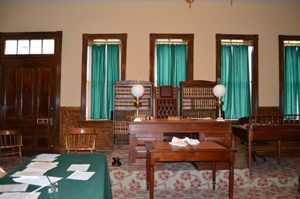
Courtroom at Fort Smith, Arkansas by Kathy Alexander.
This event earned Judge Isaac Parker the nickname “The Hanging Judge” and led to his court being called the “Court of the Damned.”
Ironically, though the public flocked to watch these gruesome displays, Maledon was shunned by the community, as the townsfolk were afraid to associate with the “Prince of Hangmen.”
However, one man was morbidly attracted to Maledon’s occupation – Heck Thomas. On one occasion, while Thomas was at Fort Smith, he asked Maledon for all the particulars as the executioner proudly displayed a collection of leg irons, straps, and ropes that had actually been used in some of the hangings.
When showing Thomas one rope that had been used in eleven hangings, Maledon commented: “It is made of the finest hemp fiber, hand-made in St. Louis and treated to keep it from slipping.”
When Thomas questioned him about the type of knot that Maledon used for the executions, George, seemingly pleased to show off his expertise, said:
“You see, a big knot is necessary to have a humane hanging. If it doesn’t break the man’s neck when he drops, he strangles. That isn’t a pretty sight. He just kicks and twists a lot.”
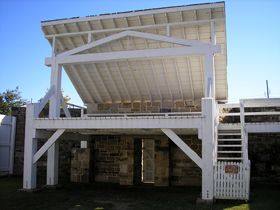
Fort Smith, Arkansas, Gallows by Kathy Alexander.
But for the curious onlookers, these public events would be short-lived. In 1878, a 16-foot-tall fence was built around the gallows, and the executions became “private affairs,” usually having fewer than 50 spectators.
The only execution that Maledon refused to carry out was that of Sheppard Busby, a U.S. Deputy Marshal, who had been convicted of killing another marshal by the name of Barney Conneley, when Busby tried to arrest Conneley for adultery. Maledon, who had had many associations with Busby in the past, refused to carry out his duty in this one instance, and Deputy G. S. White performed the execution.
After more than two decades carrying out these gruesome tasks, Maledon retired from the federal court in 1894 and opened a grocery business in Fort Smith. But he was yet to face one of his most difficult life situations when, the next year, his 18-year-old daughter, Annie, was murdered by Frank Carver. Annie met Carver in Fort Smith while he was there being tried on whiskey charges. The two soon began a brief love affair, which led her to follow him to Muskogee, Oklahoma, where she was surprised to find that Carver was already married to an Indian woman. When the two entered into a heated argument on March 25, 1885, a drunken Carver shot the girl. She was seriously wounded and taken back to Fort Smith, where she died three weeks later, on May 17.
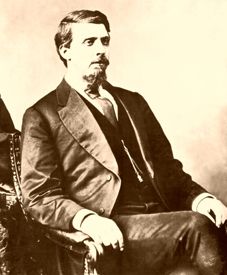
Judge Isaac Parker.
Finding himself before Judge Isaac Parker, Carver was found guilty of murder and sentenced to hang. However, Carver hired a fancy lawyer, who soon appealed the case to the Supreme Court, and the sentence was changed to life in prison.
George Maledon was so disgusted by the decision that he left Fort Smith and took a “show” on the road where he displayed relics from hangings, including ropes, pieces of the gallows’ beam, and photographs of some of the nation’s most notorious outlaws. Setting up a tent in various cities, hundreds of people flocked to the show to hear Maledon speak and view the gruesome displays.
Just before he left Fort Smith, Maledon was asked if his conscience ever bothered him about the hangings or if he feared the spirits of the departed. To this, he replied, “No, I have never hanged a man who came back to have the job done over.”
By 1905, Maledon’s health was seriously failing, and he entered an old soldier home in Humboldt, Tennessee, where he spent the remainder of his days. Though some sources say he died June 5, 1911, just shy of his 81st birthday, according to government records and other reliable sources, Maledon died on May 6, 1911, and was buried at the Johnson City Cemetery.
Maledon has the dubious honor of executing more men than any other executioner in U.S. history.
The final execution in Fort Smith occurred on July 30, 1896. Eleven and a half months later, the original gallows were demolished, and the debris was completely burned. However, a new gallows was reconstructed at the original site in 1981 as part of the Fort Smith National Historic Site. The site also includes the barracks, courthouse, commissary, jail building, and a visitor’s center that focuses both on Fort Smith’s military history and the years it served as the federal court.
©Kathy Alexander/Legends of America, updated April 2026.
Also See:
Fort Smith National Historic Site
Forts & Presidios Across America
Judge Isaac Parker – Hanging Judge of Indian Territory
See Sources.