
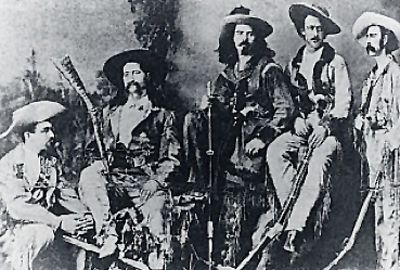
Wild Bill Hickok (second from left) and Charlie Utter (far right).
Charles H. Utter, better known as “Colorado Charlie,” was a trapper, guide, and prospector who made his way West. He became good friends with Wild Bill Hickok and knew Calamity Jane.
Charlie was born about 1838 near Niagara Falls, New York, and grew up in Illinois. As an adult, he moved West and, in the 1860s, earned a living as a trapper, prospector, and guide in Colorado.
Charlie was a small man, at five and a half feet tall, but he made up for it in his dandified appearance. He was extremely neat, with long flowing blond hair and a perfectly groomed mustache. He was known to have worn hand-tailored fringed buckskins, fine linen shirts, beaded moccasins, a big silver belt buckle, and a pair of revolvers mounted in gold, silver, and pearl.
He slept in a tent surrounded by fine California blankets and always kept a mirror, combs, razors, and whisk brooms. Obsessed with cleanliness, he bathed every morning, an oddity in the mining camps and settlements of the Old West. Allowing no one, not even Wild Bill Hickok, into his tent, he was a deadly person, threatening to shoot anyone who entered.
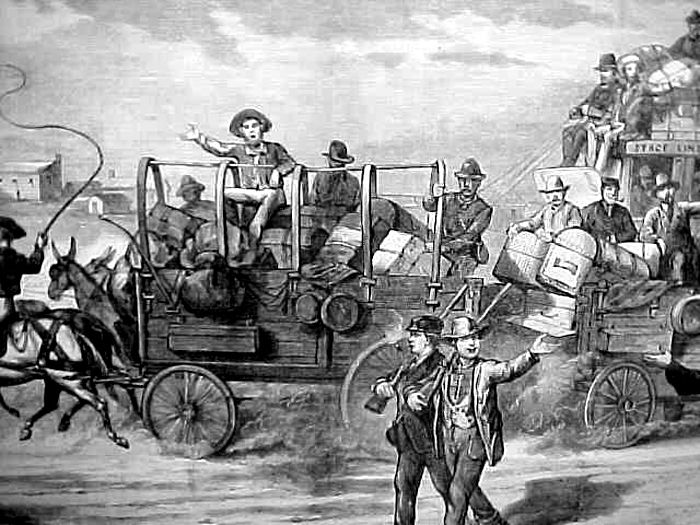
A wagon train comes through Cheyenne, Wyoming, by Leslie’s Illustrated Newspaper.
Charlie’s reputation as a trapper, prospector, and guide earned him the nickname “Colorado Charlie.” While there, he met a 15-year-old girl named Tilly Nash. The daughter of a baker from Empire, Colorado, she was impressed by his boyishly handsome face and charisma, and in 1866 they married.
Charlie continued working in Colorado until he heard about the gold finds in the Black Hills. Sure the area would be a smashing success, he described it as “a real lollapalooza,” and he and his brother Steve soon planned to head to Deadwood, South Dakota.
In the spring of 1876, Charlie and his brother, Steve, organized a wagon train in Georgetown, Colorado, and headed for South Dakota. When the wagon train passed through Cheyenne, Wyoming, he ran into his old friend Wild Bill Hickok, who joined the caravan and more than 100 others, including prospectors, gamblers, and a troop of “working girls.” Later, in Fort Laramie, Calamity Jane also joined the wagon train.
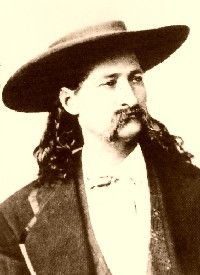
James Butler “Wild Bill” Hickok.
The circumstances of Charlie Utter and Wild Bill Hickok’s first meeting are not explicitly known. Still, they more than likely met in Kansas sometime in the mid-1850s and kept in contact throughout their travels through Colorado.
By the time Charlie and the rest of the caravan arrived in Deadwood in mid-July, Charlie and Bill had partnered in the Wagon train. One of Utter’s self-imposed duties was to look after Wild Bill, protecting him from his worst enemy – himself. Having known Hickok for a long time, Utter knew how Hickok’s excessive drinking and gambling could get him in trouble. Monitoring Bill, he often tried to protect himself from his habits, though it rarely worked.
After arriving in camp, Utter began a mail express service between Deadwood and Cheyenne, where he and his other riders carried letters for 25 cents apiece. Crossing hostile plains and mountains, the riders often carried more than 2,000 letters at a time. When the fateful day of Hickok’s murder arrived, August 2, 1876, Utter was tending to his business affairs. However, as soon as he heard, Charlie rushed back and claimed the body at the saloon.
He soon placed the following notice in the Black Hills Pioneer:
“Died in Deadwood, Black Hills, August 2, 1876, from the effects of a pistol shot, J. B. Hickok, formerly of Cheyenne, Wyoming. Funeral services will be held at Charlie Utter’s Camp on Thursday afternoon, August 3, 1876, at 3 p.m. All are respectfully invited to attend.”
Bill was laid out in a coffin, and people filed by all day long to pay their last respects. Before Hickok was buried, Utter took a lock of his hair and later sent it to his widow, Agnes Lake.
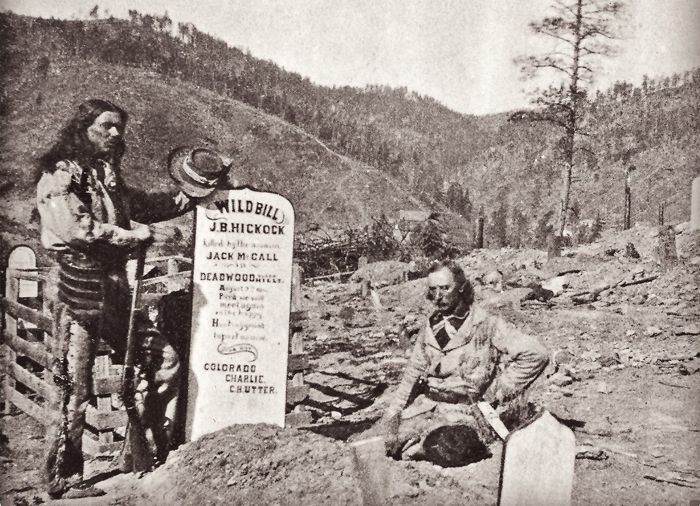
Steve and Charlie Utter at the grave of Wild Bill Hickok.
The following day, his funeral was held, and Charlie made him a marker that read:
“Wild Bill, J. B. Hickok, was killed by the assassin Jack McCall in Deadwood, Black Hills, on August 2, 1876. Pard, we will meet again in the happy hunting ground to part no more. Goodbye, Colorado Charlie, C.H. Utter.”
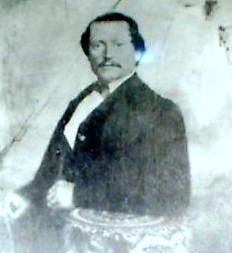
Jack McCall killed Wild Bill Hickok.
Ironically, as Hickok was being buried in the plot that Utter paid for, Jack McCall’s murder trial took place at McDaniel’s Theatre. In the farce of the trial, McCall was found not guilty and allowed to be let go. However, it was later found that the trial was illegal, as the Deadwood camp had no authority. McCall was soon picked up by U.S. Marshals and was retried and hanged in Yankton, South Dakota, on March 1, 1877.
That same year, Charlie returned to Colorado but came back to Deadwood in 1879 to oversee the relocation of Hickok’s body to the Mt. Moriah Cemetery. In February 1879, Utter purchased the Eaves Saloon in nearby Gayville, South Dakota. But just a month later, he ran into trouble for selling liquor without a license. In June, he was found guilty of maintaining a nuisance dance hall. He returned to Deadwood and lost all of his possessions in the tragic fire that destroyed much of the mining camp on September 26, 1879.
After the Deadwood fire, many Black Hills miners left Deadwood for richer gold deposits in Colorado, Idaho, New Mexico, Texas, and South America. By February 1880, Utter was in Leadville, Colorado, exploring the many mining camps up and down the valley. That same year, he and Tilly separated, and Charlie moved on to the Durango, Colorado, area. He then headed to Socorro, New Mexico, where he operated a saloon and gambling den. While there, he was said to have fallen in love with a beautiful faro dealer named Minnie Fowler.
Beyond New Mexico, Charlie’s trail began to be lost in history. However, according to biographer Agnes Wright Spring, records show that a Mr. C.H. Utter traveled to Panama, with some tales saying he worked as a doctor and pharmacist. This tale was supported by Utter’s friend, Upton Lorentz, who maintained that Charlie settled in Panama around 1888. There, he was said to have run a pharmacy, practiced medicine among the local Indians, and even delivered babies. Lorentz also said he last saw Utter, blind and grizzled, sitting in a rocking chair in front of his pharmacy in 1910.
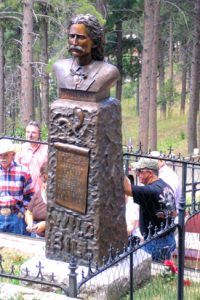
Bill Hickok Grave, Deadwood, South Dakota by Kathy Alexander.
Was this Colorado Charlie? The details of Utter’s final days are unknown.
©Kathy Alexander/Legends of America, updated October 2026.
Also See:
Wild Bill Hickok & The Dead Man’s Hand
Black Hills Historic Characters & Tales
Deadwood – Rough & Tumble Mining Camp
See Sources.