

Elizabethtown, New Mexico,1868.
Elizabethtown, New Mexico, a ghost town in Colfax County, was once a bustling mining camp that was New Mexico’s first incorporated town.
Rich in history and once full of life with over 7,000 residents, it is hard to imagine Elizabethtown as it once was. Now, the sparse remains of the once-bustling boom camp look silently upon the Moreno Valley and the face of the imposing Baldy Mountain.
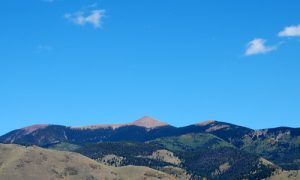
Baldy Mountain, New Mexico. Kathy Weiser-Alexander.
It all began in 1866, just one year after the Civil War ended, when Ute Indians arrived at Fort Union (northeast of Las Vegas, New Mexico) wanting to trade “pretty rocks” for supplies. Stationed at Fort Union, Captain William H. Moore was acquainted with one of the Indians. He had once found the Indian badly wounded and on the verge of death, given him water, and taken him back to the fort, where he was nursed back to health. Ever grateful to Captain Moore, the Indian gave him several of the “pretty rocks,” which Moore quickly recognized as being rich in copper. The ore had been found on the upper slope of Baldy Mountain (12,441 feet) on the Western edge of the Maxwell Land Grant. The Indian agreed to lead Captain Moore and several other soldiers to a spot high on the majestic mountain, where enough copper was found to stake the first of many claims in the area.
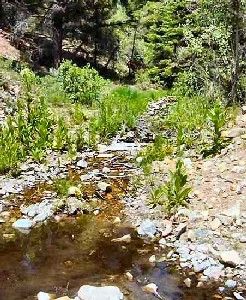
Willow Creek by Kathy Alexander.
While continuing to explore the area, three of the men made camp on the banks of Willow Creek. Passing the time, one of the men took a gold pan from his saddlebag and began sifting the creek gravel. When his loud, excited shout pierced the quiet evening, his companions came running to his side. All thought of copper vanished from their minds as the three stared at the sparkling gold flakes lying in the base of the pan. They wasted no time, immediately exploring the area, spending the next several days panning the creek and chipping at the rock. But it was already October, and Winter comes early to the high slopes of Baldy Mountain. Vowing to keep their findings secret, the three carved the words “DISCOVERY TREE” on a Ponderosa Fir next to their camp, descended the mountain, and began the long trek back to Fort Union.
But the secret was just too big, and during the long idle months of Winter, their pledge was broken. Word got out, and when the snow melted in the spring of 1867, they were just the first of many men flooding the area to find their fortunes.
Lucien B. Maxwell, a long-time resident of the area and sole owner of the Maxwell Land Grant, owned the Moreno Valley as well as Baldy Peak. The already wealthy land baron and entrepreneur watched the storm of gold seekers with great interest and realized that he couldn’t fight the inevitable. Taking full advantage of the situation, Maxwell welcomed the squatters by charging them for the use of his land, placer and quartz claim fees, and tolls for the use of the good road he had constructed.
Miners paid $1 a month for a 500 square-foot parcel, $12 a year in advance for a placer or gulch claim, and half the proceeds of a lode claim. Some of the miners paid, but many did not, a situation that would plague Maxwell and the investors who later bought the grant. By July of 1867, 17 companies had established 400 claims within an eight-mile radius of Old Baldy.
In addition to Maxwell’s real estate interests, he quickly became involved in mining activities, placing several placer claims himself. He joined Captain Moore and several entrepreneurs to form the Copper Mining Company in 1867, which soon found the first lode of gold.
Meanwhile, back in June 1867, Captain William Moore and his brother, John Moore, opened a general store Southwest of the peak to supply the many miners who were streaming into the territory. Many of the settlers quickly moved their tents to the area around the store, and it wasn’t long before cabins began to sprout up. Before the month was out, it was clear that the general store would become the center of a town, and Moore began construction on the first house in the rapidly growing settlement.
The very next year, Moore and other businessmen platted a townsite, incorporated the village (the first in New Mexico), and began selling lots at prices ranging from $800 to $ 1,200.
The town was named after the captain’s daughter, Elizabeth Catherine Moore, who had just turned four, but it was quickly nicknamed E-Town by most locals. Elizabeth Moore was the first school teacher and lived her entire life in Elizabethtown.
By the end of July 1868, about 400 people were living in Elizabethtown. A sawmill and several other stores followed Moore’s, as did the inevitable saloons and gambling houses. As in most Old West towns, dancing, dining, and drinking were popular, as was a burgeoning red-light district comprising several cabins. Other women of the “profession” worked their trade in second-floor rooms connected to the saloons, where dumbwaiters carried drinks to their guests.
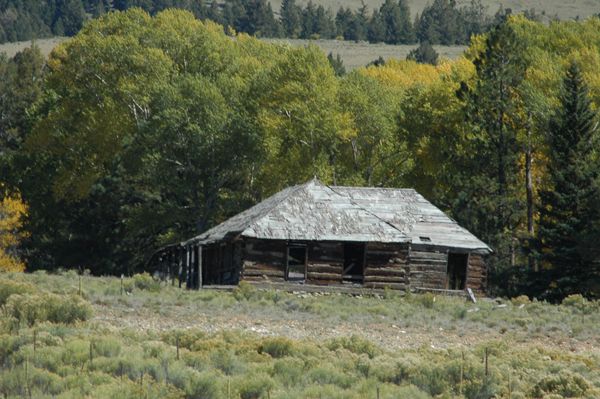
Elizabeth Moore Lowrey’s last home still stands across the valley from Elizabethtown, by Reletta Clumsky.
Lucien B. Maxwell envied the rapid success of Elizabethtown and, not wanting to be outdone, began planning another townsite just six miles away.
Partnering with several business associates, including Territorial Governor R.B. Mitchell, they laid out the new townsite and named it after Maxwell’s eldest daughter, Virginia. But Virginia City was too far from the “action” and never really got off the ground.
The mines attracted many new residents, including settlers from Texas who brought herds of cattle and made livestock raising another principal industry in the County. E-town kept growing, and the first crude structures were replaced by five well-built stores, a drug store, seven saloons, three dancehalls, two hotels, a brewery, and a flour depot. The saloons boasted dance floors, gaming tables, and bars that were 100-200 feet long.
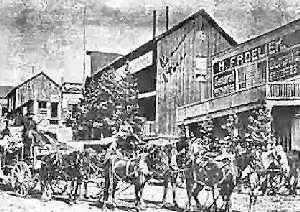
Elizabethtown, New Mexico Street Scene
The sawmill was kept busy providing lumber for commercial buildings and private homes. By 1869, E-town had about 100 buildings, and by late that year, enough families had joined the miners to require a schoolhouse and a Protestant church. A Catholic parish soon followed.
In 1869, Scranton and Aken started the first newspaper, the Elizabeth Lantern, which they later sold to William D. Dawson, who renamed it the Railway Press and Telegraph. Dawson had strong views, which he expressed freely, and it was noted in the Colorado Miner that he had whipped up townspeople into “a furious rage” with his newspaper.
During the harsh winters, mining in the area was shut down, and E-Town’s population would rise and fall with the weather. Even when the weather was good, the mining was erratic — when new gold was found, the town would grow as word spread, only to fall again as interest dwindled. Those hardy settlers who stayed often had to deal with drunks, outlaws, and Indian raids, as well as the harsh Winter weather.
Elizabethtown, New Mexico, once boasted over 7,000 residents and was often visited by notorious gunmen such as Black Jack Ketchum and Clay Allison.
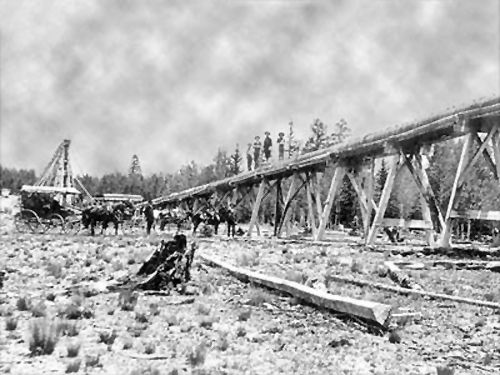
Big Ditch Flume that ran between Red River and Elizabethtown.
As the mining boom continued, the area’s creeks were found to be inadequate to supply the mining operations and the citizens of the bustling boomtown. Again, the entrepreneurs—Maxwell, Moore, and others — searched for a solution.
The “Big Ditch” was built to divert water from the Red River through ditches, pipes, and trestles — around mountaintops and through canyons for a distance of 41 miles (only 11 miles in a straight line) The cost was a monumental $280,000; however, only about 1/10th of the water that went into the ditches and flumes came out at the other end due to leaks, seepage, and evaporation. Although it did not initially bring in as much water as hoped and required constant maintenance, the Big Ditch was in use until 1900. Eventually, a lawsuit resulted, which banned the diversion of water.
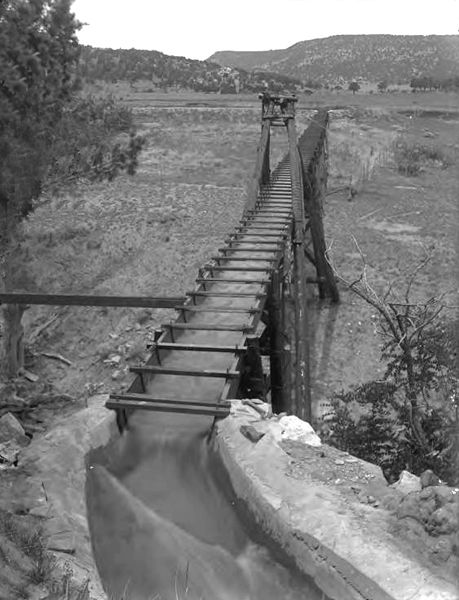
Big Ditch Flume
In 1870, Elizabethtown boasted 7,000 residents, seven saloons, three dance halls, five stores, a school, and two churches. One of several hotels, the Mutz Hotel, was built by Herman Mutz, a rancher and cattleman of the area. That same year, the territorial Legislature recognized the area’s rapid growth, created a new county, and named it after Vice President Schuyler Colfax. Elizabethtown was designated to be the Colfax County seat.
Like many frontier towns of the West, Elizabethtown had its share of gruesome stories. Amazingly, it appears that E-town housed a serial killer at the time. Charles Kennedy, a big, husky, full-bearded man, owned a traveler’s rest on the road between Elizabethtown and Taos. After travelers registered at the rest stop, some would disappear, never to be heard from again. These traveling strangers were rarely missed in the highly transient settlement.
Evidently, when travelers stopped for a bed and a meal, Charles killed them, stole their valuables, and either burned or buried their bodies. These events might never have been known, except for his wife’s confession, when she fled from him in terror in the fall of 1870.
The bleeding Ute Indian woman burst into John Pearson’s saloon, where Clay Allison, Davy Crockett (a nephew of the American frontiersman), and others were whiling away the hours. After being helped to a chair, she told the story of how her husband had killed a traveler and their young son. Hysterical, she told the shocking story of how her husband had been luring travelers, perhaps as many as 14, into their cabin and then murdering them. On the day she fled, she had witnessed another traveler whom her husband had enticed inside with supper. During the meal, the passerby asked his hosts if there were many Indians around. Her unfortunate son made the fatal mistake of responding, “Can’t you smell the one Papa put under the floor?” At this, Kennedy went into a fury, shot his guest and bashed his son’s head against the fireplace. He then threw both bodies into the cellar, locked his wife in the house, and drank himself into a stupor. Terrified, the woman waited until her husband passed out, then climbed up through the chimney and escaped to tell her story.
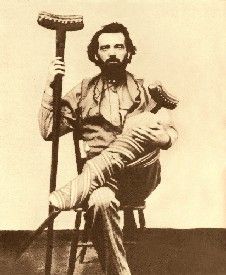
Clay Allison, gunfighter
Clay Allison, a local rancher who was known for his gun-fighting skills and was almost always around when anything violent happened, led a group in search of Kennedy. In contrast, others were sent to search the house for evidence to support the woman’s story. The search provided several partially charred human bones still burning in the fire, and two skeletons beneath the house. Later, another skull was found nearby, and a witness to one of the murders came forth. Kennedy, still drunk, was quickly found and taken into custody. He was given a pre-trial on October 3, 1870, where the witness appeared, testifying that he had seen Kennedy shoot one of the travelers.
The court ordered that Kennedy be held for action by the grand jury, but rumors began circulating that Kennedy’s lawyer was going to buy his freedom. Three days later, Allison and his companions snatched Kennedy from the jail, threw a rope around his neck, and dragged him by a horse up and down Main Street until long after he was dead. His body was not allowed by the townspeople to be buried in the Catholic cemetery and was interred outside the cemetery boundaries.
The legend of Charles Kennedy continues, which states, in most documents, that Clay Allison decapitated Kennedy, placed his head in a sack, and carried it 29 miles to Cimarron. When he arrived at Cimarron, he demanded that the head be staked on a fence at the front of the Lambert Inn (later the St. James Hotel, where it stayed until it mummified and finally disappeared one night.
However, during research for this article, it was discovered that Lambert’s Inn wasn’t built until 1872, and that Fred Lambert was operating a saloon in Elizabethtown at the time of Kennedy’s death and continued to do so until 1871. In a discussion with Beni-Jo Fulton, the curator of the E-Town Museum, she speculated that perhaps the story was true, but that the head was more likely staked in front of a saloon in E-Town rather than Cimarron.
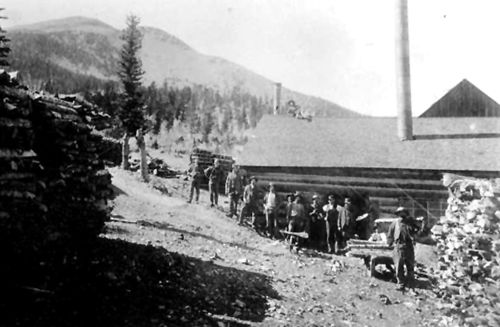
Red Bandanna Mine, late 1800’s.
E-Town was also home to another bad boy — “Coal Oil Jimmy” Buckley. Buckley stirred up some excitement in 1871 by leading a group of outlaws in a series of stagecoach Hold-up on the road to Cimarron. But Jimmy’s career was cut short when the town posted a $3,000 “dead or alive” reward.
Two of Jimmy’s “friends” pretended to join him and his band of outlaws, then, waiting for the right moment, shot Jimmy and his chief partner down, returning to E-Town with the dead bodies to collect the reward.
For about five years, E-Town reigned as one of New Mexico’s most important towns, but mining operations began to diminish dramatically. The fever cooled as mining costs started to outweigh the volume of ore produced.
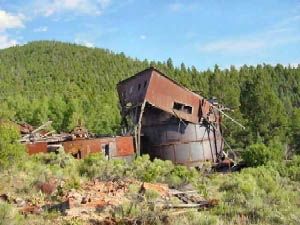
The remains of the Red Bandanna mine remain intact and unbothered, as the mine is on private property. Because a local ranch landlocks it, the public cannot access it. Photo by Kathy Alexander.
A few minor operations continued, but most of the residents moved on in search of better opportunities. The settlement was reduced to about 100 residents and lost its “county seat” status to Cimarron in 1872. Cimarron remained the Colfax County seat for ten years before passing it along to Raton.
By 1875, Elizabethtown was a virtual ghost town. Still, it was given a second chance in November 1878 when the Atchison, Topeka, and Santa Fe Railroad advanced its track from Trinidad, Colorado, into New Mexico. Now, ore could be shipped much more cheaply, and investment in the Elizabethtown-area mines once again increased, along with the population. E-Town was reborn!
The money collected from liquor licenses was earmarked for schools. The school’s baseball team arranged games against Catskill, Midnight, and Trinidad, making their community proud by winning many of them. Footraces and boxing matches were also common events in the community. Elizabethtown had finally found its share of respectability by becoming not just a mining town but a town with families and gentile social events.
Saturday-night dances, complete with a fiddle band, were so popular that people would travel several miles over mountain roads to attend. When snow covered the roads, sleds replaced wagons, and folks danced their cares away. The dances were said to have been “nice” affairs, where participants dressed in their most elegant clothes and everyone was on their best behavior.
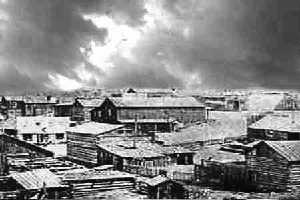
Elizabethtown in the 1890s.
Several well-mannered young men, riding good horses, flashing plenty of money, and claiming to be cowboys, arrived at one dance; the floor manager introduced them so all might enjoy the evening. The single women of E-Town were enraptured by their manners. These young men became part of the social life in several of the surrounding towns. Not until later, when they were captured, did townspeople learn these young men were actually members of “Black Jack” Ketchum’s outlaw gang. The notorious outlaw gang had terrorized the 4-corner states in the late 1890s, robbing trains, stores, and killing men during their crimes or shoot-outs when they were threatened. Black Jack Ketchum was hanged in Clayton, New Mexico, on April 26, 1901, and is buried in the Clayton Cemetery.
In 1901, the Oro Dredging Company began treating a monstrous dredge, fondly christened the Eleanor. The enormous piece of equipment, born of the machine era, posed numerous challenges in its transportation through the mountain passes to E-Town. Piece by piece, the dredge was hauled from the railhead at Springer via mountain roads and water. The dredging company built a dam three miles from E-Town and hauled the biggest pieces on a large boat. By August 1901, the dredge began production, handling up to 4,000 cubic yards of dirt daily. In its first year of operation, the Eleanor paid for herself and cleared $100,000, mining a remarkable one-quarter of all the gold found in New Mexico that year.

Eleanor Dredge in Elizabethtown, New Mexico
In September 1901, Dr. L. L. Cahill purchased the La Belle drugstore and moved it to E-Town. LaBelle was another mining camp in the area that ceased to exist in 1901. Mining continued, but tragedy struck E-Town in 1903 when a fire broke out in the second story of one of the largest retail establishments, the Remsberg Store. In the dry mountain conditions, the flames quickly engulfed the mostly wooden buildings, flames spreading throughout the town.
The Raton Range Newspaper reported on September 3, 1903:
“A Colfax county gold mining town was almost wiped out by fire Tuesday. Only one business institution is left standing. Remsberg & Co. are the heavy losers. The fire originated from an unknown source, possibly from a defective flue. The fire started on Tuesday afternoon at about 2:15 p.m. in the entertainment hall n the second floor of the Remsberg store building, and thirty minutes after the fire was discovered, the building and all it contained, except about $700 or $800 worth of dry goods, were destroyed. H. B. Phelps, the manager of the store, and William Walker, a clerk, with great difficulty and considerable risk to their lives, got the company’s books and money from the safe and, with the assistance of willing hands, were able to salvage dry goods to the amount of several hundreds of dollars. The building was a two‑story structure on the corner of the town’s main business street. The flames spread to the Mutz Hotel, a two‑story building adjoining. From there, the fire spread to Harry Brainard’s place, then to Remsberg’s, Gottlieb & Iufelder’s general store. Across the street in the next block, the Moreno Hotel caught fire from flying embers, and in one hour and fifteen minutes from the time of the discovery of the fire, all the buildings mentioned were reduced to ashes. The only mercantile establishment left in town is the store of Herman Froelick.”
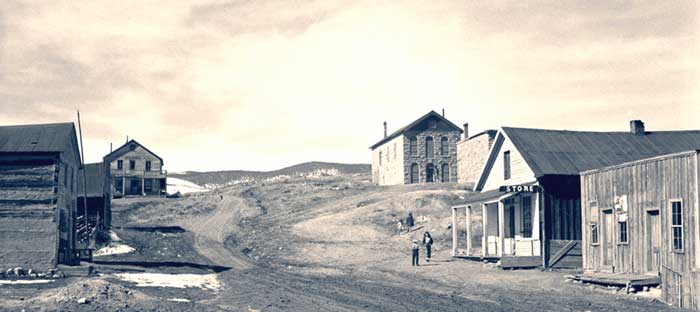
Elizabethtown, John Collier, 1943.
At about the same time, the owner of the dredge mortgaged Eleanor to finance a similar venture in Colorado. Unfortunately, the next year was unprofitable for Eleanor, and the owner ended up filing for bankruptcy. The dredging operation finally died in 1905, and Eleanor was left to rust and sink into the sands of Moreno Creek. The buried remains of Eleanor remain there, but no trace of her can be seen now.
By 1917, E-town’s lifeblood was nearly drained. The mines no longer produced profits, and the townspeople had moved away, abandoning their homes because no one wanted to buy them. Investors went bankrupt, and even the staunchest old-timers left. Now and then, a few people would drift back in hopes of recovering something, but the new veins struck didn’t assay enough to mine and ship the ore.
Alice Bullock took a teaching post in Elizabethtown in the 1920s, teaching in a one-room classroom oatthe old school, where she was also responsible for cleaning, chopping wood, and all other duties There were no books for the eight pupils, all members of two families, but her position only lasted a little over a month when the Red Bandana Mine was re-opened and hired the fathers of her pupils. The families moved, and her job ended. She was the last teacher in E-Town.
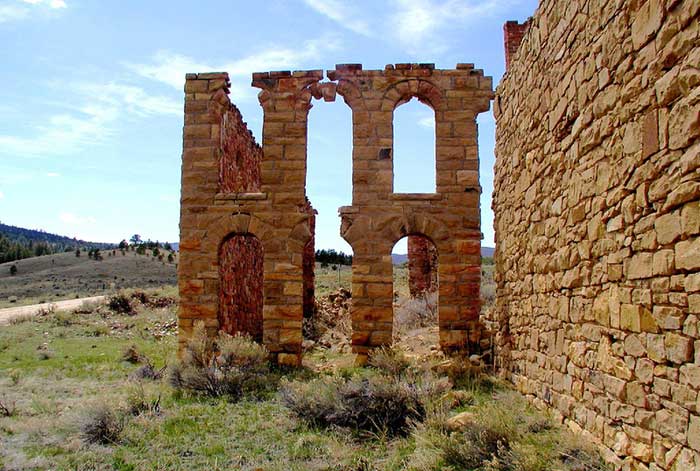
The ruins of the Mutz Hotel, Dave Alexander, May 2004.
The Moreno Valley produced five million dollars in gold in 75 years – most of it in the first 40 years. In 1956, the old schoolhouse was sold for salvage. Curious people continued to frequent the site, and unfortunately, a camper set a fire in the old Mutz Hotel, which further destroyed its remains, though its stone skeleton still stands. Vandals destroyed the Catholic Church and many of the other remaining remnants.
Today, there is very little left of this once prosperous town. The stone ruins of the Old Mutz Hotel, which long dominated the slope above NM Highway 38 North of Eagle Nest, have now been reduced to just a few low walls and a scattering of stones. However, Froelick’s Store still stands, the church has been rebuilt, and there are a few other scattered buildings on the property.
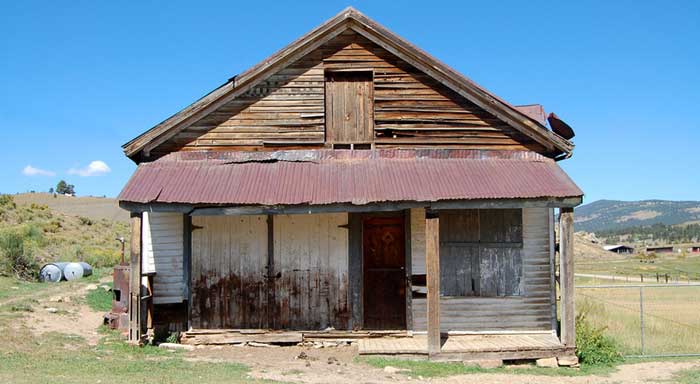
Froelick Store in Elizabethtown, New Mexico. Photo by Kathy Alexander
Just within the past 10 years, we were told about restoration efforts and a museum in Elizabethtown. However, on our visit in August of 2021, we found that the museum was no more and the old Froelick Store and property were for sale.
The Elizabethtown Cemetery is just about a mile up the road from the ruins and overlooks the beautiful valley.
Elizabethtown is 4.8 miles North of Eagle Nest on NM 38; turn left (West) on B-20, a dirt road, then 0.3 miles to buildings from the turnoff.
©Kathy Alexander/Legends of America, updated August 2026.
Special Note: Elizabethtown, New Mexico, part of the rich history of Moreno Valley, is one of the earliest stories from our beginnings in June of 2003.
See our E – Town Photo Gallery HERE
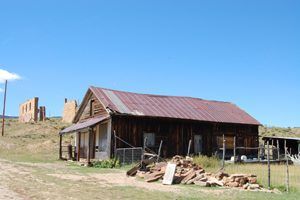
Froelick Store in Elizabethtown, New Mexico by Kathy Alexander.
Also See:
Black Jack Ketchum – Train Robber
Charles Kennedy – Old West Serial Killer
Clay Allison – New Mexico Bad Boy
Cimarron – Wild & Baudy Boomtown
See Sources.