
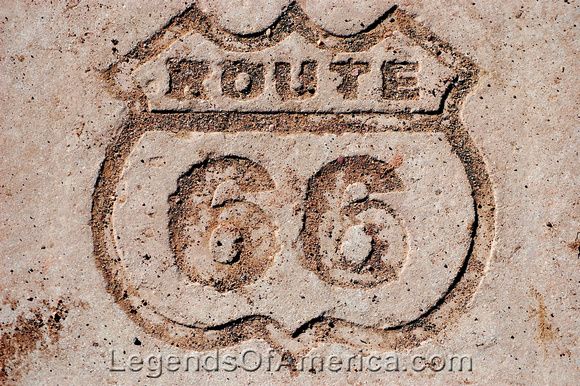
A Route 66 shield is carved in rock to commemorate where the Mother Road once ran through the Petrified Forest National Park in Arizona. Photo by Dave Alexander.
“Life doesn’t happen along the interstates. It’s against the law.”
— William Least Heat Moon, Blue Highways
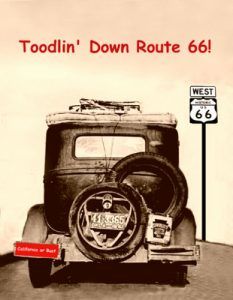
Toodlin’ Down 66 Postcard by Kathy Alexander. Available at Legends’ General Store.
The often romanticized Mother Road inspires in many of us a nostalgic bone that niggles at something buried deep within us. While some may see Route 66 as a link to our parents and grandparents, others may feel the freedom the road provided to those early travelers. And then, for those who live continuously in the nostalgic past, the Mother Road is the next adventure beyond the Santa Fe Trail. Whatever the reason, the Mother Road is an experience, a feeling, a perception, a taste of sight and sound, and a mystery that can only be resolved by driving the pavement itself.
The “super-highway,” as it was thought of in 1926, represented unprecedented freedom to travel across the American West. Spawned by the rapidly changing demands of America, entrepreneurs Cyrus Avery of Tulsa, Oklahoma, and John Woodruff of Springfield, Missouri, conceived of the grand idea of linking Chicago to Los Angeles and began lobbying efforts to promote the new highway. While other East/West highways existed at the time, most followed a linear course, leaving out the rural communities dependent upon transportation for farm products and other goods.
No doubt a daunting task for the pair, the federal government finally pledged to link small towns in the U.S.A. with metropolitan capitals in the summer of 1926, and the American Association of State Highways designated the road as U.S. Highway 66 on November 11. Unfortunately, a few years later, the depression came, halting progress on the new “Super-Highway.”

John Steinbeck
However, in 1933, thousands of unemployed men were put back to work, and road gangs paved the final stretches of the road. By 1938, the 2,300-mile highway was continuously paved from Chicago to Los Angeles.
In 1939, John Steinbeck proclaimed Route 66 as the “Mother Road” in his classic novel The Grapes of Wrath. A year later, the movie immortalized Route 66 in the American consciousness. Shortly after that, more than 200,000 people migrated to California to escape the Dust Bowl of the Midwest, symbolizing the highway as the “road to opportunity.”
When World War II broke out, Route 66 was invaluable in transporting troops, equipment, and products across the vast West to California, where the government established multiple industries and armed force bases. When the war ended in 1945, the Mother Road transported thousands of troops home.
Perhaps more than any other American highway, the Mother Road symbolized a new positive outlook that spread through the nation’s postwar economic recovery. Route 66 was more than just a highway for thousands of returning servicemen and their families. “It became,” one admirer said, “an icon of free-spirited independence linking the United States across the Rocky Mountain divide to the Pacific Ocean.”
The tourist industry grew almost immediately, giving rise to countless tourist courts, motels, service stations, garages, and diners. However, the excessive truck travel during World War II and the ever-expanding automobile industry had left the Highway in appalling conditions, with narrow pavements and poor road conditions.
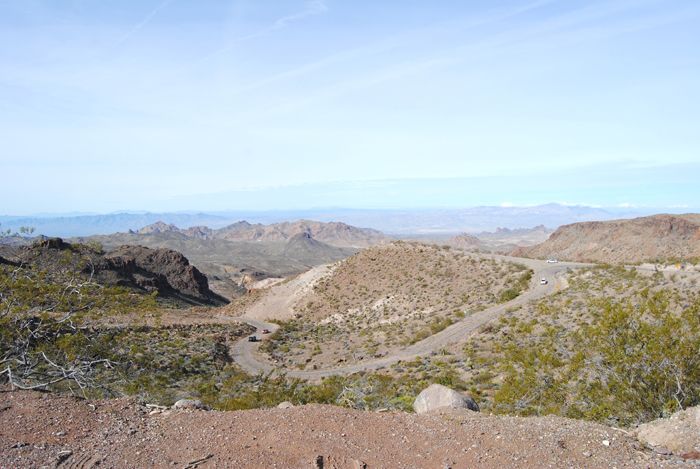
View from the summit of Sitgreaves Pass, Arizona, by Kathy Alexander.
In the mid-1950s, the public lobby and President Dwight D. Eisenhower demanded a federal sponsorship for a system of divided highways. On June 26, 1956, the Federal-Aid Highway Act was passed by Congress for a national interstate highway program. The act, also known as the National Interstate and Defense Highways Act, allocated over $30 Billion to construct over 40,000 miles of interstate highways, the largest public construction project in U.S. history at the time. On June 29, Eisenhower signed it into law. While it is remembered by many as Eisenhower’s most significant domestic achievement, the flip side was the demise of small towns along highways that connected more isolated parts of the country. With the Highway Act, Route 66 was doomed.
Doomed or not, by the 1960s, many points of interest were familiar landmarks to a new generation of travelers. The television series “Route 66” was aired, “driving” the Mother Road into homes all over America. Though the series created great interest in the American public, it was to be short-lived, as, by 1970, nearly all segments of original Route 66 were bypassed by modern four-lane highways. On October 13, 1984, all of the poorly maintained vestiges of Route 66 ultimately succumbed when the final section of the original road was bypassed by Interstate 40 at Williams, Arizona.
The nine-foot wide road between Miami and Afton, Oklahoma, by Kathy Alexander.
As Route 66 was decommissioned on June 27, 1985, its signs were removed, and the Mother Road was almost lost. Even today, the Mother Road appears on very few current maps. Most states have installed Historic Route 66 signs along portions of the road, but, unfortunately, they rarely give exit directions where the road often veers off from the interstate highways.
The route today is not what it was in the past. The sights and sounds of the Mother Road change daily with the emergence of new businesses and development along the old highway. You will want to take many pictures because what is here today might be gone tomorrow.
However, much is preserved, and the Route 66 Historical Associations and private groups have done much to preserve these vintage treasures. As you travel along, you will often see a sign or marquee of the vintage road, as these icons of history are preserved, though their buildings are long gone. In June 2018, the National Trust for Historic Preservation included Route 66 on its 11 most at-risk sites, which highlight architectural and cultural spots it deems in danger from development or neglect.
Traveling the road, you will experience everything from the frustration of finding the route in a metro city to being pleasantly surprised by the next small town you venture into. The landscape quickly changes from the hustle and bustle of the metropolitan area to quiet meandering roads to tallgrass prairies, where you feel you might be the only person left on earth.
While planning your trip, it’s a good idea because the road can be confusing; the whole idea is to experience Mother Road. We advise getting a couple of good Route 66 books and some good maps before you begin your adventure. Here and there, some places will give you a road sign when the road veers off the interstate, but mostly not. Even with a few good maps, you will undoubtedly take a wrong turn occasionally. Take the Business Loops off the interstates when possible – they will often lead you to your photo opportunities of our scenic past.
Such is the experience!! Enjoy the ride!
© Kathy Alexander/Legends of America, updated July 2024.
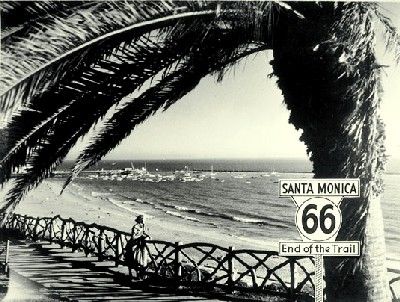
Route 66 ends in Santa Monica, California (1935 Vintage Postcard)
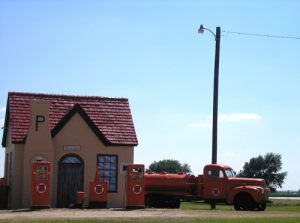
Restored 1927 Phillips 66 in McLean, Texas, by Kathy Alexander.
See Sources.
Go East to West from Illinois
Back to Route 66 Main Page
Go West to East from California