
By Jim Hinckley.

William Galloway and his manure spreader around 1905.
Do you know what links Fred and Augie Duesenberg, Maytag appliances, and an obscure manufacturer of tractors and farm machinery? The answer is William Galloway.
Born on a farm near Berlin, Iowa, in 1877, Galloway did nothing in public school to distinguish himself from other students, and likewise during his years at Monmouth College in Illinois.

Rural Road in Franklin County, Iowa by Carol Highsmith.
After college, he traveled Iowa’s rural roads, selling specialty goods to farm families. His next step was to work as a traveling salesman for a farm implement dealer in Reinbeck, Iowa.
In 1901, after literally learning the business from the ground up, he established his farm implement dealership in Waterloo, Iowa. Galloway, however, was ambitious and had a vision for the future.
The cornerstone of the William Galloway Company, established in Waterloo, Iowa, in 1905, was manufacturing various agricultural products, including manure spreaders and harrow carts. The company sold everything it produced by mail order. Soon, Galloway began selling products produced by other manufacturers, and in less than a decade, the company became the largest mail-order farm equipment supplier in the country.
In 1908, Galloway expanded his product line to include manufacturing a vehicle promoted as a conveyance that could carry the family to church on Sunday and haul loads during the week. Load-carrying capacity is questionable, as the primitive high-wheeler was powered by a two-cylinder, 14-horsepower engine.

William Galloway Plant, Waterloo, Iowa.
His venture expanded into automobile manufacturing in 1910, when he acquired a substantial interest in the Maytag-Mason Motor Car Company after securing a guarantee that the company would relocate from Des Moines to Waterloo, Iowa. Senator Fred L. Maytag had initially established Maytag to produce agricultural machinery and washing machines. Still, after acquiring a controlling interest in Mason Motor Car Company in 1909, he expanded operations to include automobile manufacturing.
The cornerstone of the Mason-built automobiles was a two-cylinder engine designed by Fred and August Duesenberg. Incorporated in Des Moines, Iowa, in 1906, the Mason Motor Car Company was named for Edward R. Mason, the primary financier behind the endeavor.
Promoted as “The Fastest & Strongest Two-Cylinder Car in America,” the Mason garnered critical acclaim as a hill climber in numerous events and, after 1907, as a racecar. However, this did not translate into sales, and the company reorganized in 1908.
Maytag’s acquisition of controlling interest in the company and a subsequent merger did little to bolster sagging sales. Neither did manufacturing an automobile sold under the Galloway name in 1911.
Although the William Galloway Company continued to manufacture agricultural equipment profitably, the company’s namesake still hoped to become a successful motor-vehicle manufacturer. In 1910, Galloway and C.W. Hellen bought Dart, a truck manufacturer in Anderson, Indiana, and moved the company to Waterloo. In 1914, the company reorganized as Dart Truck & Tractor Company, a manufacturer of chain-driven tractors, and after 1916, worm- and internal-gear-driven models.
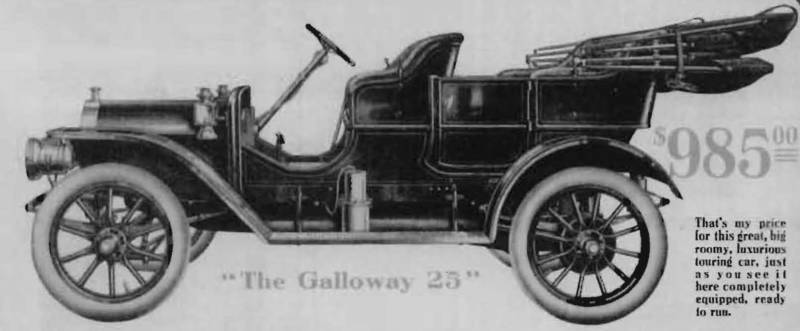
The Galloway 25 1911. Photo courtesy of the Mason Motor Car Company, Des Moines, Iowa history website. The website indicates it was a Maytag with a Galloway emblem, but no known example exists today.
The following year, he made one more attempt to produce a passenger vehicle under the Galloway name. Instead, it debuted as the Arabian, a vehicle that, except for the nameplate, was simply an Argo manufactured in Jackson, Michigan, by Benjamin Briscoe.
When Briscoe divested himself of the company and sold it to Mansell Hackett in late fall 1916, manufacturing continued under license at the Galloway facilities in Waterloo, Iowa. The Chilton Trade Directory lists the car as in production in 1919, but in reality, production ended at the end of 1917.
All of this took place while the company continued expanding its agricultural line and mail-order business. The 1913 catalog featured 146 pages of pumps, cream separators, plows, harrows, Galloway wagons, anvils, forges, iceboxes, mattresses, roofing, work clothes, windmills, and almost anything the farmer could imagine.
Even the “Little Wonder Vodaphone” to “Open Your Doors to Whole World of Entertainment” was available for ordering. The Galloway catalogs sold tennis rackets, roller skates, and even bicycles.

1917 Galloway Catalog, image courtesy of Farm Collector Magazine.
In late 1915, Galloway turned his attention toward the manufacture of what he envisioned as the blending of the passion for building a motor vehicle and his farm implement and supply company – a tractor. The Galloway Farmobile 12-20 debuted in 1916, and the company’s 1917 catalog notes that the tractor, which sold for $995, featured “a 4-1/2-by-5-inch engine and a 2-speed transmission.” Promotion claimed that the Galloway-manufactured tractor “Pulls Anything, Anywhere, Anytime.”
The October 17, 1918, edition of Automotive Industries noted that the new worm-drive tractors resulted from three years of experimentation. The article also states that “…in January of this year the company received an order for 1,080 tractors of this type from the well–known British firm of Henry Garner, Ltd.”
An appraisal of the company’s fourteen-acre complex of shops and offices valued it at $1,462,000. Profits soared, and Galloway built a red brick home that mirrored his success.
Plans for expansion in the decade to come mirrored the company’s soaring sales and diversification. That, however, required financing. Volume 99, Bankers Magazine, 1919, “One of the largest bond issues ever handled by Iowa banks has been underwritten and sold by the Waterloo Clearing House Association without the assistance of either Wall Street or LaSalle Street interests. This was the $1,750,000 issue of the William Galloway Company of Waterloo, Iowa, hearing date of July 1, 1919, and due July 1, 1925.”
The article continued with, “Both are a direct obligation of the William Galloway Company and are a lien against its plant, properties, and business.”

Buddie Knutson stands on his vintage Galloway Tractor. Photo by Jim Hinckley.
Then, in the blink of an eye, the empire crashed. Overextension, the severe post-war recession, and a plunge in agricultural commodity values brought the William Galloway Company to the brink of bankruptcy in 1920.
His sons revived the company in late 1926, but on a much smaller scale. As a mail-order company for farm supplies, it lasted into the early 1940s, and William Galloway passed away in 1952.
Today, Galloway, his catalog business that provided serious competition to companies such as Sears & Roebuck, his automotive manufacturing ventures, and the namesake tractors are less than a historic footnote. A couple of trucks, an array of Galloway-stamped products ranging from engines to watch fobs, and thirteen tractors, twelve in the United States and one in France, are all that remain from Galloway’s once-formidable empire.
©Jim Hinckley, Legends of America, updated October 2026.

Jim Hinckley.
About the Author: Jim Hinckley is an award-winning author and photographer and an official contributor to Legends of America through a partnership developed in October 2012. Hinckley is a former Associate Editor of Cars and Parts Magazine and author of multiple books, including several on Route 66. See Jim Hinckley’s America.
Also See:
Jim Hinckley on Legends Of America