
by Jim Hinckley.
During the formative years of the American automobile industry, many progressive-thinking American cities vied for the title of motor city, hoping to strike industrial gold. Jackson, Michigan, was counted among the leading contenders.
One of Jackson’s earliest automotive proponents was Byron J. Carter, whose diverse manufacturing endeavors included bicycle and steam-driven press components as well as rubber stamps. In 1899, his growing fascination with the automobile took the form of a gasoline-powered prototype.
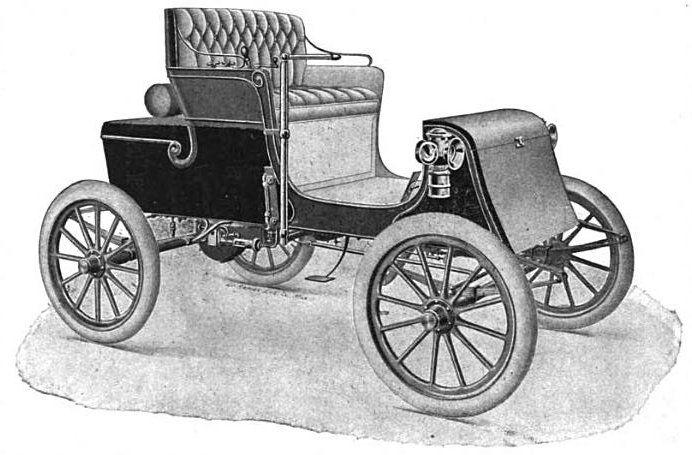
1903 Jackson Steam Car.
However, because he was familiar with steam engines and related equipment, a steam-powered Stanhope manufactured by the Michigan Automobile Company of Grand Rapids, Michigan, in 1901 became his first marketable vehicle. The following year, Carter patented a three-cylinder, six-horsepower steam engine, secured financial backing from Charles Lewis, president of Lewis Spring & Axle and a director of Union Bank of Jackson, George A. Mathews, owner of the Fuller Buggy Company and a director of the Jackson City Bank, and incorporated the Jackson Automobile Company.
At the behest of his partners, who were hedging their investment gamble, the company manufactured steam-powered automobiles under the Jaxon name and six-horsepower gasoline-powered automobiles under the name Jackson. Promoted with an advertisement proclaiming, “Steam is Reliable and Easily Understood,” the Jaxon was a 1903-only model, as the directors’ refusal to fund the development of Carter’s friction-drive transmission led to his departure from the company.

1905 Jackson Model C.
Without the innovative Byron Carter, the Jackson would have become just another product from another automobile manufacturing company, but one with a well-deserved reputation for durability. The company’s slogan, “No Hill Too Steep, No Sand Too Deep,” was not an idle boast but built upon customer experience.
Before merging with Dixie Flyer and National, the company soldiered on for another twenty years with only a few deviations from the conventional. In 1919, the company devoted a year solely to manufacturing trucks. Perhaps the company’s most unusual expression of independent thinking was the Duck in 1913, a vehicle driven from the back seat.
After leaving Jackson, Byron Carter quietly assembled resources and financial backing for another automobile manufacturing company, one that would use his revolutionary, patented friction-drive transmission. The resulting Motorcar Company was associated with Jackson only briefly; in 1906, Carter reorganized it as the Cartercar Company and moved operations to Detroit.
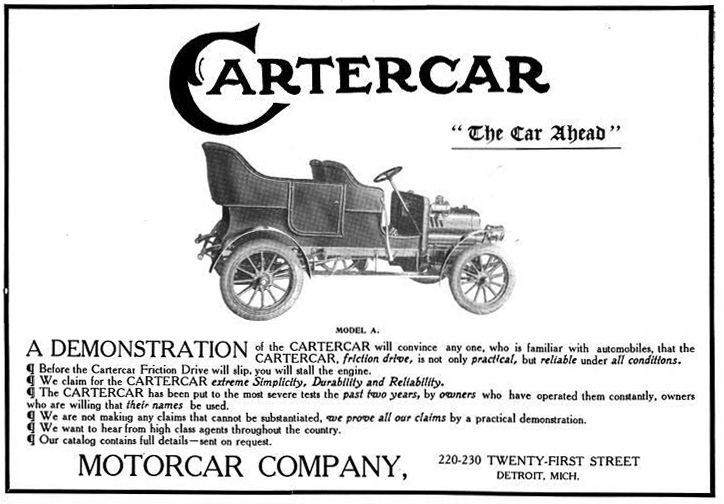
Ad for Motorcar Company of Detroit, Michigan – Cartercar – 1906.
Another automotive pioneer associated with Jackson was David Buick, who initiated a timid, fledgling attempt at automobile manufacturing in this city. The endeavor was short-lived but boosted several specialty machine shops that later provided key components to companies including Ford, Olds, and Maxwell.
By 1914, when Benjamin Briscoe established Briscoe Motor Corporation in Jackson, Briscoe and the city were automotive manufacturing veterans. Benjamin Briscoe’s first automotive venture was financing the formation of Buick Manufacturing Company in 1902. His second automotive venture came in 1903 with a partnership with Jonathan D. Maxwell.
This partnership culminated in the creation of Maxwell-Briscoe Motor Company in 1905. Briscoe used this success to create the United States Motor Company, a General Motors-style conglomerate that collapsed in 1912.
His next venture proved even less successful. Hoping to capitalize on the cyclecar craze, Benjamin and his brother Frank established Briscoe Freres in France and imported the cars into the United States as the Argo.

1915 Briscoe B-15 Cloverleaf Roadster. Photo from RemarkableCars.com
Undaunted by his string of failures, Briscoe launched the Briscoe Motor Corporation in Jackson, with the Swift family of Chicago as its financial cornerstone. The company’s initial offering debuted at the New York Automobile Show in 1914 to mixed reviews, largely because of its unconventional styling.
The car used compressed paper-mâché composite panels over a wood frame for the body. Like Pierce-Arrow, the car featured a flared headlight. However, unlike the offerings from the luxury car manufacturer from Buffalo, the Briscoe featured but one headlight mounted at the top center of the radiator housing!
Until the company’s demise in 1921, highly unorthodox thinking dominated the boardroom. In 1916, the company promoted vehicles with an advertisement that proclaimed, “Buy the Four. Use it for a month. If you want the Eight, pay the difference and a small charge for installation work.”
A smaller model with a French-designed, air-cooled, four-cylinder engine appeared later that year. Offering easy assembly plans for a four-cylinder automobile, using components supplied by Briscoe, to any community that wanted to become an automotive manufacturing site, followed in mid-1917.
The last gasp came with a daring plan to cut costs through product simplification. Working with his chief engineer, Jules Haltenberger, Briscoe designed interchangeable spring shackles, a reversible propeller shaft, identical clutch and brake pedal castings, and one-size bolts for most chassis components. The result was the desired cost-cutting through simplified production and an automobile fraught with a never-ending array of component failures.
The automotive manifestation of independent thinking in Jackson did not end with the closure of Jackson, Briscoe, or the dozen other manufacturers that operated in the city before 1920, nor did the quest for industrial gold. The final chapter was written in late 1953, and the initial production of the stunning Kaiser Darrin took place at Kaiser’s Jackson facilities.
©Jim Hinckley, December 2012, updated October 2026.
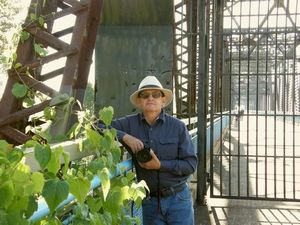
Author Jim Hinckley.
About the Author: Jim Hinckley is an award-winning author and photographer who is an official contributor to Legends Of America through a partnership developed in October 2012. He is a former Associate Editor of Cars and Parts Magazine and has written multiple books, including several on Route 66. You can follow him on Jim Hinckley’s America.
Also See:
Legends of the American Automobile
Jim Hinckley – Author & Legends of America Contributor
Transportation Photo Galleries