

By Jim Hinckley.
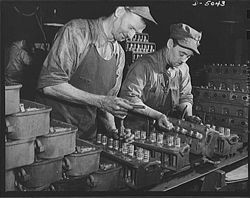
Assembling Jeep engines at Continental Motors, Michigan. Photo by Alfred T. Palmer, 1942.
Who would you include if asked to compose a list of the ten men most responsible for the development of the American automobile industry? Would Henry Ford, David Buick, Walter Chrysler, Ransom Olds, Benjamin Briscoe, and Charles Nash make that list? Would it include A.W. Tobin and Ross Judson, two men who laid many of the industry’s foundational stones?
In the first decades of the 21st Century, Tobin and Judson may have been more than an obscure footnote in automotive history, but the business they created gave a staggering number of famous and forgotten manufacturers a rock-solid foundation to build on. It also served as an integral component in developing the fledgling American aeronautical industry.
The Tobin and Judson automotive empire began in 1901, when Ross Judson, a gifted mechanical engineering student, examined a Mercedes L-head four-cylinder engine and noticed several inherent flaws. After this discovery, he was convinced he could resolve these issues and vastly improve the engine.
In 1902, almost immediately after graduating from the Armor Institute of Technology, Judson drafted a sales pitch and presented it to his brother-in-law, A.W. Tobin. His enthusiasm for the project, presented against the background of a developing gold rush atmosphere in the auto industry, carried the day, and Judson soon had a partner in Tobin, a $2,000 investment of capital from his partner, a hayloft converted to a machine shop in Chicago, and a company named Autocar.
Judson promoted his first engine with an eye-catching display that debuted at the 1903 Chicago Automobile Show. To display their product at such a prestigious event, Judson and Tobin must have had high expectations. However, the inundation of orders left them overwhelmed and ill-prepared.
To fill these initial orders, the company launched full-scale production simultaneously with expanding its fledgling facilities. By 1904, the exponential increase in orders left Judson and Tobin in the enviable position of needing a suitable location for dramatic expansion.
Numerous communities and municipalities offered prospective automotive manufacturers a wide array of incentives in exchange for establishing manufacturing facilities. The automotive industry was fast becoming a cash-creation dynamo, and every town wanted its share of the pie.
Judson and Tobin evaluated several communities before letting Muskegon, Michigan, woo them with its incentive packaging, which led to the relocation of Autocar operations and the construction of a state-of-the-art, 16,000-square-foot factory in that city in 1905. The following year, the company experienced equally dramatic changes; Studebaker increased its order from 100 engines to 1,000, the discovery that a company in Ardmore, Pennsylvania, had used the name Autocar since 1899 led to reorganization under the Continental name, production of a wide array of stationary engines commenced, and the number of employees increased from 25 to almost 600.
One year later, the company expanded operations to include an aircraft engine production and development division. This division, like the rest of the company, would evolve with the rapidly changing technological innovations spurred by the automobile industry. In 1929, it became a subsidiary of Continental Aircraft Engine, with the A-70, a 170-horsepower radial engine, as the foundation.
In late 1910, a new automotive manufacturing concern, Hudson, ordered 10,000 engines, providing the funding for Continental to launch an ambitious expansion program that included expanding the Muskegon facility, building a factory in Detroit, and outfitting both factories with state-of-the-art equipment.
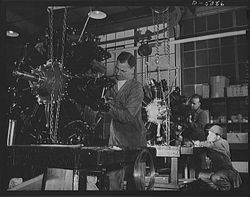
Airplane engines assembled for testing at Continental Motors, Michigan. Alfred T. Palmer 1942.
Two years later, Walter Frederick, a former truck manufacturing company Autocar engineer, assumed Judson’s position as chief engineer. Utilizing his extensive experience and knowledge, the company expanded the engineering department. It launched an innovative program to manufacture standardized engines for catalog sales to automobile manufacturers, companies needing stationary industrial engines, aircraft firms, or tractor manufacturers.
The company also offered various engine options. If a client requested engine specifications not listed in the catalog, staff engineers modified existing models accordingly.
The next two decades were a golden era for Continental. Apperson and Case, Crawford and Jordan, Ace and Vellie, Durant (including Star and Erskine), and dozens of other companies used Continental’s engines. Numerous companies that manufactured trucks exclusively, including Corbitt, Federal, Schacht, Selden, Sterling, and Reo (derived from the initials of the founder, Ransom E. Olds), also used Continental’s engines.
The 1920s were another pivotal period of transition for the company. W.R. Angell, a member of the company’s board of directors, finalized an agreement with William Durant, the founder of General Motors, who was building a similar company, to supply engines for his new line of automobiles – Durant, Star, and Flint. During the same period, tentative merger negotiations initiated between Continental and three manufacturers that utilized that company’s products, Peerless, Moon, and Jordan, which had the potential for making a tremendous impact on the American automobile industry, collapsed in the initial stage of development.

The dawn of a new decade at Continental began with Ross Judson’s retirement and W.R. Angell’s rise to the company’s presidency. His expansion of the company’s diesel truck, aircraft, and agricultural engine divisions kept it afloat during the tumultuous days of the Great Depression. However, his decision to launch a Continental-manufactured automobile and purchase a truck manufacturing enterprise, Divco, brought the company to the brink of financial ruin.
Together, the short-lived Continental Beacon, Flyer, and Ace were little more than new emblems on the equally short-lived De Vaux, and the 1932 acquisition of Divco triggered the company’s first financial crisis.
Continental’s diverse legacy did not end with the Great Depression or the post-war era of unprecedented optimism. Continental engines powered the grandfather of the Jeep, the Bantam Reconnaissance and Command Car prototype, and the iconic Checker taxi through early 1964. Then there are the contributions of the reincarnated Continental, Ryan Aeronautical, and Teledyne Continental Motors, a fitting legacy of two forgotten pioneers, Tobin and Judson.
©Jim Hinckley, February 2013, updated March 2025.
Author Jim Hinckley
About the Author: Jim Hinckley is an award-winning author and photographer who is an official contributor to Legends Of America through a partnership developed in October 2012. He is a former Associate Editor of Cars and Parts Magazine and has written multiple books, including several on Route 66. You can follow him on Jim Hinckley’s America.
Also See:
Jim Hinckley – Author & Legends of America Contributor