
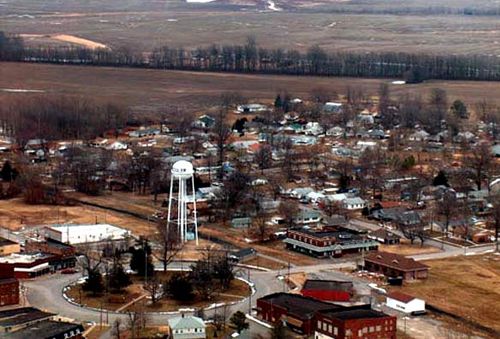
Zeigler, Illinois.
By Raymond D. Null.
Nestled away in the rolling hills of the Franklin County area of southern Illinois lies the forgotten town that, in 1904, was only a breath away from being the nation’s capital. It was here that, in 1901, a Chicago multi-millionaire named Levi Zeigler Leiter and his son Joseph brought the family fortune and began building a small empire. After buying 8,000 acres of land, Joseph began sinking a coal mine that would become the original headquarters of the nationally known Zeigler Coal Company.
Leiter was so sure that his mine would be the largest and most modern that he used champagne instead of water to mix the cornerstone concrete. For good measure, he threw in a couple of expensive diamond rings and his gold watch into the mix. Engraved in the cornerstone was the date of 2004 because Leiter claimed his mine modernization would be a hundred years ahead of its time.
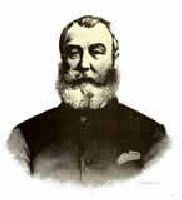
Levi Zeigler Lieter.
In 1903, Joseph began clearing the land around the mine, with a blank check, his father’s blessing, and support from his wealthy friends in Chicago. Among the Leiter family’s friends were super-rich Palmer Potter, Marshall Field, and George Pullman, who together accounted for a very large portion of the nation’s wealth. Along with the wealth came the prestige and power that could open many important doors, and one door that was always open was the White House, where the President often granted political favors in exchange for large financial contributions.
The Leiters had contributed large sums of money to the presidential campaign of Theodore Roosevelt, and the time had come for them to call upon the President for a payback political favor. There was not enough satisfaction for the Leiters in the claim of having gotten Roosevelt elected President of the United States, because they wanted something that would elevate them to the very top of society and overshadow everything others had accomplished.
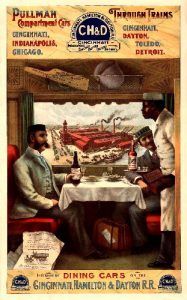
Pullman Car Advertisement
In 1880, George Pullman, the owner and founder of the Pullman railroad car and coach company, built his own company town just south of Chicago, and the Leiters saw an opportunity to do the same thing in Franklin County. President Roosevelt always considered himself a country boy at heart and loved hunting and fishing, and the Leiters knew they had the area that would satisfy the President’s favorite pastime. Here on the Leiter property in Franklin County was an abundance of quail and ducks, buffalo and deer, and plenty of rabbits and squirrels, and they knew it was a perfect spot for the President to live. Joseph hired an architect familiar with the design for Washington, D.C., to come to Franklin County to design the town he planned to build.
The design would be likened to the nation’s capital, with a circle and streets running from it like spokes from a wagon wheel. As Leiter began building his town, he decided to name it Zeigler in honor of his father’s middle name. The Leiters and their rich friends knew it was time to flex their powerful financial muscles, call in the political favors, and attempt to convince the President to move the White House and the nation’s capital to the Leiters Franklin County town of Zeigler.
Political contacts were made, lobbying began, and the wheels were set in motion for the big move to make Zeigler the nation’s capital. Everything seemed to be moving in the right direction for the Leiters, and Joseph opened his coal mine on June 8th, 1904, and brought the first load of coal to the surface. His future now looked brighter than ever, but it would be short-lived.
The very next day after the mine’s grand opening, Joseph’s father died from a rare heart disease, and Joseph’s future suddenly began looking dim. Not only was his future in jeopardy, but the blank checks that he had enjoyed for most of his life would probably be in jeopardy, and his chances of getting the Presidential White House moved to Zeigler died with his powerful father. Labor problems with the Ku Klux Klan and the unions began to take a toll on the man who claimed that he would always operate “union-free,” and it came to the point where he had to struggle to protect his own property.
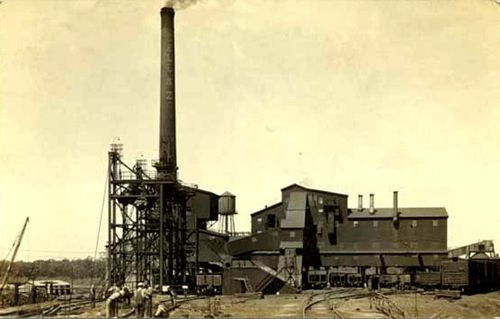
Zeigler Mine
He built a large fence around his mine that resembled an army fort, mounted large searchlights and several large-caliber “Gattling Guns” around his mine and the town’s entrances, and issued orders to the gun-slinging thugs he had hired as security guards that they were to “shoot to kill” any trespassers. Joseph continued to build his town, which consisted of a large two-story colonial-style office building at the center of the circle and a large personal home, along with a company store, on the circle. He built schools and a hospital and donated land so the local churches could be built. Joseph’s “master & slave” attitude finally led to his downfall in the coal industry, and after a few severe mine explosions, he left the business in 1910 and leased his holdings to the Bell and Zoller Coal Company. His dreams and plans were shattered, and he returned to Chicago, where he remained very successful in other businesses.
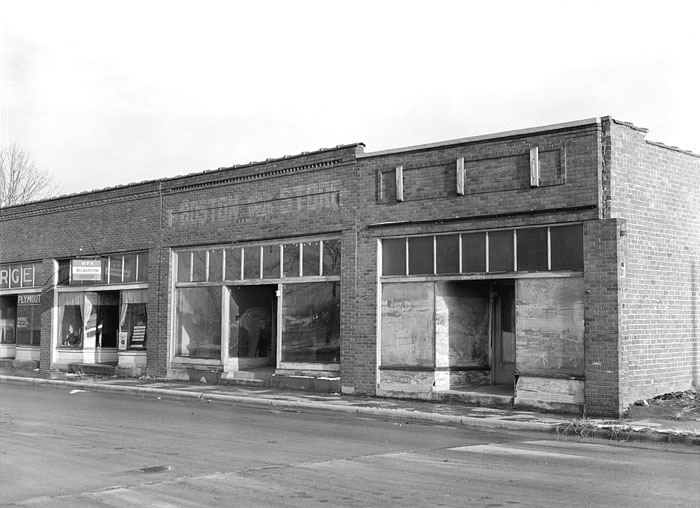
Abandoned stores in Ziegler, Illinois, by Arthur Rothstein, 1939.
Bell and Zoller kept the town of Zeigler moving forward, reaching its peak in 1926, boasting a population of nearly 7,000 residents, 3,500 employees, and 174 businesses. When the Great Depression hit the nation, few people in Zeigler recognized its impact. The Bank of Zeigler was one of only a few banks that survived the Great Depression by flying in large amounts of money from St. Louis, Missouri. In an effort to show investors their desire for survival, the bank officials asked for and received special permission and special plates from the US Treasury Department, printed their own money, and put it into circulation. However, businesses began moving from Zeigler, and with the decline in the coal industry, so many of the residents.
In the early 1940s, a memorial board was erected on the circle to honor men serving in the military. It is surprising that the small town of Zeigler provided over 450 men to the military during the war effort, and the board was later replaced by a stone monument honoring those who lost their lives in the wars. As the years passed, the demand for coal continued to dwindle, and so did the population of Zeigler; today, the town has a population of 1700 and is a mere shell of what it once was.
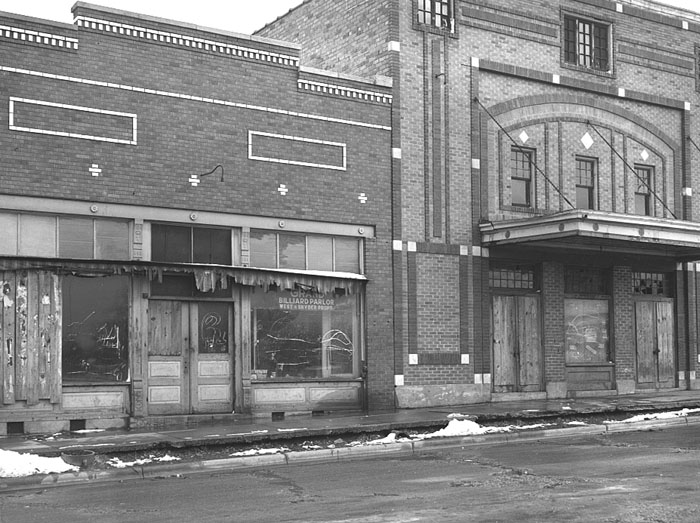
Abandoned buildings in Ziegler, Illinois, by Arthur Rothstein, 1939.
Today, there is no trace of the large coal mine, the mine office in the circle, or the hospital and company store. The large home Leiter built for his residence has been remodeled and remains a private residence on the circle. Once in a while, the name of Joseph Leiter may be mentioned in a conversation between history buffs or by an elderly resident, but to the younger generation, Zeigler is just the small town where they live. They have no idea that their town was once within a human breath of becoming the home of the Presidential White House and the nation’s capital.
Approximately 550 Zeigler photographs of the town’s original buildings and early settlers, dating from 1900 to 2000, have been collected by the people of Zeigler, who compiled 100 of the best photos into two volumes and donated them to the city of Zeigler. A historical book of Zeigler titled “The Town That Big Joe Built” was completed by this writer, and copies have been donated to the Zeigler Women’s Club, which sells them.
Submitted and written by Raymond D. Null, June 2005, updated February 2024.
About the Author: Raymond D. Null is the author of two books, including The Town That Big Joe Built and Zeigler…USA — My Hometown. Null is a long-time resident of Zeigler, Illinois.
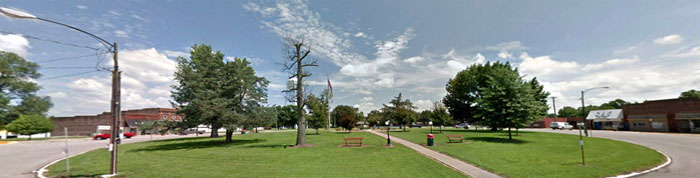
Zeigler, Illinois Circle, courtesy Google Maps.
Also See: