
By Jesse Galanis.
Before electric light, cities operated within limits. Gas lamps marked streets, but they were unreliable and dim.
So when the sun went down, so did activity. Shops closed earlier than demand. Most people treated night as something to get past, not to use.
Electric lighting was phased in slowly. A lit square. A factory floor that stayed on after sunset. A street where people lingered longer than they used to.
Those early exceptions mattered. Once light stopped being scarce, cities began testing what else could stretch with it and how it could help with work, entertainment, and public spaces.
The story of America’s first electric cities is the story of how those tests added up, and how night slowly became part of everyday urban life.
The Dawn of Electric Light: A Historical Overview
In the late 1870s and early 1880s, electricity was fragile, expensive, and difficult to scale. Early bulbs burned out quickly. Power dropped over distance. Engineers were still figuring out how to light a single building reliably, let alone a city.
Two Approaches Emerged
Edison built tightly controlled direct-current systems meant to serve dense urban blocks. Tesla and Westinghouse pushed alternating current, which could transmit power over longer distances but required a different kind of infrastructure. Their technical disagreement, later labeled the War of Currents, shaped how electricity moved through cities, where power stations were built, and how far lighting networks could extend.
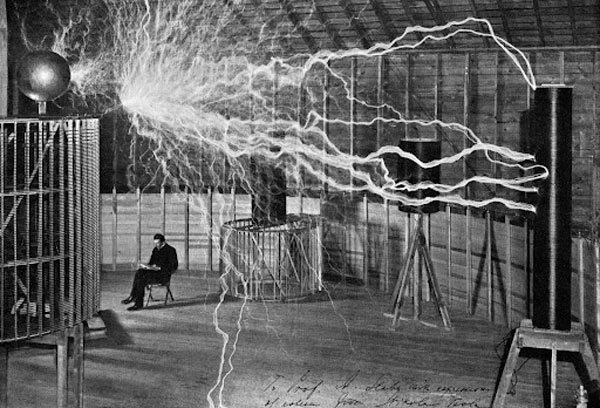
The fight wasn’t just technical. Patent disputes beginning in 1879 forced companies to prove their designs worked outside the lab. Courtrooms became testing grounds, and losing a case often meant losing a market. The pressure accelerated improvement and pushed cities toward systems that could scale and withstand public use.
By the early 1880s, arc lamps were lighting public squares and large interiors, while incandescent bulbs spread through offices and homes.
City leaders backed these installations for reliability, order, and economic return, betting that electric light would make urban life run longer and more predictably.
First Electrified Cities in America
There isn’t a single “first” electric city so much as a series of early tests. Each one answered a slightly different question about what electric light could do, and where it made sense to use it.
In Cleveland, the experiment played out in public. On April 29, 1879, Charles F. Brush’s arc lamps lit up Public Square.
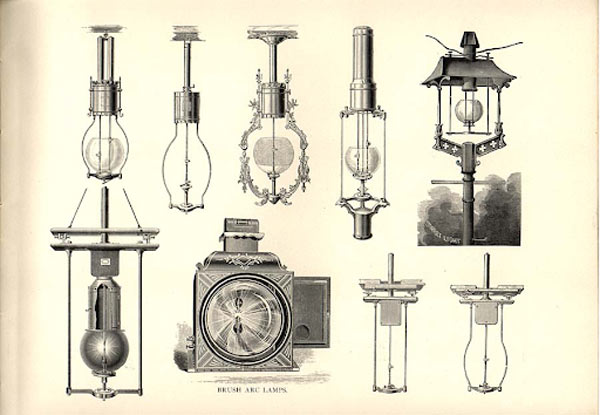
The light was powerful and unforgiving, closer to daylight than gas glow, and people noticed. Crowds gathered. Newspapers wrote about it. The takeaway wasn’t subtle: if you light a place well enough, people will stay longer than they planned to.
Wabash leaned into that idea even harder. When four Brush arc lamps illuminated the courthouse square on March 31, 1880, the town quickly declared itself the first electrically lighted city in the world. The claim traveled faster than the technology, but it stuck.
New York’s contribution looked quieter but mattered more in the long run. With the launch of Pearl Street Station in September 1882, Edison wasn’t lighting a square or making a spectacle. He was selling power.
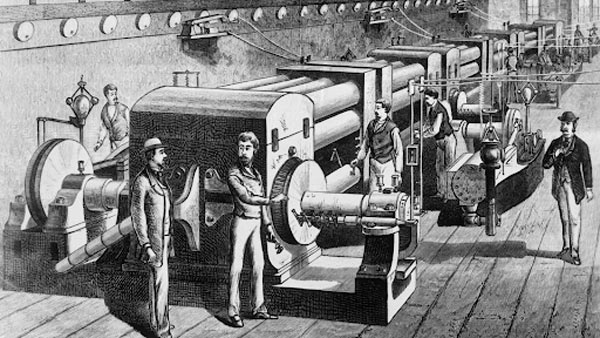
Offices, banks, and printing houses in lower Manhattan paid for direct current delivered through a centralized system. Meters, conductors, generators, this was a business model as much as a technical one, and it became the template other cities would follow.
From there, the glow spread unevenly. Cities like Detroit, San Francisco, and New Orleans experimented with arc-lit streets and landmark buildings. Smaller towns tried shortcuts.
Moonlight towers with tall masts crowned with clusters of lamps promised to light entire neighborhoods from a single point. Most disappeared as grids improved, but Austin’s towers, installed in the 1890s, still stand as reminders of how improvised early electric cities really were.
Urban Nightlife Transformation
City leaders expected fewer accidents and a bit more order. What they got was a steady drift of people outward and later into the night.
Once the streets stayed lit, evenings loosened. People didn’t rush home the way they used to. Cafés tested later closing times. Theaters added second and third shows and found audiences waiting. Newspapers responded with evening editions, aimed at commuters who were still out when the presses rolled.
Adrian Iorga, Founder and President of Stairhopper Movers, runs a business where timing mistakes compound fast.
Iorga says, “Most people don’t announce that their plans have changed. They show up later, or not at all. We see it when buildings run late, or streets stay busy past normal hours — moves spill into the night, traffic patterns shift, and elevators get booked longer than expected. Electric light didn’t make nightlife louder overnight. It made everything run later, whether you planned for it or not.”
Some places turned light itself into the draw. At Luna Park, which opened in 1903, bulbs weren’t just functional. They outlined buildings, framed walkways, and sold the idea that night was something to look at, not just move through.
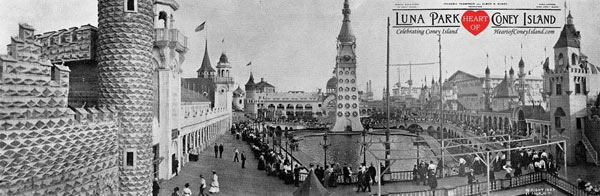
Rare panoramic picture of Luna Park taken from the Chutes shortly after opening in 1903. image source
Retail adjusted quickly. Longer hours meant more foot traffic without expanding floor space. Service jobs multiplied. Commercial districts stopped thinking in terms of closing time.
What emerged wasn’t a single “nightlife scene,” but a quieter reworking of schedules that made after-dark activity routine rather than exceptional.
Tom Rockwell, CEO of Concrete Tools Direct, works with contractors whose timelines rarely stop cleanly at sunset.
Rockwell says, “Once job sites became usable later in the day, expectations shifted fast. Crews poured longer, finished setups after dark, and staged materials overnight. Lighting didn’t just support nightlife. It changed how workdays ended, or stopped ending at all. You can trace a straight line from early street lighting to the assumption that progress shouldn’t pause just because it’s dark.”
You can see that adjustment happening in real time in the newspapers. Articles talked about brighter streets and safer promenades in plain, observational language.
Browsing the Library of Congress’s Chronicling America today, those reactions read less like celebration and more like people noting, almost offhandedly, that the city no longer shut down when the sun did.
Cultural Shifts Induced by Urban Lighting
Once cities stayed lit, darkness stopped being a backdrop and started behaving like a surface, something light could bounce off, fracture, and exaggerate. Storefronts reflected themselves. Alleys held shadow instead of swallowing it.
Writers and artists picked up on that quickly. Night scenes became sharper, more deliberate. Light wasn’t just illumination anymore; it was contrast, mood, exposure. Streets looked awake even when they were quiet, and that tension showed up in stories and images.
You can see it clearly in the work of Edward Hopper. In Nighthawks, the light isolates the scene.
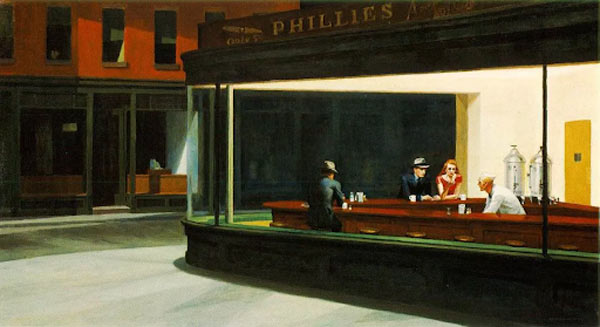
Nighthawks, by Edward Hopper. Image source
The diner glows, but it also separates the people inside from the street outside, turning brightness into distance. That same logic runs through noir fiction and film, where neon signs and hard shadows don’t make cities feel safer, just more watchful.
The phrase “the city that never sleeps” came later. The feeling arrived first: a sense that night had become active, visible, and emotionally charged. Electric light didn’t erase darkness. It gave it edges, and those edges reshaped how American cities were imagined and represented.
The Societal Impact: Benefits and Challenges
The benefits were immediate and visible. With electric lighting, businesses stayed open longer and service jobs multiplied. Entertainment districts are filled out rather than emptied after sunset. Streets became easier to navigate. Streetcars ran later. Police patrols worked with clearer sightlines.
The downsides arrived more quietly. Power plants burned coal and pushed smoke into already crowded skies. Night lost some of its finality. Shift work expanded. Factories, printing presses, and transit systems began operating around the clock. Artificial light made longer days possible, but it also blurred the boundary between work and rest in ways people didn’t fully reckon with at the time.
Ryan Walton, Program Ambassador at The Anonymous Project, works with people whose lives don’t follow clean day-night boundaries.
Walton says, “A lot of the people we support don’t experience night as downtime. It’s when things get quieter, lonelier, or harder to manage. When cities extended the day with electric light, it created opportunity, but it also erased natural stopping points. For some people, that loss of pause matters. You can see how progress solves one problem and quietly creates another, especially for anyone already living on the margins.”
Over time, the sky itself changed. As the lighting spread and grew brighter, stars faded from view. The 2016 New World Atlas of Artificial Night Sky Brightness found that most people now live under some level of skyglow, with the Milky Way invisible to many urban residents.
Cities have since tried to correct course by shielding fixtures, lowering color temperatures, and adding controls, but those fixes are adjustments, not reversals. Once the night was lit, there was no simple way to turn it back off.
Technological and Infrastructural Developments
Electric lighting only worked if the systems behind it worked. Early efforts focused less on brightness and more on reliability. Power had to be generated, moved, measured, and shut off safely when something failed. None of that infrastructure existed yet.
The first central stations established a basic pattern: generate electricity in one place, distribute it through a controlled network, and charge customers for use.
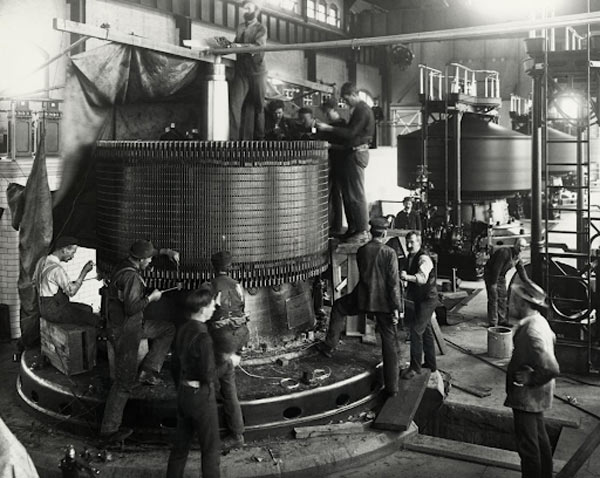
Adams Station Power Plant in Buffalo, NY (c. 1890s) – the second enterprise to provide electricity to Niagara Falls, NY. image source
That model solved some problems and exposed others. Direct current worked over short distances but didn’t scale well. As cities spread, engineers looked for ways to transmit power over longer distances with fewer losses.
Alternating current solved that problem. Long-distance transmission made it possible to separate power generation from consumption and link cities to larger supply areas. Large hydroelectric projects in the 1890s showed that electricity could be transmitted across regions, not just neighborhoods, and that lighting systems could expand without being rebuilt from scratch.
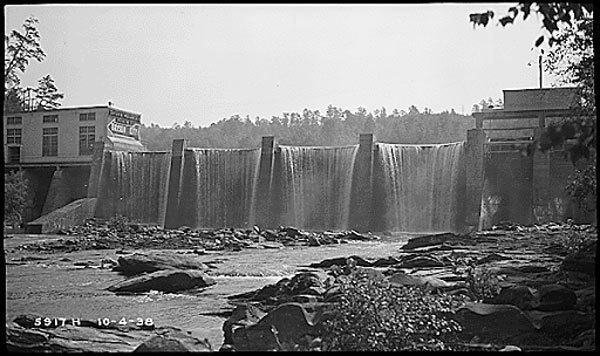
Smoky Mountain Power Company Dam. Image source
As networks expanded, failures became harder to tolerate. Fires, shocks, and equipment breakdowns forced cities to adopt common safety standards. Testing, certification, and uniform components reduced risk and accelerated expansion, even if they added cost.
Andrew Bates, COO of Bates Electric, oversees large electrical systems where small failures cascade quickly.
Bates says, “Most electrical problems don’t come from one big mistake. They come from systems being asked to do more than they were designed for, longer days, heavier loads, and more people using power simultaneously. Early city lighting ran into the same issue. Once the streets stayed bright all night, everything downstream had to hold up. Wiring, transformers, safety margins. Reliability only matters once people depend on it.”
Lighting itself kept improving. Bulbs lasted longer. New lamp types changed how streets and interiors looked, while cities experimented with different layouts and mounting heights to get more usable light from the same power.
Some ideas stuck. Most were incremental. Over time, electric light became less of a novelty and more of a dependable background condition.
The Long Arc of the American Night
America’s first electric cities changed how time was used after sunset. What began as experiments in a few public squares and business districts gradually reshaped work hours, leisure, and expectations about when a city should be active.
The path from early arc lamps to centralized power stations and long-distance transmission tied technical decisions to everyday routines in ways that were hard to undo.
Those choices still linger. Walk through downtown at dusk, and much of what feels normal, the lit storefronts, the steady movement, the assumption that the city stays open, comes from that first round of electrification.
New technologies now refine the same system rather than replace it. The questions haven’t changed much either: how much light is enough, who gains from longer days, and what gets lost when night never fully arrives.
From forgotten frontier tales to roadside oddities and historic personalities, America’s past comes alive at Legends of America. Explore history the way it was lived, not just recorded.
©Jesse Galanis, for Legends of America, submitted February 2026.

Jesse Galanis
About the Author: Jesse Galanis is a professional writer whose aim is to make complex concepts easy to understand. He strives to provide quality content that assists people in everyday life.
More from Jesse Galanis:
Hidden Figures of American History: Untold Stories from Across the States
Hidden Figures: Unsung Women Who Shaped America’s Frontier
Best Fall Getaways With Historical Roots: Leaves, Legends, and Small Town America
Discover Your Roots: Step-by-Step Guide to American Genealogy Research
Preserving History in a Changing America: Modern Challenges
Also See:
Thomas Edison – The Man Who Lit the World
Alexander Graham Bell – A Life Shaped by Sound and Invention