

Skidoo, California, 1908.
“On the borderline between California and Nevada, just a few miles from Nevada’s big, bonanza gold camps of Goldfield, Rhyolite, and Tonopah, California promised to give birth to the most wonderful gold mines America has yet produced. Here the golden goddess is again singing her siren song of enchantment, and California is again beckoning to the world with a finger of gold: and the world is listening, and looking, and coming — TO SKIDOO!”
In 1909, when this enticingly optimistic editorial appeared, Skidoo was a thriving-year-old mining camp. Her cramped townsite, dizzyingly nestled atop the Panamint Range, already boasted over 30 tents, several frame buildings, and many amenities of civilization, including restaurants, hotels, and a newspaper.
It was a far cry from the desolate, lonely conditions of January 1906, when two wandering desert prospectors, John Ramsey and John “One Eye” Thompson, winded their slow way up Emigrant Canyon toward the newly discovered gold strike at Harrisburg.
Although the Panamint Range had been known for almost its entire length since the early 1850s to contain gold- and silver-bearing veins, early mining efforts focused chiefly on silver and lead, largely overlooking and failing to prospect the gold veins. Only in the early 1900s was this precious metal becoming a highly prized and sought-after commodity.
Skidoo and Harrisburg, discovered about six months earlier and located about 5 ½ miles further South, were the direct offshoots of the big Nevada bonanzas of Tonopah, Goldfield, and Rhyolite. Excited and encouraged by the seemingly quick riches exposed in these areas, the desert mining community became hungry for more. Prospectors began gravitating westward across Death Valley in search of rumored treasures in the Panamints.
The long trek of Ramsey and Thompson toward Harrisburg was suddenly interrupted by a rare freak of nature in the Death Valley region — a blinding fog. Quickly becoming disoriented in the murky light and afraid of getting lost in one of the many surrounding canyons, the two decided to camp near Emigrant Springs and proceed on their way in the morning. By the next day, the fog had lifted, revealing nearby ledges whose color seemed promising. After checking them out, Ramsey and Thompson found that what they saw dismissed any thought of a further journey and prompted them to quickly locate several claims in the vicinity. This series of rich ledges, comprising the Gold Eagle Group, appeared to stretch north-south for about 1 ½ miles, varying from two to twelve feet wide and showing $82 in gold per ton.
Somehow, they kept their discoveries secret until their claims were properly documented and recorded; it was not until a couple of months later that news of the strike began to spread. Immediately realizing that these veins were probably located in the same mineral belt that had been the source of riches for Panamint City over 30 years earlier and that was now proving so productive in the Harrisburg vicinity, hordes of miners turned their burros toward Emigrant Springs, hoping to be early enough to cash in on the bonanza. Though located in California, the camp soon fell almost wholly into the hands of Nevada capital and enterprise. As soon as word of the strike reached the pioneers of the Bullfrog Mining District, the area’s future was assured, for their intervention and investment made Skidoo one of the longest-lived and most successful Death Valley mining camps.
The Nevada mogul most responsible for Skidoo’s success was Ernest A. “Bob” Montgomery, who immediately purchased the original Gold Eagle Group of claims from Ramsey and Thompson. Steel magnate and mining investor Charles M. Schwab also invested heavily in the area, as did Senator Nixon and George Wingfield of Tonopah, Nevada. Meanwhile, the new find practically emptied Harrisburg as hundreds of prospectors flooded the area.
Bob Montgomery intended to waste no time developing his Skidoo interests, which included plans to install a quartz mill at the site by January 1907. Although sufficient water for domestic purposes could be acquired from Emigrant Springs, approximately five miles away by trail and seven by wagon, a more abundant water supply would be needed to provide the hydraulic force necessary to run the milling plant. Accordingly, water rights to the springs near Telescope Peak, at an elevation of about 7,400 feet, were acquired from a Fred Gray of Ballarat, to be conveyed by gravity pressure to the mill and townsite in a long pipeline.
A negotiable road from Emigrant Springs was also needed to bring in construction supplies. Montgomery employed 20 men for this task, expecting to increase this force soon to 75 and later to 250 when the mill was in operation. The Skidoo Mines Company promoted and backed all this initial development work.
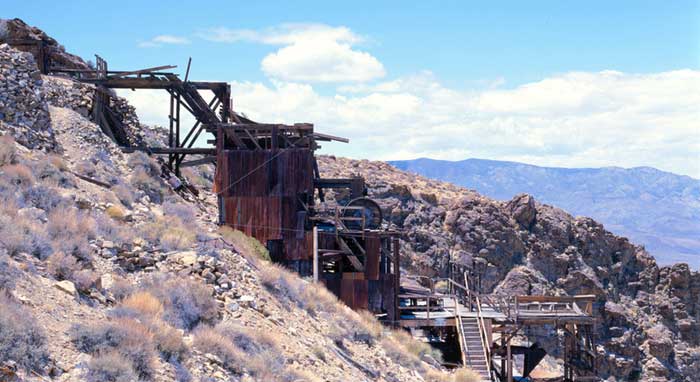
Skidoo Mine in Death Valley, California by Gianfranco Archimede, 2000.
By the Fourth of July, 1906, a real spirit of optimism pervaded the camp, its over-abundance of energy and enthusiasm finding an outlet in the discharge of guns and the explosion of gunpowder in front of buildings gaily decorated with bunting and flags. Such optimism seemed duly warranted, for arrangements were already being made for an auto line into the district from Beatty, a stage line seemed assured, a post office had been applied for, mine options were being taken up right. They left, and several companies expected to start production soon.
On Montgomery’s property, at the rechristened Eagle Mine, a spate of construction activity was currently underway, resulting in the erection of several lumber buildings, including a bunkhouse, cookhouse, boarding house with kitchen, an office, and a blacksmith shop, in the company camp located on the hilltop above the mine workings.
Communications with Ballarat had improved substantially with the start of a tri-weekly stage line. Still, to reach the new camp’s full potential, it was concluded that a communication and transportation line with Rhyolite was needed, requiring much work on the road crossing Death Valley, which at the time was so sandy it could not support loaded wagons. A telephone line to the Bullfrog Mining District was also considered essential to keep mining men in Skidoo apprised of the rise and fall of shares.
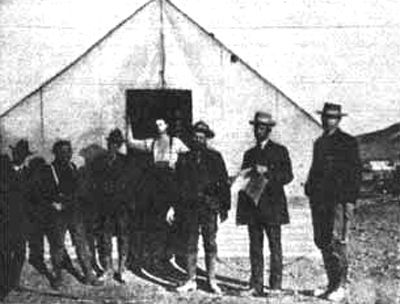
Skidoo News, 1907.
From its beginning, Skidoo showed a definite tendency toward organized, systematic development that undoubtedly helped sustain it through the rough years ahead. The rapid influx of mining men to the vicinity, some with families, made establishing a townsite and disbursing residential and business lots the next natural step in the area’s growth.
By the end of August 1906, a townsite, variously designated Montgomery and later Hoveck, was platted just east of the Skidoo Mine and served as the center of milling operations. A post office opened under the name of “Hoveck.” However, neither “Montgomery” nor “Hoveck” captured the townspeople’s imagination, and the townsite and post office were renamed “Skidoo” in 1907. It was initially named “23 Skidoo,” an early 20th-century slang term meaning “take off.” However, the postal service refused to accept “23” as part of the name.
Lots on Skidoo Street went almost in a day. Winter would delay new construction, but by spring significant frame buildings were already being built. Meanwhile, a new gold strike in the fall of 1906 on the North end of Sheep Mountain added to the mining excitement. This area later proved also to contain sizeable quantities of copper ore. The Skidoo pipeline was also progressing, and the first pipe consignment arrived in mid-September. Seventy-five men worked on the water system, and at the mine, the main shaft, already down sixty feet, exposed magnificent ore filled with free gold. Work was beginning on the road to Rhyolite, and hopes were high that Borax Smith’s railroad would be extended westward from his Lila C borax mine.
In November 1906, the Skidoo News arrived. Operated by James G. Sterrett and Edwin S. Drury of Encampment, Wyoming. Soon more businesses were established, including an engineering and assay office; the Kimball Brothers stage line began canvassing the wagon road between Rhyolite and Skidoo; a water station was established at Stovepipe Wells; John Calloway began running a six-horse bi-weekly stage from Ballarat; and an eating house and feed stable were projected.
Mining conditions throughout Inyo County were healthy during the closing months of 1906, with 150 miners reportedly working in the Emigrant District. Harrisburg was taking on a new lease of life because of activity in the surrounding region, and Ballarat was thriving as the distribution point for supplies for an extensive mining section, including not only the Wild Rose District but also the revitalized camps in the Darwin, Modoc, and Coso districts. To the North, numerous valuable copper properties in the Ubehebe and Saline Valley regions were drawing much attention. To the East, Greenwater, the site of a bonanza copper strike, attracted investors from across the country.
Over the next few months, conditions at the new camp improved slowly but steadily. By early January, the first power hoisting plant was installed at the mine, and work continued on the road to Rhyolite. By the first of the year, Skidoo boasted 33 tents, several frame buildings, a prominent general mercantile store, a lodging house, a restaurant, a newspaper, and several saloons. Soon, the road to Rhyolite was negotiable by motorcycle, stage, or auto. The Kimball Bros. stage line quickly launched a five-day round-trip service from Rhyolite to Skidoo via Stovepipe and Emigrant Springs, with a one-night stopover at the former. A one-way fare cost $20; the express rate was 5¢ per pound. During this same time, a telephone line from Rhyolite was nearing completion to Stovepipe Wells. By March 1907, it was complete and already extended nearly five miles up the Panamint slope toward Skidoo.
Meanwhile, a new and highly profitable phase of activity began with the opening of leasing opportunities on the Skidoo Mines Company property to interested parties. According to Hoveck, the company would eventually lease everything except for the three big ledges on the Skidoo and the three on the Cocopah Mine that the company was working. The company anticipated that the first shipment of gold bullion from the Skidoo Mine would be made before the end of July, that an 80-stamp mill would be operating by the summer, and that it would furnish water and electric power to any surrounding properties that desired it.

Skidoo Club, 1907.
In March, the Skidoo Bank and Trust Company took up temporary quarters in the general store. Due to numerous delays, however, it was not until May that the renamed Bank of Southern California opened its doors. The future looked so rosy that stonemasons imported from Los Angeles were already quarrying the native white stone for use in a new two-story stone building that would house a large store and several business offices besides the bank. In February, Salt Lake parties formed the Panamint Artificial Ice Company, intending to divert water from the Telescope Peak pipeline to their $5,000 ice plant on four town lots. Two men already running large businesses in Tonopah and Greenwater planned to establish the Skidoo Lumber Company.
In March, a man named Captain W. R. Wharton, a Pennsylvania capitalist and stockholder in the Skidoo Mines Company, bought the Skidoo townsite and proceeded to plat a new residential addition to the East of the original townsite, where he erected two portable houses, sold lots ranging in price from $100 to $1,000 each, and oversaw the development work on those promising claims embraced within the townsite.
Skidoo’s population soon reached 400-500 citizens, who were being served by L. E. Thompson’s sizeable general merchandise store, four saloons, a meat market, laundry, bakery, newspaper, and lumber yard, lodging houses, three restaurants, assayers, surveyors, a physician, lawyers, brokers, and more. Social activities were held in the Skidoo Club and in the more elite Panamint Club, which demanded an initiation fee of $100. By April, the town contained about 130 residences and business houses of frame, wood, and iron.
Because the Telescope Peak pipeline was not yet finished, water continued to be hauled in wagons from Emigrant Springs by a ten-horse team and sold for $4 a barrel, or three to ten cents a gallon or higher, to townspeople. However, Skidoo and the surrounding Emigrant District were now accessible by stage from both Ballarat and Rhyolite, as well as by several private cars, including J. W. Calloway’s sixty-horsepower auto with a capacity for ten passengers. Another significant milestone in the town’s history came in the early spring of 1907, when Skidoo was connected to Rhyolite by phone.
Like Goldfield, Nevada, Skidoo was fast becoming famous for her leases. Next to the Skidoo and Granite Contact mines, these were most important in proving the district’s richness. Figures vary considerably regarding the number of men employed by the Skidoo Mines Company at any one time, ranging from 40-70 for April 1907 alone. By spring, the company had spent several thousand dollars on the mining camp. The company headquarters were now housed in a fine building containing a large central office, a private office for the superintendent, a parlor, a bathroom, and several private bedrooms for employees. Other recent improvements at the campsite included a boarding house, bunkhouse, and another building, encompassing a reading room, officers’ dining room, and a lady cooks’ room.
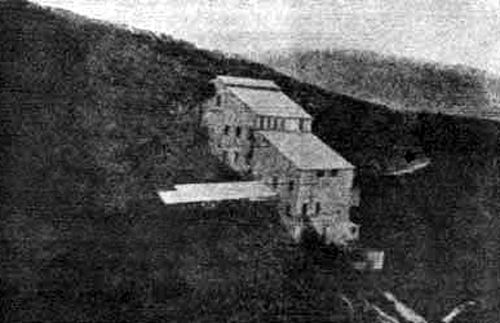
Skidoo Mill, 1909.
By mid-April, eight leases had been given out on the Skidoo Mines Company property, and mining investors from across the country were envisioning the immense profits to be made at Skidoo.
Some of these included Captain W. R. Wharton, who closely associated with Charles M. Schwab and his enterprises; Patsy Clark, the copper king involved in Greenwater mining; Captain John L. Armit of Colorado Springs, who was actively engaged in mining throughout the West; various officials of the John S. Cook & Co. Bank of Rhyolite, Nevada, and countless others.
In May 1907, the town of Skidoo appointed peace officers, a new road was proposed to Keeler, and the Skidoo Board of Trade was established. However, the first summer brought frustrating problems on the Skidoo pipeline, and it was not until September that the line was completed to Harrisburg. By the end of November, the pipeline was still two miles and one hill away from Skidoo.
By the end of the year, the Panic of 1907 was sweeping the country, closing mines across the American West. Still, Skidoo saw only a slight population reduction to about 300 people.
The Skidoo Pipeline was finally completed at the end of the year, and 1908 saw continued positive, improving conditions. The immediate need was a school district, and work was progressing on the Keeler-Skidoo Road. Though Skidoo was not initially affected by the Panic of 1907 like so many other camps, most available cash had already been used, and gaining more capital was scarce.
During this time, the atmosphere was charged, and doubts about the future temporarily strained tempers; Joe “Hooch” Simpson was hanged. Simpson, a gambler from Reno who had lived in Skidoo for some time, had a reputation as a grumpy character who drank too much. After Simpson fancied that a man named James Arnold had done wrong to him, he entered Arnold’s store and shot him to death. Arnold was one of the town’s founding fathers and one of the best-liked men around. Simpson was immediately arrested, and upon Arnold’s death a few hours later, it was only by some of the greatest diplomacy that law officers were able to avert an immediate lynching. But only a temporary stay of execution had been granted, for on April 22, Simpson was dragged from confinement and efficiently and unceremoniously attached by the neck to a telephone pole. Word of the deed spread quickly, and when newsmen arrived from other parts wanting pictures of the event, Simpson was re-hanged with pleasure.
The late spring of 1908 brought the commencement of teaming between Owens Valley and Skidoo along a vastly improved route, and by May, the first stamp mills were falling on the high-grade rock at the Skidoo mill. In early June, the first gold brick from the Skidoo Mine, estimated at $4,000, was transported to Rhyolite and then shipped to the mint by Wells Fargo express. Ten stamps were now in operation, and the full mill process encompassed crushing, amalgamation, and concentration, with cyanide still to be added. The second brick from May production was valued at $7,000. By the end of June, the mill was treating around thirty-five tons daily, with an increase to twenty stamps planned when the mine’s demands justified the additional expenditure. Meanwhile, ore bodies were increasing, and their average value remained steady.
By summer, the results of the Panic of 1907 were causing lean business—the bank failed, the Nevada stage line withdrew, and the Skidoo News closed. Still, the camp boasted 150 people, and the Skidoo Mines Company could still increase its output. Although Bob Montgomery once hoped the Nevada–California Power Company would extend electrical service into Skidoo and other sections in the district south of Rhyolite, thereby furnishing power for his mill and freeing the present water line for use by other mills in the area, this never came to pass.
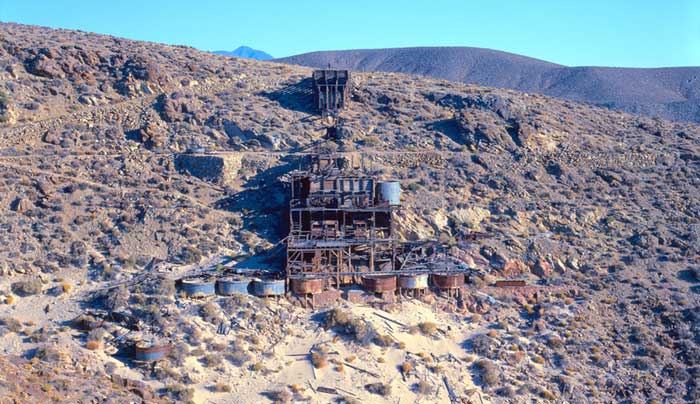
Skidoo Mine in Death Valley, California by Gianfranco Archimede, 2000.
Because no mills were nearby, little mining activity occurred in Skidoo in the fall of 1908. Although the Skidoo Mine continued operations and improvements, the town’s population declined by early 1909. In July, the Los Angeles Mining Review reported that the Skidoo Mine ranked second only to the Keane Wonder in California in 1909. By this time, the Skidoo Mines Company had paid off all its indebtedness, and it paid its first dividend in July, aggregating $50,000 at five cents a share.
Despite the ongoing and successful development at the Skidoo Mine, the town itself was becoming increasingly depleted, and in September 1909, the school district was closed.
When Frank Montgomery, Bob Montgomery’s nephew, took over management of the Skidoo Mine in the winter of 1909-10, a new era of productivity began. More aggressive than his uncle, he put half the workforce on development and the other half charged with supplying ore to the mill. It was not long before they located the most extensive and prosperous ore body. Despite pipeline troubles, the company saw better returns. Although the mine could keep up production for several years, monthly net profits suddenly started a downhill slide, broken only temporarily by an occasional banner year.
At the start of 1911, three producing companies and five producing lessees operated on the Skidoo Mines Company property. July recorded the most extensive run in the life of the mine–$18,000. The company paid dividends in October 1911 and again in May 1912. By then, it was reported that the company was maintaining an approximate production of $14,400 a month and earning net profits of about $4,800.
Production took a hit in January 1913 when the pipeline froze and burst in several places, forcing the mill to shut down and discharging 40 miners. Because future operations appeared doubtful, most men left camp, leaving only a few leasees on the property. Undaunted, the company began the slow process of repairing the pipeline. Still, when half the repairs were complete, a more serious calamity befell the operation when a fire of unknown origin destroyed most of the mill structure on June 2, 1913. The loss was a staggering $50,000, with only one battery of five stamps being saved. Although parts of the old structure could be reused, the mill needed a large amount of new material to modernize. By October 1913, a new ten-stamp mill was in commission, and a heavy Winter yield was expected.
Production progressed well enough that by July 1914, the company paid another dividend, proving the resiliency of the company and the resources of its mine. By October, 35 men were again on the company payroll involved in exploration and development work. In 1915, the mine continued to make improvements, and the town of Skidoo still supported a small population, although several lots were being sold.
Skidoo’s days were numbered, however. In September 1917, it was reported that Skidoo’s rich vein had pinched out, and the mine had closed permanently, around the same time as the demise of Rhyolite and Greenwater. The post office closed that same year, and the mill and pipeline’s iron and steel remnants were dismantled and sold.
However, in January 1926, the Skidoo mines were reopened under different ownership, and work continued under various companies throughout the early 1940s. In the early 1950s, the tungsten boom hit the Skidoo area, and though several hundred claims were located, the ore was low-grade. Sporadic mining would continue for several decades, leaving shafts, cuts, and tailings throughout the area.
Though there are no townsite remains, it is listed on the National Register of Historic Places. The area is dotted with mining ruins, equipment, shafts, and adits, and the old mill and a cemetery still stand. It is located off Wildrose Road on an unpaved road that requires a high-clearance vehicle.
Compiled and edited by Kathy Alexander, Legends of America, updated September 2026.
Primary Source: Greene, Linda W. and Latschar, John A.; Death Valley Historic Resource Study; National Park Service, 1979.
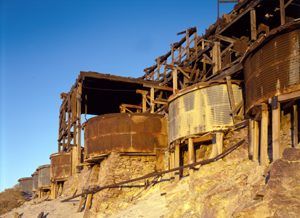
Skidoo Cyanide Tanks
Also See:
Our Journey To Death Valley (from the Photo Blog)