Hot and Cold Water Towers in St. Clair, Missouri.
St. Clair, Missouri, located on Route 66 in Southeast Franklin County, Missouri, was established in 1843 as a stagecoach way station.
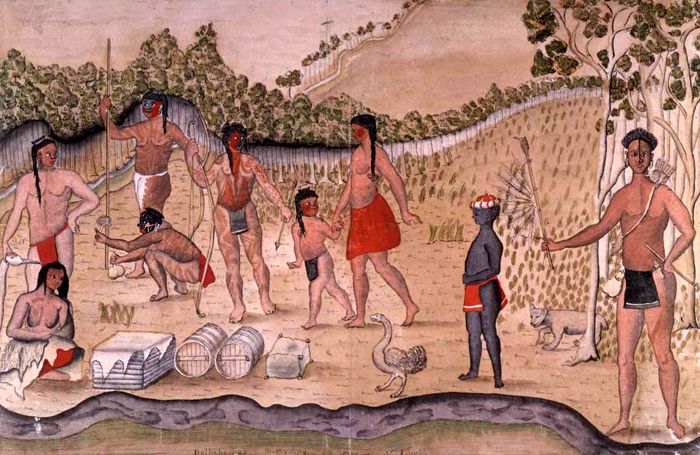
Illinois Indians.
The earliest settlers in eastern Missouri were Frenchmen seeking gold and silver around 1720. At this time, the area was inhabited by the Illinois Indians. By the 1830s, all Native American tribes in the area were forcibly moved to present-day Oklahoma, and the area was opened to white settlement. Farmers primarily settled the area, clearing forests to grow crops. However, others came to work in lead and barite mines, including the Virginia Mines about five miles Southwest of St. Clair and the iron and lead mines of nearby Moselle and Anaconda in the 1840s.
One of the first settlers of St. Clair was B.J. Inge in 1843, who established a stagecoach way station on the road from St. Louis to Springfield, where it met the road to Virginia Mines. The settlement was called “Traveler’s Repose” when a post office opened. The stagecoach station comprised 13 rooms for lodging, a tavern, and the post office.

Missouri Pacific Railroad
In 1859, the Missouri Pacific Railroad arrived, and the town was renamed St. Clair in honor of a railroad civil engineer. At that time, an official town plat was laid out. With the railroad’s arrival, the town grew into a shipping center for lead, iron ore, barite, lumber, livestock, poultry, and grain.

Phoebe Apperson Hearst was born and raised in St. Clair, Missouri.
In June 1862, a local girl named Phoebe Elizabeth Apperson, born in St. Clair in 1842, married millionaire George Hearst. Hearst, originally from nearby Sullivan, Missouri, had headed West during the California Gold Rush in 1849. Though he did very well, he returned to the area in 1860 to care for his dying mother when he met Phoebe. When they married, she was just 19, and he was 40.
Afterward, they moved to San Francisco, California. The following year, she would give birth to their only child, William Randolph Hearst. Phoebe became an American philanthropist, feminist, and suffragist while her husband, George, continued to amass his fortune, establishing and investing in mines across the West. Some included the Homestake Mine in the Black Hills of South Dakota, the Comstock Lode and the Ophir Mine in Nevada, the Ontario Silver Mine in Utah, the Anaconda Copper Mine in Montana, and more. Their son, William, became internationally known as a newspaperman and publisher.
Mining and lumbering remained a mainstay of St. Clair’s economy, but that changed in the early 1920s, when the town had about 450 residents. The International Shoe Company saved the community in 1922, soon employing one out of three working-age people. The arrival of Route 66 in 1926 further boosted the town, bringing more people through, and area citizens responded by building services along the highway. By 1930, the town boasted a population of 1145.

Art’s Motel and Cabins was once a popular stop on Route 66 in St. Clair, Missouri.
Over the years, the town continued to grow even after Route 66 was rerouted west of town in the 1950s. Later, this alignment would become Interstate 44.
After International Shoe Company closed in 1982, many residents began commuting to St. Louis for employment. However, in the following years, more industries and businesses were established. Today, St. Claire’s population is about 4,700.
St. Clair includes several historic sites, including the old three-story International Shoe Company building at 160 N. Main Street, which was listed on the National Register of Historic Places in 1994. The old Panhorst Feed Store, established in 1918 at 465 Saint Clair Street, was also listed on the National Register in 1990.
The St. Clair Historical Museum, at 560 S Main Street, includes Indian artifacts, mining items, and other St. Clair and Franklin County memorabilia. At 145 Main Street, the family-owned Lewis Cafe has been serving home-cooked meals since 1938.
As travelers continue Southwest, a photo opportunity arises when St. Clair’s quirky hot-and-cold water towers appear.
Route 66 meanders along the North Service Road for about 8.5 miles to Stanton, home of the popular Meramec Caverns.

Watch for the large barn that advertises Meramec Caverns between St. Clair and Stanton, Missouri. Photo by Kathy Alexander.
©Kathy Alexander/Legends of America, updated October 2026.
Also See:
Missouri Route 66 Photo Gallery
Sources: