

The remains of the 1757 Presidio de San Saba in Menard, Texas, by Kathy Alexander.
The Presidio of San Saba, located one mile West of Menard, Texas, on the San Saba River, was founded in April 1757 to convert the Lipan Apache Indians to Christianity and help Spain secure its claim to the territory.
Before establishing the mission and presidio, the Apache had long been known to attack Spanish Missions until the Apache and the Spanish agreed to peace in 1749. Seeking an ally and protection from their enemies, the Apache requested a mission. Though the Spanish were wary that they could “tame” and Christianize the fierce Apache Indians, they knew that missionary activity could be expanded northward if they gained their cooperation. They might establish an overland route to Santa Fe, New Mexico.
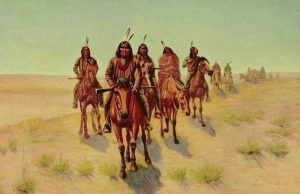
Apache Warriors
In 1752, Spanish authorities approved an expedition to explore the Apache territory and locate a site for a possible mission. The San Saba River area seemed most promising because it had fertile soil, appeared to have mineral deposits, and the local Apache promised to come to a mission.
In 1756, Father Terreros and his missionaries, nine Tlaxcalans from Mexico, and 100 soldiers arrived in San Antonio, Texas. The following year, they traveled to the San Saba River. They founded Mission Santa Cruz de San Saba and the Presidio San Luis de las Amarillas, better known as Presidio de San Saba.
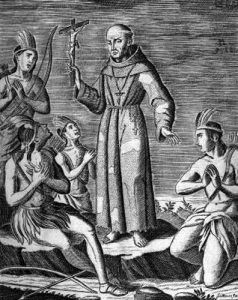
Spanish Missionary.
Oddly, when the missionaries arrived at San Saba, no Indians met them. The missionaries then sent out messengers and assembled a large group of Lipan Apache, numbering 3,000 warriors. However, the Indians were not interested in a mission or the missionaries, as they were too busy hunting buffalo or fighting with the Comanche and other Plains Tribes. None of them chose to remain at the mission, although some promised to return. Disappointed, some missionaries abandoned their assignment and returned to San Antonio.
However, the building of the mission and presidio began. Located a few miles upstream from the mission, Spanish soldiers led by Captain Don Diego Ortiz Parilla built the fortress. It was built to protect the mission, assess rumors of rich silver deposits in the area, and guard the Spanish frontier against the threat of Indian encroachment. In both size and troop strength, the Presidio was the largest and most important military installation in Texas at the time.

San Saba River at Menard, Texas by Kathy Alexander.
Although the location was good for agriculture, with green pastures and creeks, Colonel Diego Ortiz Parrilla wrote in 1758, “The Apaches were unimpressed by the strength of the new Presidio, for they quite refused to settle at the Mission. Indeed, the whole establishment stood like bait at the very edge of the Comanche territory.”
Although no Apache lived at the mission, a group of over 1,500 Comanche, Teja, Tonkawa, Bidai, Yojuane, and Hasinai warriors surrounded the mission looking for them on March 16, 1758. Mounted on Spanish horses and armed with French guns, the Indians constituted a fighting force superior to Spanish colonials. The band looted and burned the log mission buildings and killed two priests, four soldiers, and two mission residents. It was the only mission in Texas to be destroyed by Native Americans, but the Indians did not attack the nearby presidio. After the attack, the San Saba mission was abandoned, and the Spanish withdrew from the frontier, creating new lines of defense along the Rio Grande.

Destruction of the San Saba Mission by Jose de Paez, 1765.
The Comanche considered it a great victory against old enemies, and it touched off a series of Comanche raids. However, from the Spanish perspective, it was a massacre. In retaliation, the Spanish government authorized an expedition in 1759 to attack the Comanche. Led by Colonel Diego Ortiz Parrilla, over 600 Spanish soldiers from as far away as San Luis Potosí, settlements in Coahuila and Sierra Gorda, Mexico, and Tlaxcalan and Apache allies launched a punitive campaign against the northern groups, killing 55 warriors and taking 150 prisoners. However, the Spanish force was eventually repulsed when they attacked a heavily fortified Wichita village along the Red River. The Indians lured Ortiz into an ambush, and after a four-hour battle in which the Spanish suffered 19 dead, he and his troops retreated, leaving two cannons in the hands of the Indians. Afterward, the presidio commander was relieved of command.
A new commander replaced the log stockade with a stone compound in 1761, sending a message to French and American Indian groups that the Spanish intended to stay. However, the Spanish abandoned it again in 1768, leaving the lands Southeast of San Antonio to the Comanche and their allies.
Afterward, the original site of Mission Santa Cruz de San Saba was lost, and the Presidio San Luis de las Amarillas fell into ruins. The Presidio’s walls were used to hold cattle on the Great Western Trail drives in the 1870s-1880s because of water available from the San Saba River.
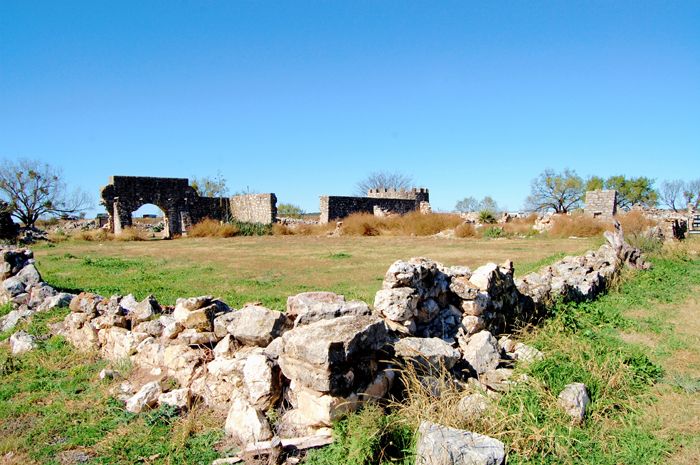
Presidio San Saba, Menard, Texas by Kathy Alexander.
The Works Progress Administration rebuilt a portion of the old presidio for the Texas Centennial in 1936.
The old mission site became known as “the lost mission of Texas” because its exact location was unknown until the early 1990s. The rediscovery of Mission Santa Cruz de San Sabá resulted from years of research and survey when the site was found in an alfalfa field East of Menard in 1993. A historic marker marks the site three miles East of Menard on Farm-to-Market Road 2092.
Presidio San Luis de las Amarillas, also known as Presidio San Saba, is located one mile West of Menard, Texas, on US 190 at 191 Presidio Road. It is a Texas Historic Landmark, is listed on the National Register of Historic Places, and is open daily with no admission fee. Visitors can walk through the site, picnic near the stone walls, and learn more on the interpretive panels that detail the history of the presidio and mission.

An ancient irrigation ditch in Menard, Texas by Kathy Alexander.
The town of Menard also features several historic sites, including the irrigation canal first cut by the Spanish in the 1750s and still used by local farmers today.
©Kathy Alexander/Legends of America, updated October 2026.
Also See:
Forts & Presidios Across America
Sources:
National Park Service
Presidio San Saba
Texas Forts Trail
Wikipedia