
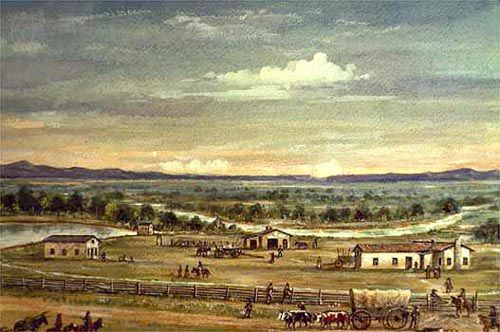
Marcus Whitman founded the Waiilatpu Mission in southeastern Washington in 1836. The mission is shown in a painting by William H. Jackson in 1865.
The Whitman Massacre National Historic Site in Walla Walla, Washington, preserves the remains of the Whitman, or Waiilatpu Mission (1836-47), the second Protestant mission in the Oregon country. Enduring wilderness hardships and dangers, Dr. Marcus and Narcissa Whitman worked among the Cayuse Indians. In the 1840s, their mission became a haven for Oregon Trail emigrants. The invasion of emigrant settlers and Indian-missionary misunderstandings brought about the tragic death of the Whitmans at the hands of the Cayuse only two years after the mission’s founding.
Early in the 19th century, stirred by accounts of explorers and traders, missionaries began to turn their gaze toward the Oregon country. As early as the 1820s, the interdenominational American Board of Commissioners for Foreign Missions began to consider a program there but was discouraged by its remoteness.
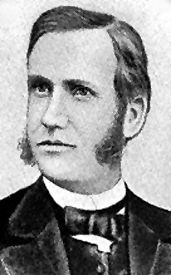
Dr. Marcus Whitman.
Finally, in 1835, spurred by reports that a Nez Percé and Flathead delegation had visited government officials in St. Louis, Missouri, seeking to learn about the white man’s religion, the board sent the Reverend Samuel Parker and Dr. Marcus Whitman westward to investigate the possibilities. In Missouri, the two men joined a fur caravan heading for the fur traders’ rendezvous along Wyoming’s Green River. Talks with the Flathead and Nez Percé inspired enthusiasm for missionary work in the Northwest among the two men. Separating, Parker pushed on to Oregon, wintering at the Hudson’s Bay Company post of Fort Vancouver, Washington, and investigating mission sites before returning to the East by ship the following spring. Whitman immediately returned there to recruit missionaries.
In April 1836, Whitman’s party set out from Liberty, Missouri. It consisted of himself, his recent bride, Narcissa, the Reverend Henry H. Spalding, his wife, Eliza, and the carpenter William H. Gray. In May, they overtook an American Fur Company caravan near the Platte River and the Loup Fork junction in Nebraska. Traveling via Fort Laramie, Wyoming, and across South Pass, they arrived at the Green River Rendezvous in July. Escorted by two Hudson’s Bay Company traders, the party then embarked on a long journey via Fort Hall to Fort Vancouver, where it arrived in September. The two wives were the first American women to travel across the continent.
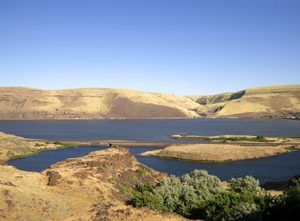
Columbia River, Washington by Carol Highsmith.
The men soon retraced their steps up the Columbia River to choose mission sites while the women enjoyed the hospitality of Chief Factor John McLoughlin. Whitman chose a spot in southeastern Washington on Mill Creek on the north bank of the Walla Walla River, 22 miles above its junction with the Columbia and the Hudson’s Bay Company post of Fort Walla Walla. The local Indians, the Cayuse, called the spot Waiilatpu (“Place of the Rye Grass”). Spalding chose a site 110 miles farther east, where he founded what came to be known as the Spalding Mission, Idaho, among the Nez Perce Indians.
The following March, Mrs. Whitman gave birth to a daughter, Alice Clarissa, the first American child born in the Pacific Northwest; two years later, the child died in a tragic drowning accident.
In 1838, missionary reinforcements arrived. Among them were the Reverends Elkanah Walker and Cushing Eells and their wives, who, the following year, founded the Tshimakain Mission about 135 miles to the north. That same year, the Reverend Asa B. Smith established the Kamiah Mission among the Nez Percé in Idaho, about 50 miles up the Clearwater River from the Spalding Mission; he maintained the mission for only two years, abandoning it because of disillusionment and a sick wife.
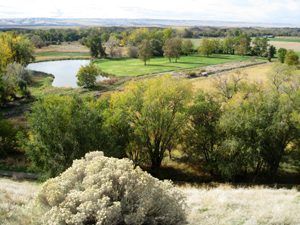
Whitman Mission site near Walla Walla, Washington, today.
In the meantime, construction of the Whitman Mission, the informal headquarters of the mission field, had begun. In time, it included a large adobe mission house, Gray’s adobe residence, and, in later years, a shelter for emigrants, a gristmill, a blacksmith shop, and a sawmill 22 miles away. Yet, despite Whitman’s energy and devotion, progress in educating and converting the Cayuse was slow. Rejecting his plea to become farmers, most continued their nomadic way of life.
Furthermore, he and the Indians could not understand each other’s customs. In addition, he and all the missionaries at the other mission stations quarreled continually. Reports of this dispute and budgetary problems led the American Board in 1842 to order the Whitman and Spalding Missions closed. It directed the Spaldings to return to the East and the Whitmans to move to the Tshimakain Mission. The missionaries ignored these instructions. To plead their case before the board, Whitman returned to Boston in a harrowing winter journey in 1842-43. After listening to his arguments, the board rescinded its original orders.
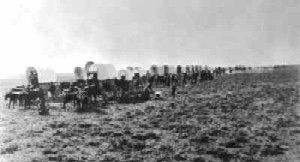
Wagon Train.
On the return trip to Independence, Missouri, in May 1843, Whitman intercepted a huge wagon train of about 1,000 emigrants, the largest wagon train to that time on the Oregon Trail. As the expedition’s physician and part-time guide, he accompanied it to his mission. The members rested and replenished their supplies there, as had another expedition the previous year. From then on, Waiilatpu was a significant way station on the trail. Even though the main trail soon bypassed it, sick and destitute emigrants headed there and received kind and generous treatment.
After Whitman’s return to Waiilatpu in 1843, relations among the missionaries improved somewhat. Those between the Indians and the missionaries, however, further deteriorated. The increasing number of emigrants frightened the Cayuse, who were aware that they were taking over Indian lands elsewhere and were bringing measles epidemics that decimated entire tribes. Whitman also devoted more and more time to caring for emigrants and less to them. As a result, the Native Americans were rapidly losing faith in the missionaries. Their growing resentment was heightened in the autumn of 1847 when a measles epidemic spread from the wagon trains to their villages and, within two months, killed about half of them. Because Whitman could not check the epidemic, some of the Indians came to believe he was poisoning them to make way for settlers.
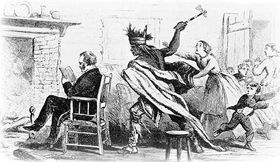
Whitman Massacre.
On November 29, 1847, a small group of Cayuse assaulted the mission, sheltering 74 people, most of whom were emigrants. The attackers killed 13 people, including Marcus and Narcissa Whitman. A few of the survivors escaped. The Indians captured 49 people, mostly women and children. Two of the young girls died, and Peter Skene Ogden, a Hudson’s Bay Company official, ransomed the rest the next month. The massacre, which set off the Cayuse War (1848), temporarily ended Protestant missionary efforts in Oregon country. In 1848, emissaries of Oregon’s provisional legislature, seeking Territorial status, carried news of the tragedy and petitions to Washington, D.C. Congress reacted by creating the Oregon Territory, the first one west of the Rockies.
The Oregon Militia responded to the Whitman Massacre in what would become known as the Cayuse War, resulting in several battles over the next seven years.
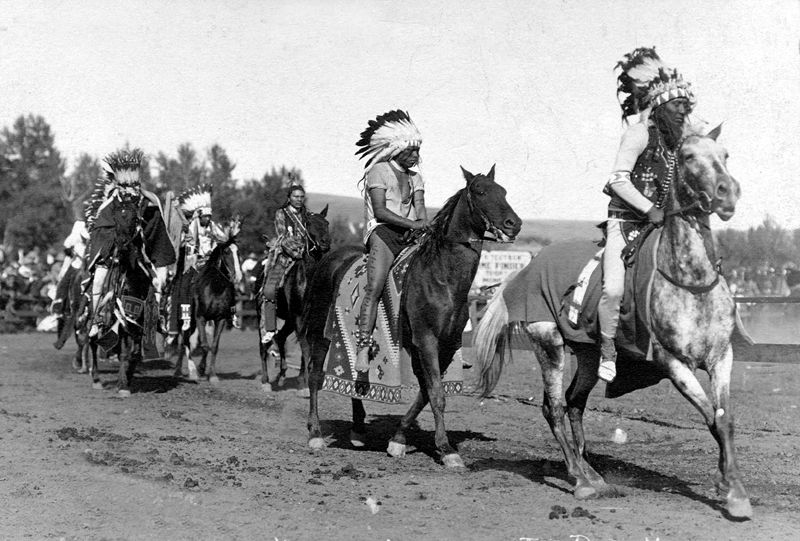
Cayuse Indian Warriors by W.S. Bowman, 1910.
In March 1850, the Cayuse were persuaded to surrender five men named Tiloukaikt, Tomahas, Klokamas, Isaiachalkis, and Kimasumpkin. The U.S. Cavalry then brought the five accused murderers 250 miles from their homelands to Oregon City, the capital seat of Oregon Territory. Court proceedings began on May 21, 1850, and the Cayuse men were provided with interpreters and lawyers. After the indictment was read, the men pleaded not guilty. The trial began two days later, on May 23, and was over the next day. After the jury deliberated for 75 minutes, all five men were found guilty and sentenced to hang. The execution was carried out on June 3, 1850, before a large crowd of Oregon City spectators. They were buried on the outskirts of Oregon City in unmarked graves.
Whitman Mission National Historic Site preserves the ruins of the mission buildings’ foundations and the restored irrigation ditch, millpond, and orchard. The Great Grave contains the remains of the 1847 massacre victims. A marble slab, placed over the grave in 1897 to commemorate the 50th anniversary of the massacre, is inscribed with their names. On a nearby hill stands a 27-foot-high memorial shaft, dedicated in 1897. The visitor center houses artifacts uncovered by archeologists and interprets the history of the mission and missionary efforts in the Oregon Country.
The mission is located about seven miles west of Walla Walla, Washington, on a short connecting road leading south from U.S. 12.
Contact Information:
Whitman Mission National Historic Site
328 Whitman Mission Road
Walla Walla, Washington 99362
509-529-2761
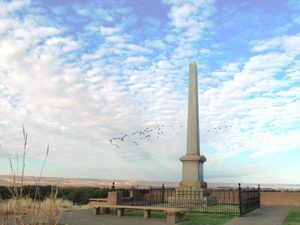
Whitman Monument near Walla Walla, Washington, by the National Park Service.
©Kathy Alexander/Legends of America, updated April 2026.
Also See:
Cayuse Tribe of Washington and Oregon
Dr. Marcus Whitman – Missionary to the Cayuse
Washington Conflicts, Battles & Wars
Source: National Park Service