
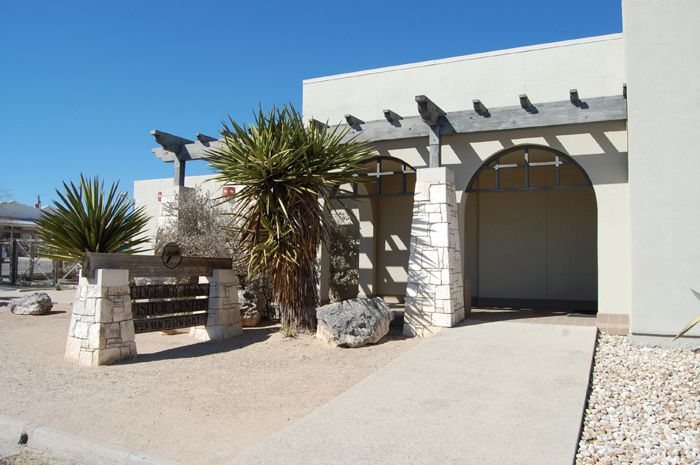
Judge Roy Bean Visitor Center in Langtry, Texas, by Kathy Alexander.
Along with several other old towns in the region, the ghost town of Langtry, Texas, got its start when the Galveston, Harrisburg, & San Antonio Railroad was built through the area in 1881. Originally a grading camp for railroad workers, it was first called Eagle Nest after the nearby creek.
Eagle Nest Creek was named for a landmark that travelers and settlers had noted for over two centuries. High atop Eagle Nest Canyon is an inaccessible but highly visible limestone cavern just East of where Langtry sits today. For years, a pair of golden eagles built a nest here, from which the canyon, creek, and railroad camp took their names.
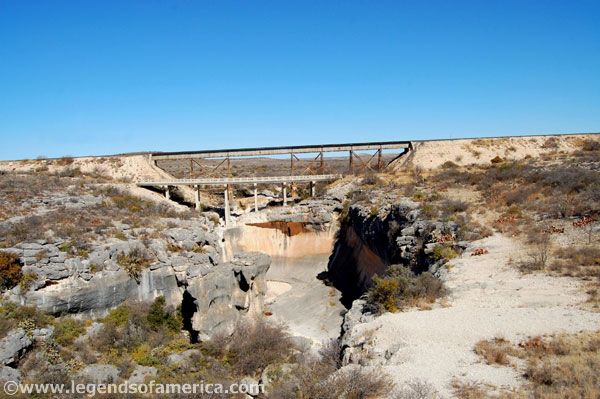
The railroad bridge and an old highway bridge over Eagle Nest Canyon, Kathy Alexander.
Down in the canyon was an old crossing used by Indian tribes, ranchers, soldiers, and Texas Rangers for years. Here, the railroad built another high bridge, but not nearly so high as the one over the Pecos River to the South.
The town grew due to the efforts of the Torres family, who owned the land where the town was laid out and provided water for the steam locomotives. Its name was changed in honor of George Langtry, an engineer and foreman who had supervised a Chinese work crew building the railroad.
On July 5, 1882, Texas Ranger Captain T. L. Oglesby penned a note to his commanding officer, General King, describing the area:
Eagle Nest, Pecos County, Texas, July 5, 1882
“Upon my arrival here on June 29, I proceeded to visit all the railroad camps and scout the country thoroughly. There is the worst lot of roughs, gamblers, robbers, and pick-pockets collected here I ever saw, and without the immediate presence of the state troops, this class would prove a great detriment towards the completion of the road. There is nothing for Rangers to do but hold this rough element in subjection and control them. The majority of the railroad camps are in Pecos County. This immediate section being 200 miles from Fort Stockton, the nearest jurisdiction Court of Justice, and the consequent minor offenses go unpunished; but, I hope to remedy that in a few days by having a Magistrate appointed for the precinct.”
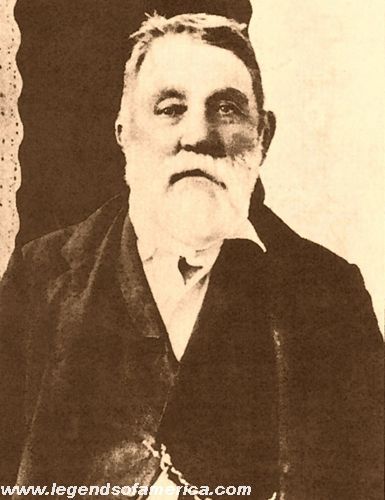
Judge Roy Bean
When it became known that a Justice of the Peace was needed for the area, Roy Bean was quick to volunteer, and on August 2, 1882, he became the “legal authority” there. He first operated his “justice” out of his tent saloon in Vinegarroon, another railroad camp to the South.
There, he quickly set up another tent saloon on railroad land, to the chagrin of Cezario Torres, who owned most of the land beside the railroad right-of-way.
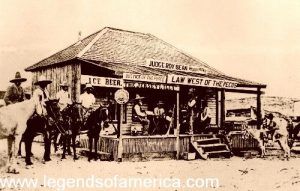
Judge Roy Bean’s Jersey Lilly Saloon and Courtroom in Langtry, Texas
By 1883, he had built a wooden structure for his saloon, called the “Jersey Lilly,” after the well-known British stage actress Lillie Langtry. Her real last name was Emilie Le Breton, and she was not related to George Langtry. Bean used the saloon as his headquarters and courtroom, calling himself the “Law West of the Pecos.”
Cezario Torres, one of the original commissioners of what was then Pecos County, unsuccessfully attempted to exclude Bean, sparking a long-running rivalry between Bean and Torres’s son, Jesús. Despite the Torres family’s objections, Bean’s establishment was an immediate success, and though his actions as a judge were often eccentric, they were generally sound for the frontier town.
Because Langtry had no jail, all cases were settled by fines, most of which were typically the amount the accused had on their person. Of the fines collected, Bean was never known to have sent any money to the state but, instead, pocketed the cash.
Though later portrayed in Western films and books as a “hanging judge,” Bean only sentenced two men to hang, one of whom escaped. And, in fact, when it came to horse thieves, who were often sentenced to hang, they would be let go under Judge Roy Bean if they returned the horses and, of course, paid a fine. The so-called “hanging tree” was generally used as a post to which the prisoners were shackled. Bean also made money by granting divorces, which he lacked the jurisdiction to do, and married numerous couples, always concluding the wedding ceremonies with the words, “and may God have mercy on your souls.”
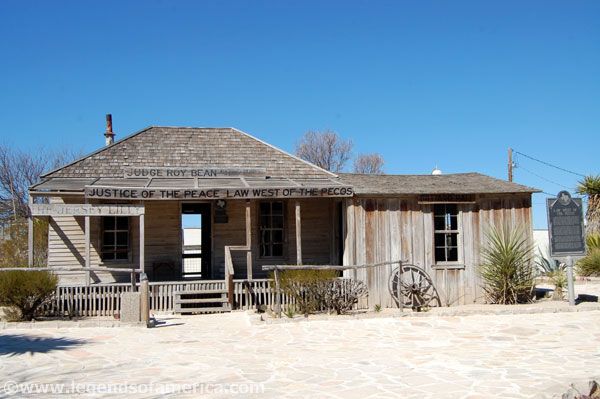
Judge Roy Bean’s Jersey Lilly Saloon, in Langtry, Texas, by Kathy Alexander.
After the East and West sections of the railroad joined in January 1883, the depot kept business brisk by supplying a steady flow of customers to local saloons and serving as a shipping point for agricultural products and supplies. In 1884, the town gained a post office, and it soon began to grow; however, most of the population was still living in tents.
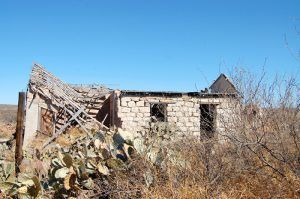
A collapsed stone building in Langtry, Texas, by Kathy Alexander.
By 1892, the town supported a general store operated by W.H. Dodd, another saloon operated by the Torres family, and a population of about 150 people.
Judge Roy Bean was defeated in the 1886 election, but the following year, a new precinct was created after Langtry became part of Val Verde County, and he was appointed again as the justice of the peace for the new precinct.
He was reelected until 1896, when he was finally defeated. However, in typical “Bean” fashion, he refused to surrender his seal and law book and continued to try all cases North of the railroad tracks.
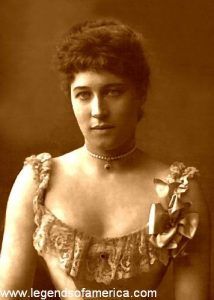
Lillie Langtry
In 1896, Judge Roy Bean made national headlines by setting up a boxing match in Langtry. Because Texas had outlawed boxing, he scheduled the heavyweight fight between Robert James Fitzsimmons and Peter Maher on a sandbar on Mexico’s side of the Rio Grande, just South of Langtry. Bean then arranged for the press, spectators, and Texas Rangers to travel by train from El Paso to Langtry. Fitzsimmons knocked Maher out in 95 seconds, winning the heavyweight title.
For years, he boasted of his “acquaintance with Miss Langtry,” telling anyone and everyone that he would one day meet her. When he built a home for himself behind the saloon, he even called it the “Opera House” in anticipation of a visit by the famous actress. Although he never met Lillie Langtry, he often wrote to her, and she allegedly replied, sending him two pistols that he cherished for the rest of his life. He also claimed credit for naming the town after her, even though it was not the case.
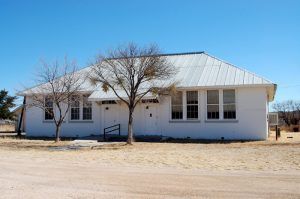
An old school in Langtry, Texas, by Kathy Alexander.
By the turn of the Century, Langtry had become the commercial center for ranching in the area, with a population of several hundred, a school, and permanent structures rather than tents.
In the meantime, Roy Bean was aging and spent most of his time on his porch, drinking and boasting, a shotgun in his arms. However, he was also known to help people experiencing poverty in the area. After a heavy bout of drinking, Bean died in his saloon on March 16, 1903, of lung and heart ailments without meeting his fantasy woman, Lillie Langtry. He was initially buried in Westlawn Cemetery in Del Rio, Texas. Still, due to the numerous visitors to his grave, he and his son, Samuel, were later re-interred behind the Whitehead Memorial Museum.
Almost a year after his death, Lillie Langtry finally visited his old home. En route from New Orleans to Los Angeles, she stopped to listen to the townspeople tell the stories of Judge Roy Bean. Of the visit, she would later write, “It was a short visit, but an unforgettable one.”

An old tourist court in Langtry, Texas, by Kathy Alexander.
At about the same time, the small community began to decline dramatically after the highway was slightly shifted northward for a more direct route. It declined even further in 1926, when the railroad moved the tracks, depot, and water tank half a mile away. By that time, the town boasted only about 50 people.
In 1939, the Texas Highway Department restored Bean’s old saloon courtroom, and by 1945, the town would be home to about 100 people. Today, his home and saloon are part of a museum and Visitor Center. With just a few operating businesses in the tiny town of Langtry today, it appears mainly like a ghost town. Although it is said to have a population of over 100 today, most residents must live on nearby ranches, as the town boasts only a few homes. Its post office is still open; however, it also has a dairy bar and a convenience store. Many area buildings are rapidly deteriorating.
Just to the West of town is the old cemetery, which, unfortunately, is in even worse condition.
Thousands of tourists, however, continue to stop at the Judge Roy Bean Visitor Center each year. A trip to this small town is well worth the stop to see the old saloon, learn about the area’s history, and take in the breathtaking view of the Rio Grande and Mexico just across the way.
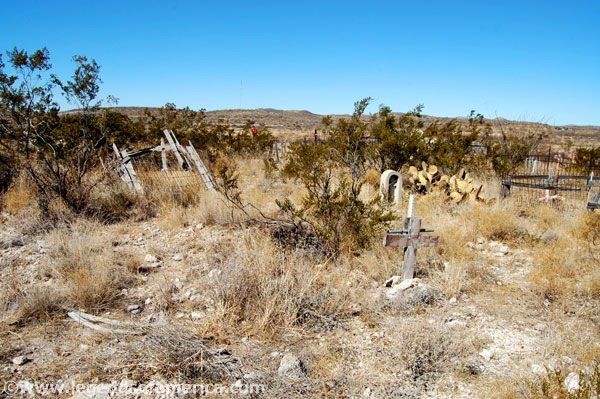
The Langtry Cemetery by Kathy Alexander.
Langtry is located on Loop 25 off U.S. Highway 90 just North of the Rio Grande and eight miles West of the Pecos River near the southwestern corner of Val Verde County.
©Kathy Alexander/Legends of America, updated August 2026.
See our Langtry Photo Gallery HERE.
Also See:
Judge Roy Bean – The Law West of the Pecos
Del Rio to Sanderson on the Pecos Trail
See Sources.