
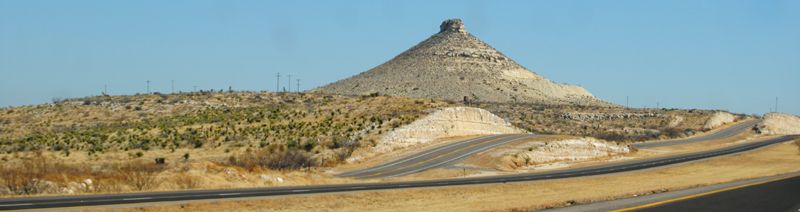
Fort Stockton, Texas Area Landscape by Kathy Alexander.
Before the military post of Fort Stockton was established, Comanche Springs, the source of Comanche Creek, had long provided water for Native Americans. It was first documented in 1849 when U.S. Army Captain William Henry Chase Whiting, leading a reconnaissance party, reached the springs and found it to be an Indian campground on the Comanche Trail to Chihuahua, Mexico.
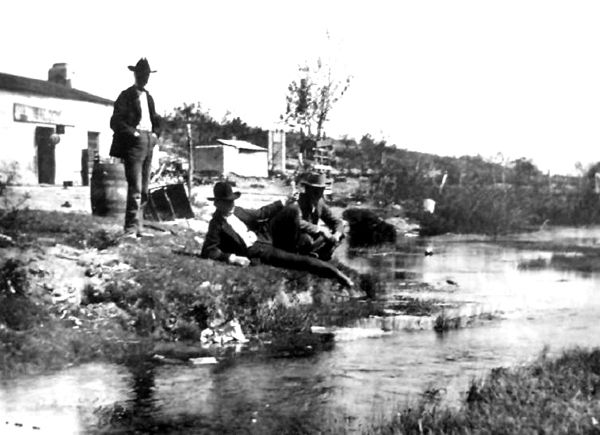
Comanche Springs.
When the U.S. Army wanted to establish a fort in the area, Comanche Springs provided an ideal site for its abundant water. First called Camp Stockton, the post was established in 1859 to protect travelers along thearea’sa trails, including the Comanche Trail, San Antonio-El Paso Road, the Butterfield Overland Mail Route, and the San Antonio-Chihuahua freight-wagon road.
The post was named for Robert Field Stockton, a United States naval commodore known for capturing California during the Mexican-American War. The camp was first built by troops of the 1st and 8th Infantry at a site Southwest of the present location, near Fort Stockton’s present Courthouse. When it was complete, Company H of the First U.S. Infantry first garrisoned it.
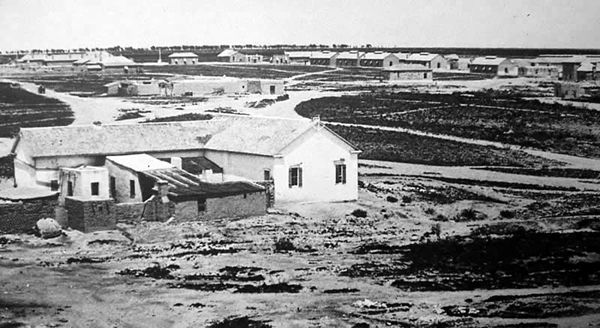
Fort Stockton,1884.
When the Civil War broke out, U.S. troops were withdrawn from the post, and Confederates briefly occupied it until they also withdrew. By the end of the Civil War, little remained of the first post. In July 1867, Colonel Edward Hatch, Commander of the 9th Cavalry, re-established Fort Stockton at its present location, about ½ mile northeast of the former camp. The new fort, designed to be much larger and stand more permanently, was re-established by four Companies of the 9th U.S. Cavalry Regiment, known as Buffalo Soldiers.
Encompassing 960 acres of leased property, the troops constructed about 35 buildings, the first being a guardhouse completed in 1868. Two buildings were built of limestone, while the rest were built of adobe.
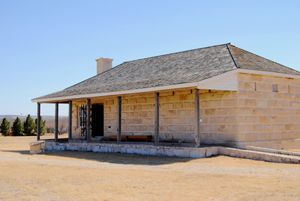
Fort Stockton Guardhouse by Kathy Alexander.
When the 9th Cavalry moved to New Mexico in 1875, Colonel Benjamin Grierson’s 10th Cavalry took over the duty of protecting westward migration and trade routes. Between 1867 and 1886, 87% of the soldiers garrisoned at Fort Stockton were Buffalo Soldiers, who endured harsh living conditions, low pay, and racial prejudice while also earning a reputation for tenacity and bravery and playing a significant role in the settlement and development of America’s western frontier. The fort also provided employment and revenue for freighters, laborers, farmers, stockmen, and merchants during this period.
The settlement that grew up around the fort would eventually take on the name Fort Stockton, but not at first. As the new post was being built, several settlers came to the area. Still, the enterprise wouldn’t begin to grow until several San Antonio entrepreneurs were convinced that water from Comanche Springs, nearby Leon Springs, and the Pecos River could be used for irrigation. The investors purchased large tracts of land for agricultural development, and in 1868, another investor, Peter Gallagher, bought the land on which Fort Stockton and Comanche Springs were located. Gallagher then platted 160 acres for a townsite that he named Saint Gaul. He also established two stores at Comanche Springs and purchased more property along Comanche Creek.

A.J. Royal.
By 1870, the area population was about 420 residents, most of whom had come from San Antonio. At this time, farmers used water from the Pecos River for irrigation, and about 7,000 acres were used for farming. When Pecos County was organized the following year, Saint Gaul became the county seat. By 1875, about 1,100 people were living in the county. Residents never liked the name Saint Gaul, and on August 13, 1881, it was officially changed to Fort Stockton.
After the threat of Indian attacks was over, the military post of Fort Stockton was closed on June 30, 1886, and left abandoned. The fort’s closure and its bypass by both the Texas and Pacific and the Southern Pacific Railroads caused an immediate slump in the area, resulting in lost trade and employment.
The city of Fort Stockton, like other frontier towns in Texas, was not immune to violence. In 1889, a newcomer who would make a name for himself over the next several years arrived. Most often called A.J., Andrew Jackson Royal moved his family to Pecos County after he was reportedly accused of murder in Junction, Texas. Establishing a ranch and running the Gray Mule Saloon, Royal was said to have killed one of his employees after getting into a dispute.
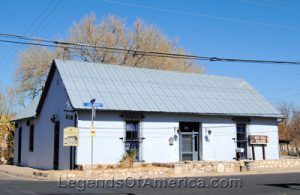
A.J. Royal once ran the Gray Mule Saloon, which still stands in Fort Stockton today. Photo by Kathy Alexander.
Despite a reputation as a quick-tempered, quarrelsome, and intimidating man, he was elected as Pecos County Sheriff in 1892. During his two-year tenure, Royal, along with the infamous deputy, Barney Riggs, aggressively intimidated community citizens. As his re-election neared in the fall of 1894, an all-out war nearly broke out between political rivals. Royal lost re-election in October and was assassinated a few weeks later. However, his deputy, Riggs, stayed in the area, killing two men in Pecos in 1896, before he, in turn, was killed by a family member in 1902.
However, by the turn of the century, the town had largely settled down, and the population was increasing because of cattle and sheep ranching. In 1926, the opening of the nearby Yates Oil Field brought on an economic boom ftoFort Stockton and several area towns.
The Works Progress Administration (WPA) constructed a county bathhouse, a swimming pool, and a pavilion at Comanche Springs in 1936. However, by 1861, the springs had ceased flowing due to irrigation, and numerous wells had been dug in the area. Today, the spring flows only intermittently. A historical marker designates the site. The park is located Southwest of the historic fort.
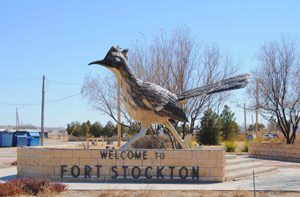
Paisano Pete welcomes you to Fort Stockton.
Tourism and petroleum and natural gas discoveries helped the area’s economy in the 1950s and 1960s. In 1952, the county’s largest gas field opened on the M.C. Puckett and Son Ranch, South of Fort Stockton. Tourism grew in 1956 when U.S. 290 linked Fort Stockton to Big Bend National Park.
In the 1980s, Pecos County’s economy still relied on farming, ranching, oil and gas production, and tourism, and the town was home to almost 9,000 people.
Today, Fort Stockton remains the county seat of Pecos County, though its population has dropped to about 7,800 because of the decline in oil production.
Only four of the original buildings remain at the historic fort, including three of the eight Officers’ Quarters and the guardhouse. However, several other buildings have been rebuilt, and the site also includes enlisted men’s barracks, officers’ row, and a museum and visitor’s center. Listed on the National Register of Historic Sites, the fort is located on the East side of town at 301 East 3rd Street.
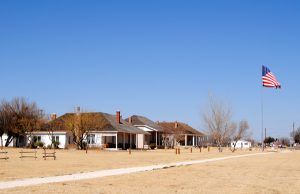
Officers Row, Fort Stockton by Kathy Alexander.
The city has several historic sites. A driving tour guides visitors to 16 points of interest, including the Historic District; the Annie Riggs Museum, housed in a turn-of-the-century adobe hotel; the 1912 Pecos County Courthouse; the 1883 Jail; the old fort cemetery; and more. Be sure to stop at the world’s largest roadrunner—Paisano Pete, a 22-foot-long statue on Main Street—for a great photo opportunity.
More Information:
Fort Stockton Chamber of Commerce
1000 Railroad Avenue
P O Box C
Fort Stockton, Texas 79735
800-336-2166
Historic Fort Stockton
300 East Third Street
Fort Stockton, Texas 79735
432-336-2400
©Kathy Alexander/Legends of America, updated September 2026.
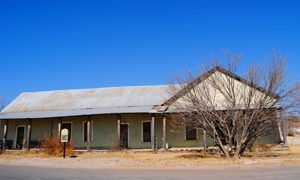
Young’s Store, Fort Stockton. Photo by Kathy Alexander.
Also See:
A.J. Royal – One Bad Pecos County Sheriff
See Sources.