
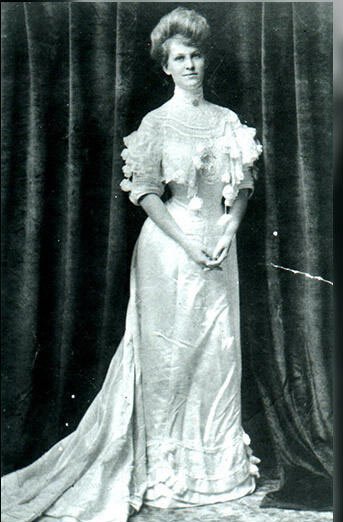
Alleged Lavinia Fisher Portrait.
Legend has held that the first widely recognized female serial killer in the United States was Lavinia Fisher. She was born in 1793, but her birth location, maiden name, or any information about her childhood is unknown. Historical records do not agree with all of the legends, but Fisher was hanged for her crimes.
The Legend:
Lavinia grew up to marry John Fisher, and the couple lived near Charleston, South Carolina. The pair made their living operating a hotel called the Six Mile Wayfarer House, which they managed in the early 1800s. Mysteriously, men who were visiting Charleston began to disappear. As more and more reports were filed with the authorities regarding these missing men, it was determined that they were last seen at the Six Mile Wayfarer House, which was called such because it was six miles outside of Charleston.
Though the local authorities began an investigation, there was no evidence that the Fishers were involved. This, coupled with their popularity in the town, led to the investigation being dropped.
Lavinia was a beautiful and charming woman, adding to her popularity in the community and the hotel’s business. However, it would later be learned that she utilized those characteristics to help her husband rob and kill many male travelers. And, as more and more men went missing, the rumor mill began to do its work.
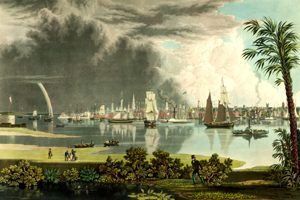
Charleston, South Carolina.
The locals soon gathered a group of vigilantes who went to the Fishers in February 1819 to stop the activities. Although it is unknown what they may have said or done, they were satisfied with their task and returned to Charleston, leaving one man, David Ross, to stand watch in the area.
Early the following day, David Ross was attacked by two men and dragged before a group of men along with Lavinia Fisher. He looked to her for help, but she choked him and smashed his head through a window. Somehow, Ross escaped and alerted authorities.
At nearly the same time, John Peeples traveled from Georgia to Charleston and, tired from his long trip, stopped at The Six Mile House to see if they had a room. He was warmly greeted by the beautiful Lavinia, who informed him they didn’t have a room available but invited him in for tea and a meal.
Her company was so pleasant that he ignored Lavinia’s husband’s odd glances at him and chatted with her, answering her every question. When she excused herself from the table momentarily, she returned with tea and good news. A room had suddenly become available if John still wanted it. He accepted, and Lavinia poured him a cup of tea.
John didn’t like tea but didn’t want to seem impolite. So, instead of refusing it or leaving it untouched, he poured it out when she wasn’t looking. Afterward, she showed him to his room. He then began to wonder why she had asked him so many questions. Why was her husband staring at him all evening?
Suddenly, he felt uncomfortable with all the information he had provided and worried he might become a robbery target. Feeling safer in the chair by the door than in the bed, he dozed until a loud noise awakened him. Looking around, he realized that the bed he should have been sleeping in had disappeared into a deep hole beneath the floor. John quickly jumped out the window, got on his horse, and fled to the authorities in Charleston.
Police then arrested John and Lavinia Fisher and two men with whom they had been operating.
The Six Mile Wayfarer House was thoroughly searched, and the grounds were dug up. Filled with hidden passages, the Sheriff reportedly found items that could be traced to dozens of travelers, a tea laced with an herb that could put someone to sleep for hours, a mechanism that could be triggered to open the floorboards beneath the bed, and in the basement, as many as a hundred sets of remains.
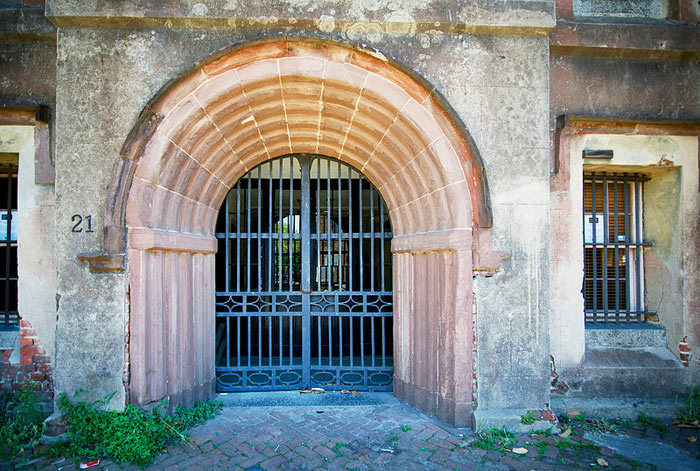
A portion of the Old Charleston Jail in Charleston, South Carolina. The jail, which was operational from 1802 until 1939, housed Charleston’s most infamous criminals. Photo by Carol Highsmith, 2017.
The Fishers pleaded not guilty but were ordered to stay in jail until their trial. In the meantime, their co-conspirators were released on bail. At their trial in May, the jury didn’t agree with their innocent plea, found them guilty of multiple robberies and murders, and sentenced them to hang. However, they were given time to appeal the conviction.
During the wait, they made a plan to escape. Housed together in a jail that was not heavily guarded, they began making a rope from jail linens. On September 13, they put their plan in place and used the rope to drop to the ground. John made it out, but the rope broke, leaving Lavinia trapped in the cell. Not willing to go without his wife, he returned to the jail, and the two were afterward kept under much tighter security.
In February 1820, the Constitutional Court rejected their appeal, and their execution was scheduled for later that month.
A local minister, Reverend Richard Furman, was sent in to counsel the pair if they wished. John freely talked to Furman and is said to have begged the priest to save his soul, if not his life. However, the cruel Lavinia would have nothing to do with him.
On the morning of February 18, 1820, the Fishers were taken from the Charleston Jail to be hanged on the gallows behind the building. John Fisher quietly prayed with the minister, whom he had asked to read a letter. Before a crowd of some 2,000 people, the letter insisted on his innocence and asked for mercy for those who had done him wrong in the judicial process. He then began to verbally plead his case before the crowd, but he asked for their forgiveness before being hanged.
Lavinia did not go so quietly. She had requested to wear her wedding dress and, refusing to walk to the gallows, had to be picked up and carried as she ranted and raved. Before the crowd, she screamed pointedly at the Charleston socialites, whom she blamed for encouraging a conviction. Before her executioners could tighten the noose around her neck, she yelled into the crowd, “If you have a message you want to send to hell, give it to me – I’ll carry it.” Then, before they could finish the job, she jumped off the scaffold herself. Not quite reaching the ground, she dangled down into the crowd. Later, onlookers would say they had never seen such a wicked stare or chilling sneer as on 27-year-old Lavinia’s face.
Though many sources say that the Fishers were buried in the Unitarian Church Graveyard between King and Archdale Streets in Charleston, this is highly unlikely. There was a Potter’s Field Cemetery next to the jail at the time, where most criminals were buried if family members didn’t claim their bodies. Additionally, church records have been searched, and there is no evidence that she was buried there. Tour guides have likely perpetuated this tale.
Beyond the Legend
Historical records do not indicate that hundreds of remains were found in Fisher’s basement. A couple of bodies were dug up on the property, but nothing to tie them to the Fishers for sure, and, according to records, they were never charged with murder. So, while Fisher is claimed to be the first female serial killer in the United States, that distinction likely belongs to Jane Toppan, who confessed to 31 murders in 1901 and was found not guilty because of insanity. One thing the records do agree on is the fact that they robbed many travelers, and highway robbery was still a hanging offense. Also called into question is whether Lavinia wore her wedding dress to her execution or whether she jumped from the scaffold herself. Sometimes, the legend is more fun to tell, and this one has lived on for a while in Charleston lore.
The Charleston Courier published this article on February 22, 1819, about Fisher’s arrest.
“In Saturday’s Courier, we gave some particulars of the conduct of a set of outlaws, who have for a long time past infested the road in the vicinity of this city and whose outrageous conduct had of late become insupportable. We then stated that the occupants of a small house five miles from town had been driven out, and the building burnt to the ground, and that certain others, in possession of a house one mile above, had been compelled to leave it, and another person put in possession of it by the owner. It now appears that as soon as the citizens had returned to town, the persons who had been thus compelled to leave the last-mentioned house returned to it in the evening and beat the person who had been put in possession most inhumanly when he escaped into the woods and made the best of his way to town. The next morning, the same gang stopped a traveler up the road, beat him cruelly, cut his head in several places, and then robbed him of about 30 or 40 in money. These circumstances being made known to the civil authority, the Sheriff of this District collected a posse of citizens and proceeded on Saturday afternoon to the spot, surrounded the house, and seized upon its occupants [three men and two women], after which they burnt the house and outbuildings to the ground, without allowing the occupants to removed an article of its contents; brought the offenders to town, and committed them to jail. The posse found in an outhouse the hide of a cow, which had been recently killed and which was identified as the property of one of our citizens. She had been missing for several days. This accounts for the manner in which the cows are disposed of, which are so frequently stolen and never afterward heard of. The inmates of the house were armed with 10 or 12 muskets and a keg of powder, but the force that went against them was too imposing to admit any chance of success in a resort to arms. One of the leaders in these high-handed depredations was arrested in town on Saturday afternoon and likewise committed to jail. We trust that these decisive steps will restore quiet to the neighborhood and enable our country’s brethren to enter and leave the city without the fear of insult or robbery.
The following is the correct list of gang members who were apprehended and committed to prison on Saturday night. John Fisher, Lavina Fisher, his wife, Wm. Heyward, James M’Elway, Jane Howard, and Seth Young. It is supposed there are more of them lurking about, and it is hoped the vigilance of the police and citizens will ferret them out and bring them to justice.
We are informed and requested to state that Mr. John People, who was robbed and unmercifully beaten by the villains mentioned above, is an honest, industrious young man from the country and had a sum of money entrusted to his care, which the robbers took from him.”
The Ghost of Lavinia Fisher
Ghost of Lavina Fisher
It should come as no surprise that, with a terrible story such as this, the ghost of Lavinia is said to still roam in Charleston. Almost immediately following her death, locals began to report seeing her face floating behind the window bars where she was held. Then, after the Great Earthquake of 1886, people began to report her wandering around in other parts of the neighborhood and the Unitarian Cemetery just a few blocks away.
The Old Jail building served as the Charleston County Jail from its construction in 1802 until 1939. Way back in 1680, when the city of Charleston was being laid out, a four-acre square of land was set aside at this location for public use. In time, a hospital, a poor house, a workhouse for runaway slaves, and a jail were built on the square.
The first structures were erected on the site in 1738 when the property was used as a workhouse for runaway slaves and a makeshift hospital for “paupers, vagrants, and beggars.” Criminals were also housed here before the Old Jail building was erected, though they were kept separate from non-offenders. Punishments and executions also took place at this location. Criminals faced whippings, brandings, torture, and food and water deprivation. For horse thieves, their ears were sometimes nailed to a post before finally being sliced off altogether. The worst offenders might be burned at the stake, hanged, or drawn and quartered. Over the years, numerous structures were built, demolished, and rebuilt.
The Jail was constructed in 1802; it consisted of four stories, topped with a two-story octagonal tower. Later changes to the building included an octagonal rear wing, expansions to the main building, and Romanesque Revival details. Unfortunately, the 1886 earthquake badly damaged the tower and the top story of the main building, and these were removed.
In the 137 years that the building was in operation, it served as a jail and an asylum, housing many inmates, including John and Lavinia Fisher. In the early part of the 1800s, numerous high-sea pirates were jailed here, and after Denmark Vesey’s planned slave revolt in 1822, hundreds were incarcerated, awaiting their trials. Vesey, a freed slave, planned an insurrection that called for free blacks to assist hundreds of slaves in killing their owners and temporarily seizing the city of Charleston before sailing away to Haiti. However, the plot was leaked, and hundreds of blacks were arrested in the conspiracy. In total, 67 men were convicted and 35 hanged, including Denmark Vesey. Increased restrictions were afterward placed on slaves and free blacks, including a law that all black seamen be kept at the jail while in port. Both Confederate and Federal prisoners of war were incarcerated during the Civil War.
Though the jail was intended to hold around 128 prisoners, over the years, as many as 300 people were often incarcerated at one time. In some rooms, prisoners were locked in cages barely the size of a person’s body. Disease, torture, and violence within the walls of this historic building were rampant, and an estimated 10,000 people died on the property during its operation. The jail was finally closed in 1939, and it sat abandoned for the next 61 years. However, in 2000, the American College of the Building Arts acquired the Old City Jail building and immediately established a stabilization program. Today, the Old City Jail is an official “Save America’s Treasures” project of the National Trust for Historic Preservation, and efforts to restore and maintain the building are ongoing.
Reports of strange occurrences began with the restoration efforts in 2000. One of the first reports was workers finding footprints in the dust after the building had been locked off for months due to lead paint contamination. More and more anomalies occurred as preservation continued, and the building was opened for tours.
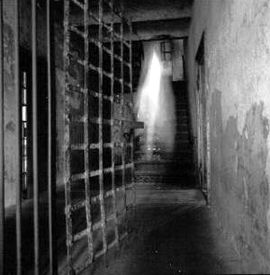 Several apparitions have been reported, including several workers who saw the ghost of a jailer with a rifle on the third floor. The phantom was said to have passed through the bars heading toward them before it vanished. Others have reported seeing a black man in ragged clothing wandering in the halls. Thought to be the spirit of a former slave, the man is seemingly unaware of the living or his surroundings. But, the Old Jail’s most famous ghost is that of the cruel killer, Lavinia Fisher. Several who have visited the historic building often claim to have seen the woman in her wedding dress, describing it as bright red and white.
Strange sounds are heard throughout the building, including the hum of a dumbwaiter moving through the floors, even though it hasn’t been operational in years. Alarms are said to go on and off randomly.
For others, their experiences have been physical. Visitors and employees alike have complained of a choking feeling and shortness of breath while on the main staircase. Others report being grabbed, pushed, touched, and scratched by unseen forces. A tour guide tells a story of feeling a rope wrap around her ankle, and a man in the basement had his sunglasses knocked off by a violent, unseen force.
Other strange happenings are also allegedly reported, such as terrible odors so bad that people feel ill. Others report feelings of being watched. Even though the basement may be pretty warm, visitors have seen their breath form a cloud of fog. Doors are found open after being closed.
Access to the jail is limited and most easily accessed through various ghost tour companies in Charleston. The Old City Jail is located at 21 Magazine & 17 Franklin Streets.
There are several tales that Lavinia also haunts the Unitarian Cemetery, where some sources say she was buried. This, however, is very unlikely as there was a Potter’s Field Cemetery next to the jail at the time, where most criminals were buried if family members didn’t claim their bodies. Additionally, church records have been searched, and there is no evidence that she was buried there. Tour guides have likely perpetuated this tale.
Update September 2012: The television show Ghost Hunters’ season premiere featured a visit to the old Charleston Jail. A skeptical camera operator experienced the scratches firsthand, which were visible on camera.
©Kathy Alexander/Legends of America, updated March 2026.
Also See:
The Vicious Harpes – First American Serial Killers
The Bloody Benders – Serial Killers of Kansas
Charles Kennedy – Old West Serial Killer
H.H. Holmes and the Murder Castle of Chicago
See Sources.