
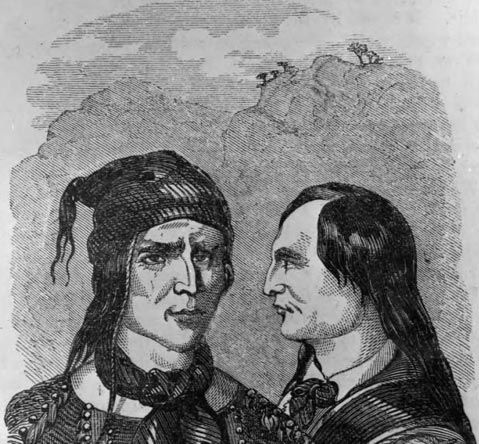
Drawing of Walkara and his Brother from an 1855 book.
Chief Walkara, also known as Walker, was born around 1808 along the Spanish Fork River in Utah, one of five sons of a chief of the Timpanogo band of Ute Indians. Described as over six feet tall and extremely strong, he was a successful warrior from a young age. His piercing eyes earned him the nickname “Hawk of the Mountains.”
While he was a young man, the Spanish did everything they could to keep the Indians in check by promoting raids and violence between the tribes.
With language skills that included Spanish, English, and several native tongues, he became a skilled negotiator. Known for his marksmanship, discipline, and bravery, he quickly became a leader, gathering a raiding band of warriors from the Great Basin tribes, including Ute, Paiute, and Shoshone.
He attacked ranches and travelers along the Old Spanish Trail between New Mexico and California, and other tribes feared his reputation so much that they paid him tribute for protection and assistance.
Often wearing yellow face paint, he became known as a great horse thief, stealing about 3,000 horses in southern California in the 1840s. Mountain men James Beckwourth and Thomas “Pegleg” Smith traded with Walkara, providing the band whiskey in return for horses.
In 1845, Justice of the Peace and Assistant for Indian Affairs in Riverside County, California, Benjamin Davis Wilson, ordered that Walkara and his marauders be tracked down and brought to justice, but he had no success.
By the time the Mormons began to settle in central Utah, Walkara had become the chief of his Ute band, who were, at first, helpful and cooperative with the Mormons.
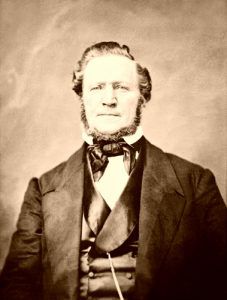
Brigham Young.
However, when the Mormons began to attempt to suppress the New Mexican trade, tensions developed with the Ute, who had long depended on the trade, especially that of native slaves, to which the Mormons strongly objected. Brigham Young negotiated a trading relationship with Chief Walkara in 1850, but the colonists began interfering in many Ute transactions. At the same time, the area was being traveled more and more by non-Mormon trading expeditions and settlers, and in a few isolated instances, some Ute Indians were killed. These tensions soon led to the Walker War, where Walkara led several Ute raids against the Mormon outposts.
The Walker War ended through negotiations between Brigham Young and Walkara during the Winter of 1853. Casualties during the war equaled about 12 white settlers and an estimated equal number of Indians. Some of those come in the most cited incident, the Fountain Green Massacre, when, on October 1, 1853, members of the Ute tribe killed four men encamped at Uinta Springs. Eight Utes were murdered in Nephi, Utah, in revenge for the massacre. The following summer, after the conflict ended, about 120 of Walkara’s tribe were baptized as Mormons.
Although immediate hostilities ended between the Mormons and the Ute, the underlying conflicts were not resolved, and isolated incidents of violence continued until Walkara died in 1855 at Meadow Creek, Utah.
©Kathy Alexander/Legends of America, updated September 2026.
Also See:
Indian Wars, Battles & Massacres
See Sources.