

Chief Red Cloud, 1900.
By Charles A. Eastman (Ohiyesa)
“Look at me. I was a warrior on this land where the sun rises; now, I come from where the sun sets. Whose voice was first surrounded on this land – the red people with bows and arrows. The Great Father says he is good and kind to us. I can’t see it…
— Red Cloud
Every age, every race, has its leaders and heroes. There were over 60 distinct tribes of Indians on this continent, each of which boasted its notable men. The names and deeds of some of these men will live in American history, yet in the true sense, they are unknown because they are misunderstood. I should like to present some of the greatest chiefs of modern times in the light of the native character and ideals, believing that the American people will gladly do them tardy justice.
It is a matter of history that the Sioux nation, to which I belong, was originally friendly to the Caucasian peoples, which it met in succession-first, to the south, the Spaniards; then the French, on the Mississippi River and along the Great Lakes; later the English, and finally the Americans. This powerful tribe then roamed over the whole extent of the Mississippi valley, between that river and the Rockies. Their use of government and their unitedness united the various bands more closely than was the case with many of the neighboring tribes.
During the early part of the 19th century, chiefs such as Wabasha, Redwing, and Little Six among the Eastern Sioux, Conquering Bear, Man-Afraid-of-His-Horse, and Hump of the western bands, were the last of the old type. After these, we have a coterie of new leaders, products of the new conditions brought about by close contact with the conquering race.
This distinction must be borne in mind: while the early chiefs were, in the simplest sense, spokesmen and leaders, possessing no real authority, those who headed their tribes during the transition period were more or less rulers and more or less politicians. It is a singular fact that many of the “chiefs”, well known as such to the American public, were not chiefs at all according to the accepted usages of their tribesmen. Their prominence was simply the result of an abnormal situation in which representatives of the United States Government used them for a definite purpose. In a few cases, where a chief met with a violent death, some ambitious man has taken advantage of the confusion to thrust himself upon the tribe and, perhaps with outside help, has succeeded in usurping the leadership.

Platte River.
Red Cloud was born about 1820 near the forks of the Platte River. He was one of a family of nine children whose father, an able and respected warrior, reared his son under the old Spartan regime. The young Red Cloud was said to have been a fine horseman, able to swim across the Missouri and Yellowstone Rivers, of high bearing and unquestionable courage, yet invariably gentle and courteous in everyday life. This last trait, together with a singularly musical and agreeable voice, has always been characteristic of the man.
When he was about six years old, his father gave him a spirited colt. He said to him: “My son, when you are able to sit quietly upon the back of this colt without saddle or bridle, I shall be glad, for the boy who can win a wild creature and learn to use it, will, as a man, be able to win and rule men.”
The little fellow, instead of going for advice and help from his grandfather, as most Indian boys would have done, began quietly to practice throwing the lariat. In a little while, he lassoed the colt. He was dragged off his feet at once, but hung on and finally managed to pick him up near the teepee.
When the big boys drove the herd of ponies to water, he drove his colt with the rest. Presently, the pony became used to him and allowed himself to be handled. The boy began to ride him bareback; he was thrown many times, but he persisted until he could ride without even a lariat, sitting with his arms folded and guiding the animal with the movements of his body. From that time on, he told me that he broke all his own ponies, and before long his father’s as well. The old men, his contemporaries, have often told me that Red Cloud was always successful in the hunt because his horses were so well broken.
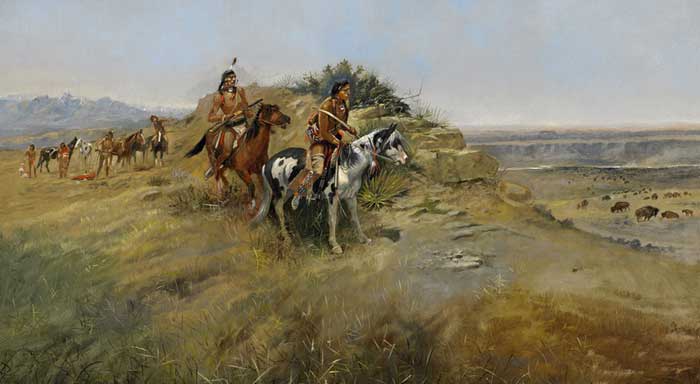
Buffalo Hunt by Charles M. Russell, 1891.
At the age of nine, he began to ride his father’s pack pony on the buffalo hunt. He told me he was 12 years old when he was first permitted to take part in the chase and found to his great mortification that none of his arrows penetrated more than a few inches. Excited to recklessness, he whipped his horse nearer the fleeing buffalo, and before his father knew what he was about, he had seized one of the protruding arrows and tried to push it deeper. The furious animal tossed his massive head sidewise, and the boy and horse were whirled into the air.
Fortunately, the boy was thrown on the farther side of his pony, which received the full force of the second attack. The thundering hoofs of the stampeded herd soon passed them by. Still, the wounded and maddened buffalo refused to move, and some critical moments passed before Red Cloud’s father succeeded in attracting its attention so that the boy might spring to his feet and run for his life.
I once asked Red Cloud if he could recall having ever been afraid, and in reply, he told me this story. He was about 16 years old and had already been once or twice upon the warpath when one fall, his people were hunting in the Big Horn country, where they might expect trouble at any moment with the hostile Crow or Shoshone. Red Cloud had followed a single buffalo bull into the Badlands and was out of sight and hearing of his companions. When he had brought down his game, he noted carefully every feature of his surroundings so that he might at once detect anything unusual and tied his horse with a long lariat to the horn of the dead bison while skinning and cutting up the meat to pack it to camp. Every few minutes, he paused in his work to scrutinize the landscape, for he had a feeling that danger was not far off.
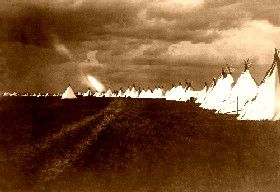
Sioux Tipis, 1902.
Suddenly, almost over his head, as it seemed, he heard a tremendous war-whoop and, glancing sidewise, thought he beheld the charge of an overwhelming number of warriors. He tried desperately to give the usual undaunted war whoop in reply, but instead, a yell of terror burst from his lips, his legs gave way under him, and he fell in a heap. When he realized, the next instant, that the war-whoop was merely the sudden loud whinnying of his horse and the charging army a band of fleeing elk, he was so ashamed of himself that he never forgot the incident. However, up to that time, he had never mentioned it. His subsequent career would indicate that the lesson was well learned.
The future leader was still a very young man when he joined a war party against the Ute. Having pushed eagerly forward on the trail, he found himself far in advance of his companions as night came on, and at the same time, rain began to fall heavily. Among the scattered scrub pines, the lone warrior found a natural cave, and after a hasty examination, he decided to shelter there for the night.
Scarcely had he rolled himself in his blanket when he heard a slight rustling at the entrance as if some creature were preparing to share his retreat. It was pitch dark. He could see nothing but judged that it must be either a man or a grizzly. There was no room to draw a bow. It must be between knife and knife, or between knife and claws, he said to himself.
The intruder did not search; instead, they quietly lay down in the opposite corner of the cave. Red Cloud remained perfectly still, scarcely breathing, his hand upon his knife. Hour after hour, he lay wide awake as many thoughts passed through his mind. Suddenly, without warning, he sneezed, and instantly a strong man sprang to a sitting posture opposite. The first gray of morning was creeping into their rocky den, and behold, a Ute hunter sat before him.
Desperate as the situation appeared, it was not without a grim humor. Neither could afford to take his eyes from the others; the tension was great, till at last, a smile wavered over the expressionless face of the Ute. Red Cloud answered the smile, and a treaty of peace was born between them in that instant.
“Put your knife in its sheath. I shall do so also, and we will smoke together,” signed Red Cloud. The other assented gladly, and they ratified thus the truce, which assured each a safe return to his friends. Having finished their smoke, they shook hands and separated. Neither had given the other any information. Red Cloud returned to his party and told his story, adding that he had divulged nothing and had nothing to report. Some were inclined to censure him for not fighting, but he was sustained by most of the warriors, who commended his self-restraint. In a day or two, they discovered the enemy’s main camp and fought a remarkable battle, in which Red Cloud especially distinguished himself.
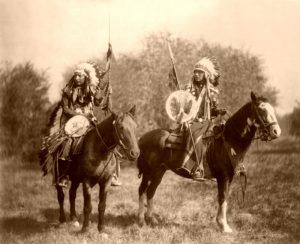
Sioux Indians on Horseback, by Heyn, 1899.
The Sioux were now entering the stormiest period of their history. The old things were fast, giving place to new ones. The young men, for the first time engaging in serious and destructive warfare with the neighboring tribes, armed with the deadly weapons furnished by the white man, began to realize that they must soon enter a desperate struggle for their ancestral hunting grounds. The old men had been innocently cultivating the friendship of the stranger, saying among themselves, “Surely there is land enough for all!”
Red Cloud was a modest and little-known man of about 28 years when General Harney called all the western bands of Sioux together at Fort Laramie, Wyoming, to secure an agreement and right of way through their territory. The Ogallala held aloof from this proposal, but Bear Bull, an Ogallala chief, undertook to dictate submission to the rest of the clan after having been plied with whiskey. Enraged by failure, he fired upon a group of his own tribesmen, and Red Cloud’s father and brother fell dead. According to Indian custom, it fell to him to avenge the deed. Calmly, without uttering a word, he faced old Bear Bull and his son, who attempted to defend his father, and shot them both. He did what he believed to be his duty, and the whole band sustained him. Indeed, the tragedy gave the young man at once a certain standing as one who not only defended his people against enemies from without but against injustice and aggression within the tribe. From this time on, he was recognized as a leader.
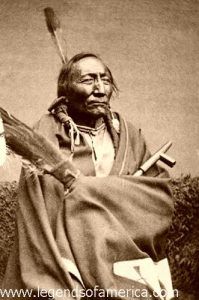
Tah-shun-ka-co-qui-pah, Old Man Afraid of His Horse.
Man-Afraid-of-His-Horse, then head chief of the Ogallala, took counsel with Red Cloud in all important matters, and the young warrior rapidly advanced in authority and influence. In 1854, when he was barely thirty-five years old, the various bands were again encamped near Fort Laramie. A Mormon emigrant train, moving westward, left a footsore cow behind, and the young men killed her for food. The next day, to their astonishment, an officer with thirty men appeared at the Indian camp and demanded of old Conquering Bear that they be given up. The chief, in vain, protested that it was all a mistake and offered to make reparation.
It would seem that either the officer was under the influence of liquor or else had a mind to bully the Indians. He would accept neither explanation nor payment but demanded point-blank that the young men who had killed the cow be delivered up to summary punishment.
The old chief refused to be intimidated and was shot dead. Not one soldier ever reached the gate of Fort Laramie! Here, Red Cloud led the young Ogallalas, and so intense was the feeling that they even killed the half-breed interpreter.
Curiously enough, there was no attempt at retaliation on the part of the army and no serious break until 1860, when the Sioux were involved in troubles with the Cheyenne and Arapahoe. In 1862, a severe outbreak was precipitated by the Eastern Sioux in Minnesota under Little Crow, in which the western bands took no part.
Yet, this event ushered in a new period for their race. The surveyors of the Union Pacific were laying out the proposed road through the heart of the southern buffalo country, the rendezvous of Ogallala, Brule, Arapahoe, Comanche, and Pawnee, who followed the buffalo as a means of livelihood. Most of these tribes were at war with one another, yet during the summer months, they often met to proclaim a truce and hold joint councils and festivities, which were now essentially discussions of the common enemy. However, it became evident that some of the smaller and weaker tribes were inclined to welcome the new order, recognizing that the government’s policy was to put an end to tribal warfare.
Red Cloud’s position was uncompromisingly against submission. He made some notable speeches in this line, one of which was repeated to me by an old man who had heard and remembered it with the remarkable verbal memory of an Indian.
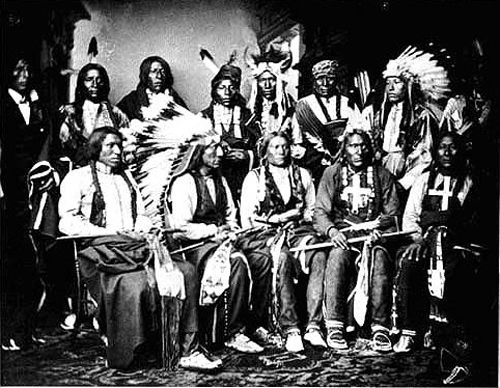
Red Cloud with his men.
“Friends,” said Red Cloud, “it has been our misfortune to welcome the white man. We have been deceived. He brought with him some shining things that pleased our eyes; he brought weapons more effective than our own: above all, he brought the spirit water that makes one forget for a time old age, weakness, and sorrow. But I wish to say to you that if you would possess these things for yourselves, you must begin anew and put away the wisdom of your fathers. You must lay up food and forget the hungry. When your house is built, your storeroom filled, then look around for a neighbor whom you can take at a disadvantage, and seize all that he has! Give away only what you do not want; or rather, do not part with any of your possessions unless in exchange for another’s.
“My countrymen, shall the glittering trinkets of this rich man, his deceitful drink that overcomes the mind, shall these things tempt us to give up our homes, our hunting grounds, and the honorable teaching of our old men? Shall we permit ourselves to be driven to and fro — to be herded like the cattle of the white man?”
His next remembered speech was delivered in 1866, just before the attack on Fort Phil Kearny. The tension of feeling against the invaders had now reached its height. There was no dissenting voice in the council upon the Powder River when it was decided to oppose to the uttermost the explicit purpose of the government. Red Cloud was not altogether ignorant of the white man’s numerical strength and resourcefulness, but he was determined to face any odds rather than submit.
“Hear ye, Dakotas!” he exclaimed. “When the Great Father at Washington sent us his chief soldier [General Harney] to ask for a path through our hunting grounds, a way for his iron road to the mountains and the western sea, we were told that they wished merely to pass through our country, not to tarry among us, but to seek for gold in the far west. Our old chiefs thought to show their friendship and goodwill by allowing this dangerous snake into our midst. They promised to protect the wayfarers.
“Yet before the ashes of the council fire are cold, the Great Father is building his forts among us. You have heard the sound of the white soldier’s ax upon the Little Piney. His presence here is an insult and a threat. It is an insult to the spirits of our ancestors. Are we then to give up their sacred graves to be plowed for corn? Dakotas, I am for war!”
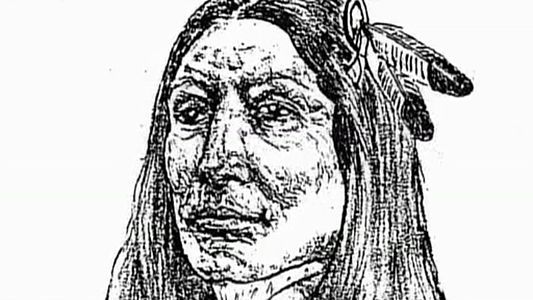
It is known that Crazy Horse did not like to have his picture taken; however, this sketch made in 1934 by a Mormon Missionary while interviewing one of Crazy Horse’s family members is said to be accurate.
In less than a week after this speech, the Sioux advanced upon Fort Phil Kearny, the new sentinel that had just taken her place upon the farthest frontier, guarding the Oregon Trail. Every detail of the attack had been planned with care, though not without heated discussion, and nearly every well-known Sioux chief had agreed to strike the blow. The brilliant young war leader, Crazy Horse, was appointed to lead the charge. His lieutenants were Sword, Hump, and Dull Knife, with Little Chief of the Cheyenne, while the older men acted as councilors. Their success was instantaneous. They had cut down nearly a hundred men under Captain Fetterman in less than half an hour, whom they drew out of the fort by a ruse and then annihilated.
Instead of sending troops to punish, the government sent a commission to deal with the Sioux. The result was the famous treaty of 1868, which Red Cloud was the last to sign, having refused to do so until all of the forts within their territory should be vacated.
All of his demands were acceded to, the new road abandoned, the garrisons withdrawn, and in the new treaty, it was distinctly stated that the Black Hills and the Big Horn were Indian country, set apart for their perpetual occupancy, and that no white man should enter that region without the consent of the Sioux.
However, this treaty was scarcely signed when gold was discovered in the Black Hills, and the popular cry was: “Remove the Indians!” This was easier said than done. That very territory had just been solemnly guaranteed to them forever, yet how stem the irresistible rush for gold? The government, at first, entered some small protest, just enough to “save its face” as the saying is; but there was no serious attempt to prevent the wholesale violation of the treaty. This state of affairs led to Red Cloud’s last great speech at a gathering on the Little Rosebud River. It is brief and touches upon the hopelessness of their future as a race. He seems at about this time to have concluded that resistance could not last much longer; in fact, the greater part of the Sioux nation was already under government control.
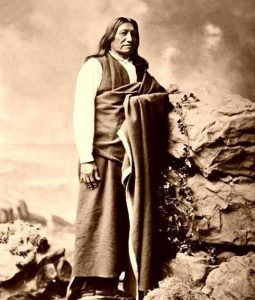
Sioux Chief Spotted Tail.
“We are told,” said he, “that Spotted Tail has consented to be the Beggars’ Chief. Those Indians who go over to the white man can be nothing but beggars, for he respects only riches, and how can an Indian be a rich man? He cannot without ceasing to be an Indian. As for me, I have listened patiently to the promises of the Great Father, but his memory is short. I am now done with him. This is all I have to say.”
The wilder bands separated soon after this council to follow the buffalo’s drift, some in the vicinity of the Black Hills and others in the Big Horn region. Small war parties came down from time to time upon stray travelers, who received no mercy at their hands, or made dashes upon neighboring forts. Red Cloud claimed the right to guard and hold by force, if need be, all this territory that had been conceded to his people by the treaty of 1868. The land became a very nest of outlawry. Aside from organized parties of prospectors, bands of white horse thieves and desperadoes took advantage of the situation to plunder immigrants and Indians alike.
An attempt was made to employ military camps to establish control and force all the Indians onto reservations. Another commission was sent to negotiate their removal to Indian Territory, but met with an absolute refusal. After much guerrilla warfare, an important military campaign against the Sioux was set on foot in 1876, ending in George Custer’s signal defeat upon the Little Bighorn.
In this notable battle, Red Cloud did not participate in person, nor did he in the earlier one with Crook upon the Little Rosebud, but he had a son in both fights. He was now a councilor rather than a warrior, but his young men were constantly in the field. At the same time, Spotted Tail had surrendered and was in close touch with government representatives.
But the inevitable end was near. One morning in the fall of 1876, Red Cloud was surrounded by United States troops under the command of Colonel McKenzie, who disarmed his people and brought them into Fort Robinson, Nebraska. Thence they were removed to the Pine Ridge agency, where he lived for more than thirty years as a “reservation Indian.” To humiliate him further, government authorities proclaimed the more tractable Spotted Tail head chief of the Sioux. Of course, Red Cloud’s people never recognized any other chief.
In 1880, he appealed to Professor Marsh of Yale, head of a scientific expedition to the Badlands, charging certain fraud at the agency and proving his case; at any rate, the matter was considered worthy of an official investigation. In 1890-1891, during the “Ghost Dance craze” and the difficulties that followed, he was suspected of collusion with the hostiles, but he did not join them openly, and nothing could be proved against him. He was already an old man and became almost entirely blind before he died in 1909 in his ninetieth year.
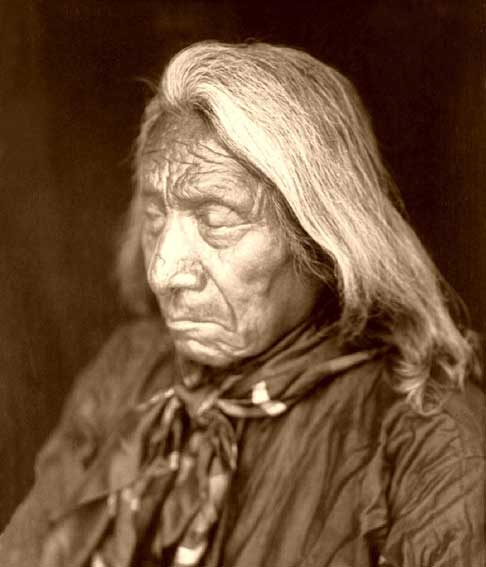
Red Cloud, 1905.
His private life was exemplary. He was faithful to one wife throughout his life and a devoted father to his children. He was ambitious for his only son, known as Jack Red Cloud, and he greatly desired him to be a great warrior. He started him on the warpath at the age of 15, not then realizing that the days of Indian warfare were well-nigh at an end.
Among latter-day chiefs, Red Cloud was notable as a quiet man, direct in speech, courageous in action, an ardent lover of his country, and possessed in a marked degree of the manly qualities characteristic of the American Indian in his best days.
By Charles A. Eastman, 1918. Compiled and edited by Kathy Alexander/Legends of America, updated November 2025.
About the Author: Excerpted from the book Indian Heroes and Great Chieftains, by Charles A. Eastman, 1918. (now in the public domain) Charles A. Eastman earned a medical degree from Boston University School of Medicine in 1890 and then began working for the Office of Indian Affairs later that year. He worked at the Pine Ridge Agency, South Dakota, and was an eyewitness to both events leading up to and following the Wounded Knee Massacre of December 29, 1890. Part-Sioux himself knew many of the people about whom he wrote.
Also See: