
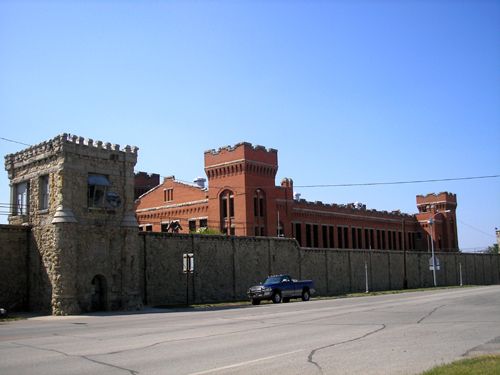
Old Montana Prison Museum, by Kathy Alexander.
Like other fledgling territories in the 19th-century American West, Montana became wild when the gold rush attracted not only those seeking their fortunes but also thieves, gamblers, and murderers. For several years following the gold discoveries of 1862, the Montana Vigilantes took it upon themselves to punish these many offenders in the lawless land of Montana. Finally, in response to a need for more organized law enforcement, the Montana Territorial Legislature requested funds for a prison during its winter session of 1866-67. The United States Congress agreed that the territory needed a prison, approved the funding request, and chose Deer Lodge as the site for the new Territorial Prison.
However, they soon found the funding inadequate, leading to revisions to the plans and many delays. Construction began in the spring of 1870 with convict labor, and the prison finally received its first convict on July 2, 1871.
Almost from the beginning, the prison was deemed inadequate and overcrowded, a condition that would result in slow but continual construction at the prison for the next 50 years. When Montana became the forty-first state on November 8, 1889, the prison became Montana’s responsibility. Finding it expensive to operate, the Board of Prison Commissioners contracted out the entire operation in 1890. Colonel Thomas McTague and Frank Conley of Deer Lodge received the contract, paying them seventy cents per prisoner daily
Frank Conley became the new warden, a post he would continue to hold until 1921. Over the next thirty years, Conley shaped the philosophy and appearance of the prison. Believing the prisoners should work, Conley updated the prison by replacing its twelve-foot wooden fence with the massive sandstone wall in 1893. Four and a half feet thick, the wall formed a solid perimeter for the prison. He also began to build a new log cell house to reduce prison crowding.
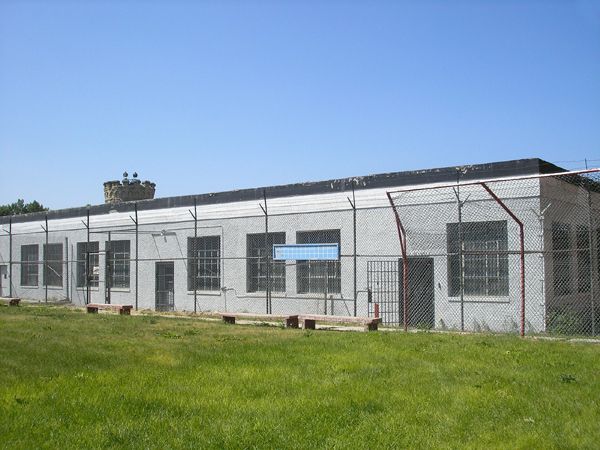
Old Montana Prison building
To reduce crowding, he put the prisoners to work, which generated income for the prison; outside the prison, camps were established where prisoners would live and be “hired out” for both public and private work. This worked so well that by the late 1890’s, approximately one-third of the prisoners worked outside the prison. At these camps, which housed about 75 prisoners each, inmates enjoyed a relatively high degree of freedom with neither chains nor cells restricting them. However, “outside work” was a privilege, and the slightest infraction of the rules would immediately send a prisoner back behind prison walls.
By the second decade of the twentieth century, about 50% of the inmates were working outside the penitentiary, traveling throughout Montana to erect numerous state buildings, pave more than 500 miles of roads, and work on 11 different ranches that provided food for state-owned institutions.
In 1908, the prison witnessed one of its most tragic events when two prisoners, George Rock and William Hayes, attempted to escape. Fleeing from the Federal Building, their failed attempt resulted in the death of Deputy Warden John Robinson, and Warden Frank Conley was required to get 103 stitches in his back and neck from stab wounds he received from the inmates. As a result, George Rock was hanged inside the prison yard that very year, and William Hayes met a similar fate the following year. They were the only inmates to be executed in the prison.
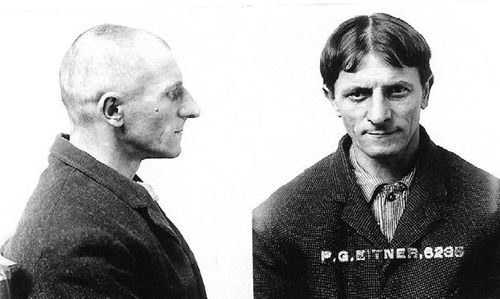
Turkey Pete Eitner.
Not all the inmates were so violent, and the guards and prisoners downright liked one. At the age of 40, Pete Eitner was convicted of murder and sentenced to life in 1918.
A model prisoner, he was assigned to tend to the prison turkeys and soon garnered the nickname “Turkey Pete.” As he aged, he began to lose some of his mental faculties, and when a man stopped one day to admire his turkeys, Eitner sold him the entire flock for 25 cents each. This ended his turkey-tending days, but that was ok because he soon fantasized about a new “job” as the owner and administrator of the prison. Prison officials humored him, “allowing” Eitner to “run” the prison from his cell. Fake checks were printed for him, which he used to pay prison expenses and payroll. He would also tell anyone who would listen that he had the coffee crop in Brazil one year and sold pink alligators, ships to the navy, and grasshopper legs to Fidel Castro.
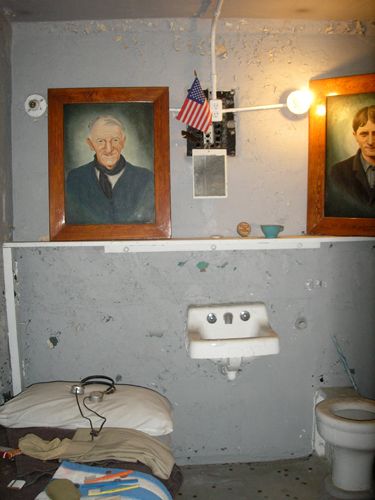
Turkey Pete Eitner Cell
When Turkey Pete died in 1967 at age 89, his cell (#1) was retired. His funeral was the only one ever held within the prison walls. Today, Cell #1 displays photos of Turkey Pete and his few belongings.
Inside the prison walls, construction also continued with the building of a women’s prison, additional dormitories for the men, a store building, a laundry, and a dining room. In 1919, a 1,000-seat prison theater was built with funding donated by Senator William A. Clark, Jr.
Protests from labor unions and security concerns ended outside work in the 1920s; however, food production continued at the thirty-thousand-acre prison-owned ranch. Work inside the prison continued in various industries, including cobbler and upholstery shops and a garment industry that made clothes for state wards. A state license plate factory began production in the late 1920s.
Though Conley’s administration drastically improved the prison, it continually suffered from overcrowding through the decades.
On April 16, 1959, the prison suffered a significant riot when two inmates named Jerry Myles and Lee Smart, Jr. led some 12 inmates in an escape attempt. Deputy Warden Theodore Rothe was shot and killed in the melee, and Warden Powell was temporarily held hostage.
The hostages were held for three days while the riot raged on. After the National Guard was brought in, the two ringleaders died in a murder-suicide. Myles shot Smart and then turned the gun on himself.
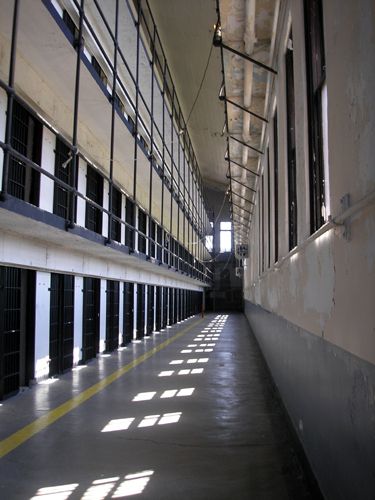
Montana Prison Museum Cells, by Kathy Alexander.
Finally, the overcrowded, old prison was closed in 1979, and its prisoners moved to a new facility five miles west of Deer Lodge.
Empty of prisoners and standing as a silent sentinel to justice, the Powell County Museum and Arts Foundation obtained the building’s lease for use as a museum. After some restoration and construction of a visitor’s center, the complex reopened in 1980, providing tours to more than 40,000 visitors annually.
Listed on the National Registry of Historic Places, the museum offers guided and self-guided tours through several of the prison’s buildings, allowing visitors to glimpse the daily life and routines of the prison. As visitors walk through the intimidating cell houses, Informational signs provide details of prison life, where tourists will continue to see original schedules, rules, prisoner artwork, and even decaying blankets on many iron cots in the prison cells. More lurid displays show a “Prison Life” photo exhibit, contraband items, homemade weapons, guns, shackles, and restraints utilized on the convicts.

Guardtower at the Old Montana Prison Museum
Evidence of a 1959 riot can be seen in the broken bricks of the west tower; cramped blackout cells can be toured, and the gallows that once hanged capital offenders remain for those of us with a morbid curiosity.
Though guards no longer occupy the turrets in each corner of “The Wall,” nor make the sounds of heavy cell doors sliding shut echo through the buildings, the tour can make even the most hardened visitor welcome their “release” into the grassy center yard.
The Old Montana Prison Museum is just one of several museums sponsored by the Powell County Museum and Arts Foundation. Deer Lodge, Montana, is home to more museums and historical collections than any other town in the Northwest. You can also see the Frontier Museum, Desert John’s Saloon Museum, and the Powell County Museum, which will transport you back to the era of cowboys and the Old West. The Montana Auto Museum features over 120 vintage vehicles, and Yesterday’s Playthings is Montana’s original doll and toy museum. Cottonwood City displays the Snowshoe Creek School and the Blood Cabin.
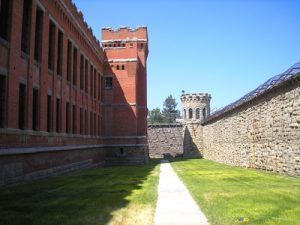
Two prisoners were hanged in this side yard of the Old Montana Prison by Kathy Alexander.
Contact Information:
Old Prison Museums
1106 Main St
Deer Lodge, Montana 59722
406-846-3111
©Kathy Alexander/Legends of America, updated March 2026.
Also See:
The Writing of Jerry’s Riot: The True Story of Montana’s 1959 Prison Disturbance
The Long History of Alcatraz Island (California)
See Sources.