
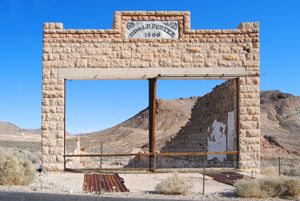
Porter General Store in Rhyolite, Nevada, by Kathy Alexander.
Walking through the many dusty, crumbling ghost towns of the American West is such a wonderful experience. Hopefully, with a bit of luck and a lot of preservation, these old towns will still be there for our children and grandchildren to enjoy.
What is a Ghost Town?
A ghost town is any historical town or site that leaves evidence of its former glory. This can take many forms—all businesses closed, municipal services at a minimum, rubble and old nails strewn about, ruins of former buildings, etc. However, some places categorized as ghost towns still have people living in them. Though they sometimes don’t want to be called ghost towns, most historians still refer to them that way if the reason or purpose for their original “boom” is gone. This would include towns like Tombstone, Arizona; Cripple Creek, Colorado; Madrid, New Mexico; and dozens of others.
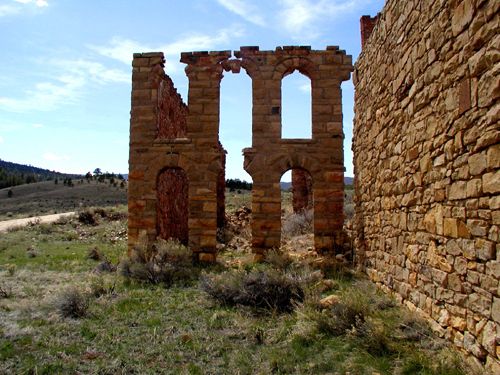
The Mutz Hotel in Elizabethtown, New Mexico, by Dave Alexander, 2004. These walls have since fallen.
Other places considered truly “real” ghost towns have very little left but foundations and sometimes still use an old cemetery, such as Elizabethtown, New Mexico.
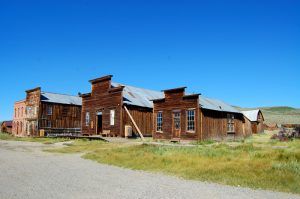
Buildings in the ghost town of Bodie, California, by Kathy Alexander.
These old sites can be excellent places to explore as we speculate about the once-vibrant lives lived there. In other old towns, you may see former business buildings such as schools and churches used as residences. A true ghost town has been abandoned entirely.
Philip Varney, the author of several popular ghost town books, defines these old communities as: “any site that has had a markedly decreased population from its peak, a town whose initial reason for settlement (such as a mine or railroad) no longer keeps people in the community.”
Varney divides ghost towns into three categories: completely deserted ghost towns like Loma Parda, New Mexico; towns with a minimal population like Elkhorn, Montana; and still-thriving towns like Central City, Colorado.
Further, he defines what to look for in a ghost town.
- Scattered rubble or sites where nature has reclaimed the land
- Roofless buildings or partially demolished buildings
- Boarded-up or abandoned buildings, no population
- A community with many abandoned buildings and a small population of residents
- Historic community or town, functional, but much smaller than in its boom years
- A restored town, state park, or replica of an old town, community, or fort

Ghost Town Code of Ethics
I Will Not
- Destroy, damage, or deface any buildings or other structures.
- Disturb any structures that are locked or appear to be occupied.
- Remove anything from the site besides apparent trash, such as candy wrappers, soft drink cans, etc.
- Enter a site that is posted as “No Trespassing” without permission.
- Do not take in a metal detector without the owner’s permission. Residents often consider this a badge of a vandal.

I Will
- Observe all rules and regulations, be they local, state, or national.
- Camp and make fires only in designated safe locations.
- Leave the land and vegetation as you found them.
- Fill all holes or excavations.
- Remove and properly dispose of any trash I find, and will not litter.
- Respect landowners’ rights and property, leave gates as found, and obey all posted signs.
- Appreciate and protect this nation’s ghost towns and the heritage they represent.
- Always conduct myself courteously, and always show consideration for others.
The above is partially taken and modified from Gary Speck’s Ghost Town Ethics, Ghost Town USA.
©Kathy Alexander/Legends of America, updated October 2026.
See our Ghost Town Photo Galleries HERE
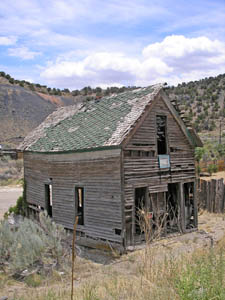
Old Company House, Madrid, New Mexico, by Kathy Alexander.
Also See:
Ancient Cities of Native Americans
Forts Across the American West
Cemeteries – Outdoor Museums of the Forgotten Past
Emerging Ghost Towns of the Plains
See Sources.