
By Joseph Harris Chappell, 1905.
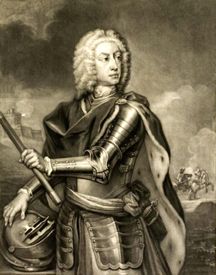
James Edward Oglethorpe, Founder of Georgia.
James Edward Oglethorpe was a British general, Parliament member, philanthropist, and founder of the Georgia Colony.
James Oglethorpe was born in Westminster, England, on June 1, 1696. From an early age, it was anticipated that he would become a notable figure, as he came from a lineage of distinguished individuals. Six hundred years prior to his birth, one of his ancestors, Sheriff Oglethorpe, served as a high-ranking officer in the English army and was killed in the famous Battle of Hastings while valiantly fighting against the invader, William the Conqueror. This brave soldier had many illustrious descendants, the most prominent of whom was James Oglethorpe.
James’s father, Sir Theophilus Oglethorpe, was a distinguished officer in the English army. He fought with great valor in numerous battles and achieved the rank of Major-General. At the age of 40, he retired from the army and settled in an elegant home in the small town of Godalming, approximately 30 miles from London.
He lived in considerable affluence with his family, providing his children with the best educational opportunities available in Europe at that time. James’s mother was a Scotch-Irish lady from a prominent family, well-educated and recognized as one of the cleverest and shrewdest women of her era. As one of the Ladies of the Court to “Good Queen Anne,” she was influential in society and made her mark in politics. A woman of strong will, she undoubtedly played a significant role in shaping her distinguished son’s character.
James grew to be a tall, lithe, and handsome young man. He was quiet-mannered, good-natured, and high-spirited. Oglethorpe received his education at a military school, and before he turned 20, he joined the English army, serving as an ensign under the renowned Duke of Marlborough. After the war, he withdrew from the army and attended college for a year or two. However, being a natural soldier, he did not enjoy the “weak, piping times of peace.” With no wars to fight in England, he joined the Austrian army, which was then at war with the Turks.
The leader of the Austrian army was Prince Eugene of Savoy, one of the most brilliant military strategists of his time. Though he was a small man, he was a great general, described by the famous English writer Carlyle as “a bright little soul with a flash in him as of heaven’s own lightning.” Prince Eugene took a strong liking to young Oglethorpe, promoting him to the position of aide-de-camp with the rank of Captain. Under the guidance of this remarkable leader, Oglethorpe honed his skills as a soldier and displayed dashing valor in numerous desperate battles.
These were Oglethorpe’s romantic days, and he loved to recount his adventures. Even in his old age, he would captivate audiences with his vivid descriptions of the battles he fought alongside Prince Eugene.
After the Turkish war ended, Oglethorpe returned to England and adjusted to a life of peace. Following the deaths of his father and older brothers, he inherited the family estates and became quite wealthy. Despite his fortune, he maintained a simple and sober lifestyle. He was elected to Parliament, where he served for many years. During his time in Parliament, a particular event caught his attention and directed him toward America, ultimately inspiring him to establish Georgia.
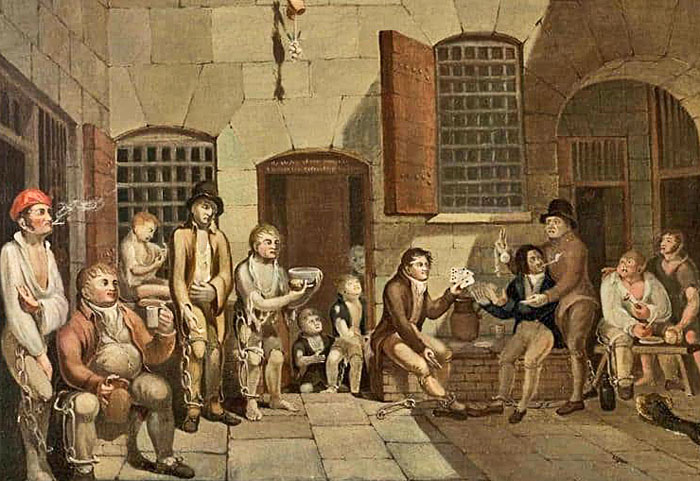
Debtors’ Prison.
At that time, England had a law that allowed creditors to imprison debtors, keeping them there until their obligations were paid. Many poor and unfortunate people, innocent of any crime, languished in these debtors’ prisons for years. This law impacted a close friend of Oglethorpe’s, a scholar and artist named Robert Castell. Castell had written an excellent book on architecture, which he illustrated with beautiful pictures of his own creation. He became so engrossed in writing the book that he neglected his business affairs. When it was published, instead of earning him money, it left him heavily in debt. Consequently, he was sentenced to debtors’ prison.
In the prison where he was assigned, smallpox was rampant, and Castell had never contracted the disease. He pleaded with the cruel prison keeper, a man named Bambridge, to allow him to stay in the common jail until the smallpox outbreak subsided or until his friends could arrange to pay off his debts, which he believed would be resolved in a few months. Bambridge agreed to this condition only if Castell paid him a cash bribe. However, Castell did not have the money, so he was thrown into the smallpox-infested prison, where he soon contracted the disease. After suffering for a few days, he died a terrible death, leaving his wife and small children in a state of poverty and helplessness.
When Oglethorpe heard of this outrage, his blood boiled with indignation; he at once introduced a bill in Parliament to have a committee appointed to examine the prisons of England and bring about reform in their management. The bill was passed, and Oglethorpe was made Chairman of the Committee. With the other members, he spent several months visiting the prisons. He found in them many practices of shocking cruelty, all of which were immediately abolished.
If Oglethorpe had done nothing more than bring about prison reform, he would still deserve the lasting gratitude of humanity. However, he did not stop there. While visiting the prisons, he became deeply sympathetic toward the poor debtors he found languishing behind iron bars, despite being innocent of any crime. Determined to help them escape their unfortunate circumstances, he earnestly appealed to Parliament. As a result, they passed a law allowing these debtors to be set free, provided they agreed to travel to America to establish a new colony for England in an unclaimed region south of the Savannah River. This area bordered Florida, which was then under Spanish control. At that time, Spain was one of the most powerful and aggressive nations in the world and maintained a hostile stance towards England, although they were not in open conflict.
Fortunately for Oglethorpe’s mission, King George II of England was eager to establish colonies in the unoccupied land south of the Savannah River to protect South Carolina from the bold Spaniards in Florida. He generously granted Oglethorpe “for the use of debtors and other poor persons” all the land between the Savannah and the Altamaha Rivers, extending as far westward as they might choose. This region was named Georgia in honor of King George. A Board of Trustees, consisting of 36 members—including some of the King’s most distinguished men—was appointed to oversee the establishment and governance of the new colony. They were to serve without pay or compensation. Lord Perceval was the president of the board, and Oglethorpe was one of its members.
The Trustees immediately began raising funds to cover the costs of establishing the colony and to support the poor individuals who could not afford any part of their expenses. Parliament allocated a sizable amount for this purpose, and additional public donations increased the total. Altogether, the Trustees soon had $150,000 available, which was sufficient to establish a small colony.
At one of the Trustees’ meetings, it was suggested that a member of the Board, a man of education and ability, should go over to America with the first colonists as their Governor and live in Georgia with them until they were well and thoroughly established. Oglethorpe nobly volunteered to go, and the Trustees were delighted. In undertaking this trying service, Oglethorpe would have to give up his luxurious home, the pleasures of refined society, and the splendid public career that was fast opening to him in England and would have to endure untold hardships, privations, and dangers.
At that time, he was 43 years old and was yet unmarried. When it was known that the great and good Oglethorpe himself would accompany the expedition, hundreds and hundreds of poor people, debtors, and others were anxious to go, but only a few could be taken. Out of the hundreds of applicants, the Trustees carefully selected 40 strong, healthy men with good morals and small families. Altogether, the party’s men, women, and children consisted of 120 souls.
The good ship, Anne, a sailing vessel of two hundred tons burden, was chartered to take the emigrants across the ocean to America. As she lay moored to the wharf at Gravesend, she held stored provisions, tools, and implements for the journey and for getting the colony well established in Georgia. Everything was then ready for the voyage.
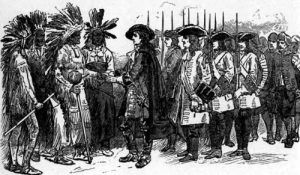
The landing of James Oglethorpe in Georgia.
On November 16, 1732, Oglethorpe and his colonists left England and arrived in Charleston, South Carolina, on January 13, 1733. There, he received advice and assistance from Governor Robert Johnson. Before moving the emigrants into Georgia, Oglethorpe, with help from the South Carolina colonists, searched for the best place for a colony. After locating a site on a high bluff near the Savannah River, he returned to South Carolina and gathered the immigrants. On the afternoon of February 12, 1733, they arrived and would soon build the city of Savannah, Georgia.
On and off, James Oglethorpe would remain in Georgia from 1733 to 1743. In 1736, he was given the rank of colonel and command of a British regiment to defend the colony against Spain. Oglethorpe lived the last six years of his stay in Georgia on St. Simons Island, where he built Fort Frederica. Here, in 1742, his forces turned back a Spanish invasion in what came to be known as the Battle of Bloody Marsh, for which Oglethorpe was promoted to brigadier general in the British Army.
Oglethorpe returned to England in 1743 and married Elizabeth Wright in September 1744. He lived his final four decades divided between London and his wife’s inherited estate in Cranham. James Oglethorpe died at age 88 on June 30, 1785.
By Joseph Harris Chappell, 1905. Compiled and edited by Kathy Alexander/Legends of America, updated March 2026.
Also See: