
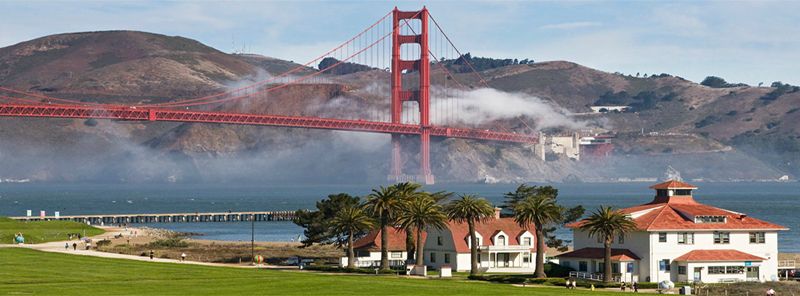
San Francisco Presidio, California, courtesy of the National Park Service.
The Presidio of San Francisco, California, is the oldest Army installation operating in the American West and one of the longest-garrisoned posts in the country. Three flags have flown over this former military post strategically located near the Golden Gate Bridge.

Spanish Presidio, 1790.
Established by Spain on March 28, 1776, the Presidio of San Francisco became a Mexican outpost in 1822 and remained under Mexican rule for 24 years before the U.S. Army took control of it in 1846. In 1847, during the Mexican-American War, the New York Volunteers occupied the Presidio’s adobes, marking the beginning of 147 years of growth as a major U.S. Army post.
During the 1850s-60s, Presidio soldiers fought Indians in California, Oregon, Washington, and Nevada.
The Army Corps of Engineers built Fort Point, a four-tiered brick-and-granite fort designed to hold 126 large cannons to protect the entrance to the Bay. The outbreak of the Civil War in 1861 emphasized the importance of California’s wealth and the military significance of San Francisco harbor to the Union.
This led, in 1862, to the first major program of construction and expansion at the Presidio since the United States acquired it. The Indian Wars of the 1870s and 1880s led to further growth at the Presidio. Soldiers stationed here saw action against the Modoc Indians in the Lava Beds of northern California and against the Apache Indians in the southwest. By the 1890s, the Presidio was no longer a frontier outpost but a central military installation and a base for American expansion into the Pacific.
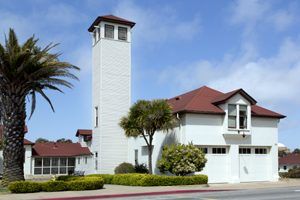
The Presidio of San Francisco by Carol Highsmith.
In 1890, with the creation of Sequoia, General Grant, and Yosemite National Parks in the Sierra Nevada mountains of California, the protection of these scenic and natural resources was assigned to the U.S. Cavalry stationed at the Presidio. Soldiers patrolled these new parks during the summer months until the start of World War I in 1914, and two years later, the National Park Service was created to manage the country’s National Parks.
The United States’ war with Spain in 1898 and the subsequent Philippine-American War from 1899 to 1902 increased the Presidio’s role. Thousands of troops camped in tent cities awaiting shipment to the Philippines, including all four African-American regiments known as the “Buffalo Soldiers.” Returning sick and wounded soldiers were treated in the Army’s first permanent general hospital, Presidio (later Letterman) Army General Hospital. By 1905, twelve coastal defense batteries of reinforced concrete were built along the San Francisco Headlands. Presidio coast artillery units were stationed near the Bay entrance at Fort Scott, with cavalry and infantry garrisoned at the main post.
Following the 1906 earthquake and fire, the U.S. Army at the Presidio assisted the civilian government by providing food, clothing, shelter, and protection. In 1914, troops under the command of General John Pershing left the Presidio for the Mexican border to pursue Pancho Villa and his men. When World War I began, General Pershing became the Commander of the American Expeditionary Forces in Europe. The Presidio expanded in the 1920s when Crissy Army Airfield was established to assist harbor defense. In 1924, the first “dawn to dusk” transcontinental flight finished here. From 1933 to 1937, the Golden Gate Bridge was built, which increased public use of the Presidio. The airfield moved north to Marin County, becoming Hamilton Airfield.
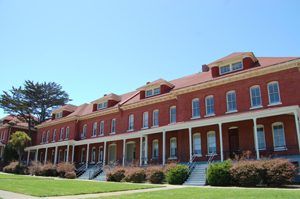
A building at the San Francisco Presidio by Kathy Alexander.
The United States entered World War II after the attack on Pearl Harbor, and Presidio soldiers dug foxholes along the nearby beaches. Fourth Army Commander General John L. DeWitt conducted the internment of thousands of Japanese and Japanese-Americans on the West Coast. In the meantime, U.S. soldiers of Japanese descent were trained to read and speak Japanese at the first Military Intelligence Service language school at Crissy Field.
The Presidio also became the headquarters for the Western Defense Command for the West Coast and Alaska. The nearby Fort Mason Port of Embarkation shipped 1,750,000 men to fight in the Pacific. As the largest debarkation hospital in the country, Letterman Hospital reached a peak of 72,000 patients in one year. In the 1950s, the Presidio was the headquarters for Nike missile defense around the Golden Gate and headquarters for the famed Sixth U.S. Army.
The Presidio of San Francisco was designated a National Historic Landmark in 1962, with more than 350 buildings of historical significance.
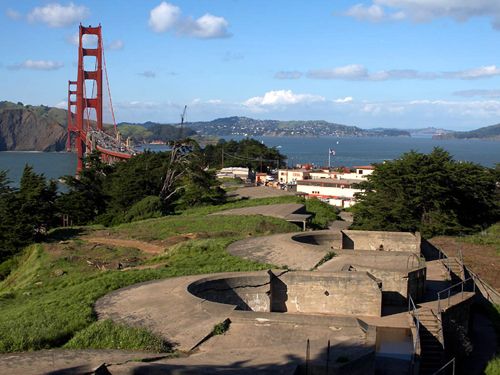
Presidio and Golden Gate Bridge by Jon Sullivan
In 1989, the army decided to close the Presidio, and it was transferred to the National Park Service in October 1994 and became part of the Golden Gate National Recreation Area.
In 1998, the Presidio Trust assumed management of most of the Presidio’s buildings and grounds. Today, it is the country’s only monetarily self-sustaining national park site.
The Presidio features 768 historic buildings and structures, including massive coastal batteries, vast miles of beaches and bluffs, Army-planted forests, and hiking and biking trails on its nearly 1500 acres. It is one of the largest and most innovative preservation projects in the Nation.
Contact Information:
Presidio of San Francisco
Building 201, Fort Mason
San Francisco, California 94123
415- 561-4323
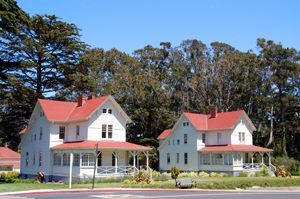
Buildings at the Presidio of San Francisco, California, by Kathy Alexander.
Compiled and edited by Kathy Alexander/Legends of America, updated March 2025. Source: National Park Service
Also See:
California Forts Photo Gallery