
By Anthony Belli
Not content with having drunk up our brandy, these scoundrels rifled our saddlebags where we had a bottle of quimagogo. One of the damned gringos drank it all, thinking it was port; the bottle held enough to kill three horses. When we saw they had gulped down this medicine like wine, I assure you we would have been terrified had we not been secretly enjoying a mood of vengeance.
— Vicente Perez Rosales, Chilean 49er
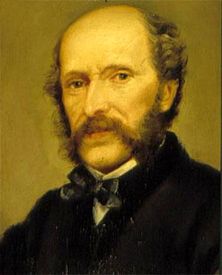
Vicente Pérez Rosales, Chilean 49’er
The California Gold Rush has no equal; Herbert Howe Bancroft said of 1849 that it was an “era” in time that had passed in a single year. The events that began with James Marshall’s discovery of gold in Coloma induced an aberration of time, space, and humanity in global history. The western slope of California’s Sierra Nevada range played host to men from nearly every nation of the world: Brits, Mexicans, Chinese, Kanakas, Peruvians, Irish, French, and Italians. All invaded the lands of the Miwok and Maidu. More came from Nicaragua, Spain, Australia, Yankees from the States—white and black —and Argentina and Chile. The California Gold Rush was the largest migration of humanity since the Crusades.
California, under American conquest, began its history as a mixed bag of races, religions, and cultures that has developed into California’s unique society and culture today. Where else can one celebrate Cinco de Mayo, Christmas, a Native American Pow-Wow, and the Chinese New Year without leaving the state? The story of the Gold Rush, therefore, is incomplete as told in textbook form; the true story of California’s Gold Rush is best told in the words of those 49ers who manned these Sierra foothills as world history unfolded.
Those from Chile certainly left their mark on California, and in a much more profound way than just leaving us with volumes of place names beginning with Chile, or in its typically American version — “Chili.” El Dorado County’s own Chileno history can be found in the mining camps of Chile Bar (inundated by Folsom Lake) and Chili Bar north of Placerville, Yomet, Pekin, Spanish Flat, Kanaka Town, Johntown, Hangtown, Garden Valley, and Chile Hill. Chilenos played an important, though unintentional, role in how Hangtown acquired its name, and Hangtown’s Main Street oak joined the ranks of two other famous California hanging trees, one at Jackson and the other at Second Garrote.
Likewise, it was Chilean miners who sought justice for the murder of one of their own, resulting in the hanging of Richard Crone, aka “Irish Dick,” who swung from Placerville’s lesser-known hanging tree, which sat in the vicinity of today’s Coloma and High Streets.
News Of Marshall’s Discovery Reaches Chile
Word of Marshall’s discovery first reached Valparaiso, Chile, with the brig JRS’s arrival on August 19, 1848. Captain G.L. Hobson, a Valparaiso merchant himself, related the tale of his difficult voyage home since half his crew had jumped ship at San Francisco upon hearing the news. He reported California’s goldfields were so bountiful that all one had to do to earn a fortune was to reach down and pick it up off the ground. Folks paid little heed to his fabulous tales from California.
Ten days later, with the arrival of the schooner Adelaida, which carried $2,500 in California gold, Chile’s future was abruptly changed. First to respond were foreign merchants, members of American and British colonies. Less than two weeks after the Adelaida arrived at Valparaiso, 45 English-speaking businessmen boarded the Virginian and sailed for California.
At this point, Chile suffered an economic decline, and many of its young men took note of the sudden departure of the “gringos.” The rush from Chile was on. The Chilean Foreign Office first issued passports to experienced miners whose passage could be paid; others worked as temporary ship’s crew, and soon each ship was filled. By June 1849, the Foreign Office had issued more than 6,000 passports.

Abandoned Ships in San Francisco Harbor, 1849.
No longer were Chileans applying for passports, adventurers, prostitutes, and folks from every walk of life departed Chile, all California bound. Those English-speaking gringos who’d first left Chile were now opening shops in San Francisco and importing goods from Chile, including foods, mining supplies, explosives, and prefabricated homes. By the end of 1849, 92 of 119 ships of Chilean registry sat in various states of decay, rotting in the San Francisco Bay, leaving Chile’s Merchant Marine fleet in ruins. However, many skeptics who remained were soon convinced, as every ship returning to Chile’s harbors was greeted by crowds yelling “News from California!” The reply was the same. Gold! Gold in abundance! Nuggets the size of boulders!
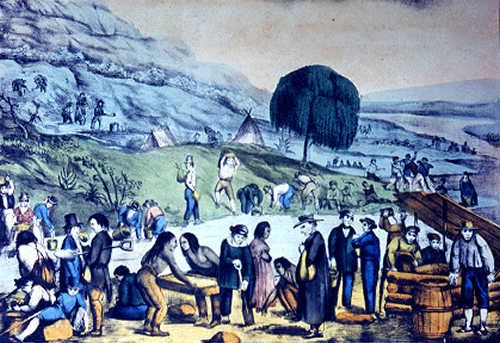
Gold Rush Diversity.
By now, Chile’s harbors were filling up with ships packed with 49ers, most from the east coast of the United States. One Captain recalled counting 300 ships in a single day, noting that 12 were from his home port of Hamburg. The economy flourished, prices for everything skyrocketed, and brothels couldn’t keep up with the sudden influx of young male clientele. Residents of the nearly deserted Juan Fernandez Islands were suddenly besieged by 49ers who’d just rounded the Horn. They found themselves at the center of a Gold Rush boomtown! Chilean businessmen invested in ships to handle the new economic and transportation crisis caused by the inability to keep up with demand. Shortly, however, what seemed like a sure thing turned sour. The ships’ captains, like the crews, abandoned ship in the San Francisco Bay to seek their wealth and glory in California gold.
Contributions To Mining
Most Chilenos arrived late in 1848, long before the 49ers from the U.S. They represented the only experienced mining men in California at the time. They educated the 48ers on how to dig shafts, chase a lead, pan for gold, and the best locations to find gold. They introduced the “corvo,” a long, slender, curved knife used to dig gold from cracks in rocks; the “poruna,” a hollowed cow or steer horn used to pour sand when testing for gold; and, when water became scarce, the “poruna,” a hollowed cow or steer horn used to pour sand when testing for gold. They taught the miners “aventamiento” (dry washing) methods. To crush ore, they improved the Mexican arrastre by adding a stone wheel, renaming it the “Chili Mill.”
Violence has always been a contingency of American culture, and it came with the 49ers. Despite the Chilean advances in mining, the American 49ers quickly targeted Chileans who, by now, had taught the 48ers all they needed to know about extracting gold. No longer of any use, Americans felt that California belonged to them, and anyone not a U.S. citizen was, in effect, stealing their gold. The result is that Americans commonly run non-Anglos out of their claims. The situation only worsened by late 1849, when mining land had become scarce and the easy “free gold” was gone. Unlike most non-Anglos in the diggings who remained passive and moved on when told to do so by the intruding Americans, the Chilenos were well educated, many of the initial Chilean 48ers came from well-to-do families, and they were proud. They quickly gained a reputation among Americans as fierce fighters who always stood their ground as equals when threatened by gringos.
This perceived arrogance further frustrated the American miners, who attacked Chileans with impunity. Murders, whippings, beatings, and mutilations became the Anglo way of dealing with these Spanish-speaking communities. For this, the Chileans hated all Yankees and called them out as cowards. “Chileans and other aliens in the area had no better luck. While preparations were being made to welcome in the New Year at Calaveras with a bloody sacrifice (referring to the Battle of Chile Bar incident), similar things were going on in Stockton, Sonora, Hangtown, Sacramento, and in San Francisco to celebrate the holiday by mass violence against aliens.
“The California of 1849 and 1850 is not at all like the California of 1852. Those earlier years were abnormal in almost every respect; what happened then has little or no bearing on the excellent relations that exist today between Chileans and Americans. California in those years was without government, without fixed laws, without society, and without established traditions. It had no predominant religion.”
— Ramon Jil Navarro, 1852
The brutal treatment of all non-English speaking folks of any color became a trademark of Gold Rush justice. Although racial hate crimes did occur, the overwhelming majority of violence resulted from American miners who sought to remove the competition, regardless of race, first with a warning, then with force. Much like the Chinese, the Chileans retreated from the mines, many settling in San Francisco and going on to become successful businessmen. Others pursued politics, becoming judges, legislators, and Congressmen, and their families became among those prominent and wealthy in the new state.
©Anthony Belli, 2003, updated November 2025.
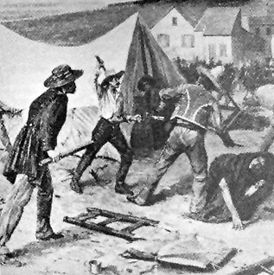
Attacking Little Chile.
About the Author: Anthony M. Belli is a native of California, currently living in the Sierra foothills of El Dorado County. Having a background in law enforcement, he was the youngest police chief in Oregon history. Now, Belli is a recognized historian, writer, and lecturer on the California Gold Rush and serves on the research staff for the El Dorado County Museum. He has been featured in several television shows, writes for Lost Treasure Magazine, and wrote the book Mysteries of Tahoe – Lost Treasure.
Also See:
Sources:
Beilharz, Edwin A. and Lopez, Carlos U.; We Were 49ers!; Ward Ritchie Press; Pasadena, California, 1976.
Boessenecker, John, Gold Dust & Gun Smoke; John Wiley & Sons, Inc.; New York, New York, 1999.
Gernes, Phyllis L.; Hidden in the Chaparral, Self-Published; Garden Valley, California, 1982.
Holliday, J.S.; The World Rushed In; Simon & Schuster, New York, New York, 1983.
Hughey, Richard; Placerville and Vicinity – Part 9; Mountain Democrat, Placerville, California, November 23, 2001.
Hughey, Richard; Hangtown: The Navarro Account; Mountain Democrat, Placerville, California, December 7, 2001.
Sioli, Paolo; History of El Dorado County; Cedar Ridge Publishing, Georgetown, California, 1998.
Witter, Daniel; Chileans Chased Dream of Gold, Appeal Democrat; Marysville, California, August 6, 2002