
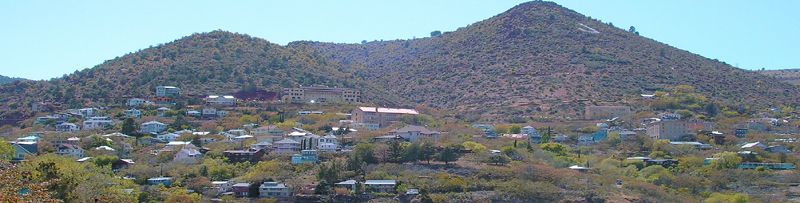
View of Jerome, Arizona, atop Cleopatra Hill by Kathy Alexander.
Perched high atop Cleopatra Hill overlooking the Verde Valley is the historic mining camp of Jerome, Arizona. Once a thriving copper mining town, Jerome has survived by becoming a mecca for artists and tourists.
Like most places in Arizona, Native Americans first inhabited the area as far back as 1,100 A.D. Several groups of ancient Indians thrived in the Verde Valley, including the Hohokam tribe and later the Sinagua at Tuzigoot. The Mogollon and Saluda occupied nearby regions of Arizona during much of the same time. By the early 1400s, the Sinagua Indians had abandoned the valley, but no one knows exactly why. By the time the Spanish explorers came to the region in 1582, the Yavapai Indians were settled there.
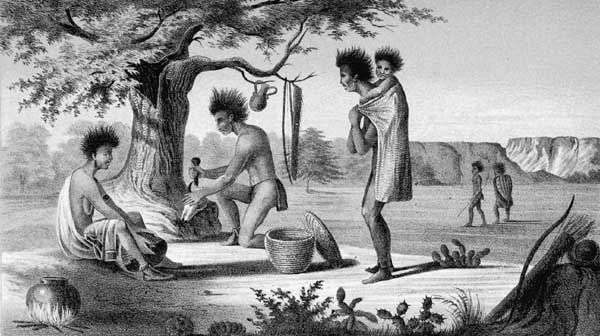
Yavapai people, by Lorenzo Sitgreaves’ first topographical mission across Arizona.
Always on the lookout for precious metals, the Spanish enticed the Yavapai to lead them to their mine, which was little more than a 16-foot cave-like pit in the area that is now Jerome. The Yavapai used copper metal to paint their faces, clothes, and blankets. But the Spanish weren’t interested in copper. In their quest for gold and silver, they soon abandoned the Indians. Through the years, a few lone prospectors worked in the area, but the Indians were left relatively alone until the 1850s. After the Mexican-American War ended in 1848 and the region became part of the United States, more and more Anglo-Americans began to settle the area. Ranchers, homesteaders, and more prospectors arrived. In 1863, gold was discovered near Prescott, and thousands of miners flooded the region.
To protect themselves from encroaching white settlers, the Yavapai, who had previously been peaceful, banded together to safeguard their land and food supplies. Hostilities broke out between the Indians and the settlers. After the Civil War, the U.S. Cavalry was sent in to subdue the Indians until General George Crook completely defeated the Yavapai in the fall and Winter of 1872-1873. What was left of the tribe was sent to the Camp Verde Reservation and later to the San Carlos Reservation.
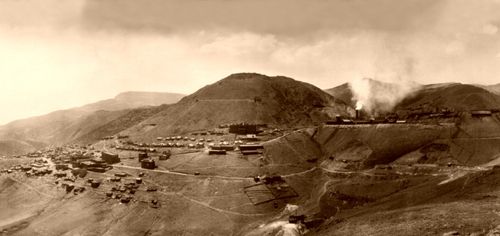
United Verde Mine, 1909.
By the 1880s, investors began to see the potential in copper, and several mines were established, including the United Verde Copper Company in 1882. Owned by Territorial Governor Frederick Tritle, the governor obtained financing from New York investors James McDonald and Eugene Jerome, for whom the town was named. The town boomed for the next year until the price of copper plummeted and the mine was forced to close. Although many people left, the town hung on and continued to grow slowly. By September 1883, a post office was established, which has never closed.
In 1888, William A. Clark, who had long owned several claims in the area, bought the United Verde Copper Company for $80,000.00. The ingenious entrepreneur began making several improvements, including bringing in a narrow-gauge railroad from Jerome Junction, which connected with Ash Fork and eventually the Santa Fe, Prescott, & Phoenix Railroad. The narrow-gauge line operated from 1895 to 1920, making its way through 187 curves and 28 bridges on its 27-mile run.
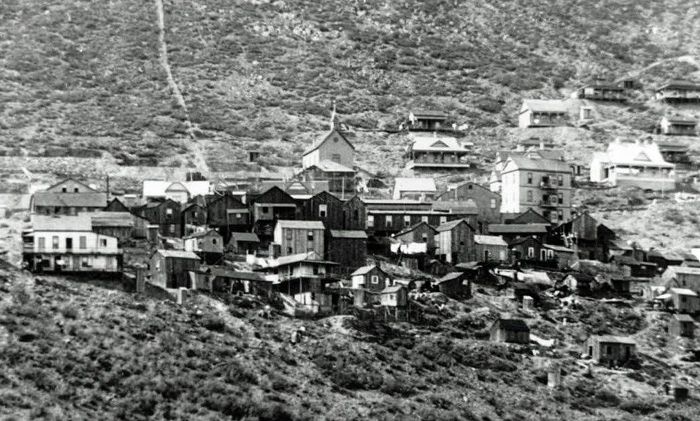
Jerome, Arizona, 1897.
Over the years, Clark expanded his operation with a surface plant in Jerome, a tunnel transfer system known as the “Hopewell Tunnel,” new loading facilities at Hope, and more standard-gauge railroads. Within seven years of purchasing the United Verde Copper Company, Clark was netting some $1 million per month in revenue.
Meanwhile, the town of Jerome was bustling and, by 1899, had become the fifth-largest city in the territory. The same year, the town was incorporated, and one of its primary focuses was specifying building codes.
Requiring brick or masonry construction, the laws were instituted to end the frequent fires that had plagued Jerome previously. Filled with wooden buildings, two blocks of the commercial district burned in 1894, and more fires blazed businesses in 1897, 1898, and 1899. One fascinating tale of the 1897 fire is when a madam from a local brothel ran into the street in a panic, offering free “business” to the entire fire department from then on if they would save her house. Not surprisingly, the house was saved.
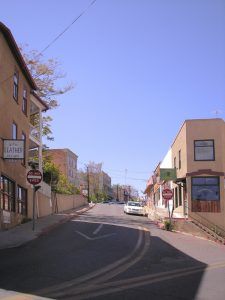
Jerome, Arizona Street View by Kathy Alexander.
Typical of many bustling mining camps, Jerome quickly gained a reputation as a rough, rowdy town with many saloons, gambling dens, and brothels. So much so that on February 5, 1903, the New York Sun proclaimed Jerome to be “the wickedest town in the West.”
Although incorporation brought official organization, a fire department, and a police force, it didn’t curb its vices or its reputation for wickedness. In fact, the chaos increased with even more prostitution, alcohol, gambling, drug abuse, and gunfights in the streets as the population continued to grow.
Continuing to expand and improve his mining operations, Clark began building another railroad in 1911, which connected the Verde Valley to Drake, Arizona. Spending $1.3 million to build the 38-mile Verde Valley Railroad, the line, operated by the Santa Fe, Prescott & Phoenix Railroad, was built in just one year.
A miracle of engineering, it took 250 men, 200 mules, and hundreds of pounds of explosives to lay the rails. Still operating today, the Verde Canyon Railroad offers a four-hour scenic train ride through the towering red rock pinnacles of Verde Canyon, through two national forests, past Indian ruins, and through a 680-foot man-made tunnel.
When World War I began, the price of copper soared, and the town really boomed, reaching about 15,000 people. Immigrants came from all over the world to work in the copper mines, which operated 24 hours a day. Several hotels were built solely to house the miners, who often rented rooms for eight-hour shifts. Many of the town’s businesses also operated around the clock – especially those of the more “shady” variety – including eight brothels, 21 saloons, and numerous opium dens. However, the more “civilized” folk also built three movie theaters, schools, swimming pools, bowling alleys, restaurants, churches, and an opera house.
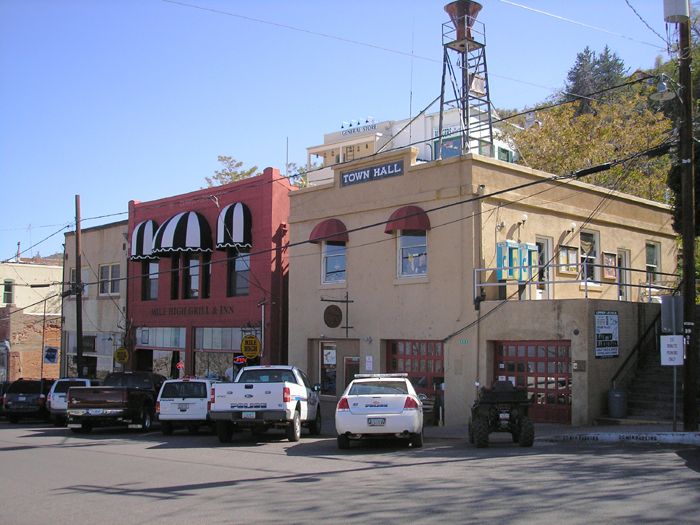
Jerome, Arizona buildings by Kathy Alexander.
Though the town was thriving, a cauldron of dissatisfaction was also boiling. Miners were becoming extremely unhappy about pay and working conditions in the mines. Union organizers were active, especially those of the Industrial Workers of the World (IWW), most often called the “Wobblies.” This group, which had been widely loathed by middle-class America, became much feared and hated at the outbreak of the war because many of their members were foreign and they posed a threat to the social and industrial order. They were also found to be “suspicious” simply because they were “Easterners.”
Though the non-miners may have been suspicious, the miners joined the union in waves, and by May 1917, strikes were in full force in all the mines in the Jerome area; a month later, they had spread statewide. But the mine owners in Jerome were having none of it. On July 12, armed agents of the mine owners roughly rounded up some 67 labor union organizers and unionized miners on a railroad cattle car and shipped them to Kingman, Arizona, warning them not to return if they valued their lives, an event that became known as the Jerome Deportation.
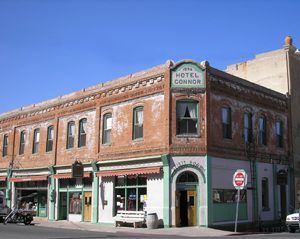
Hotel Connor in Jerome, Arizona by Kathy Alexander.
After the war, the price of copper ore began to decline, and it became harder and harder to extract from the mountain. By the time the Great Depression began, Jerome, along with the rest of the nation, was in a full-blown depression, and by 1930, the mines had closed. However, in 1935, Phelps Dodge bought up most mining operations in the area and began mining again on a larger scale, using tons of explosives and creating a huge open pit just North of the town. Using a full-scale underground railroad, the ore was moved to a new smelter in Clarkdale. Constant blasting and tunneling beneath the mountain had a dire consequence for the city of Jerome, as the town began to slide down the hill. Some businesses, including a movie theater, pharmacy, pool hall, and JC Penney’s, made an unwanted move. Other businesses crumbled. Jerome’s famous “Sliding Jail” can still be seen hundreds of feet downhill from its original location.
But the town’s hardy residents continued to “hang on,” and when World War II ended, copper prices rose again, putting the town “back in business.” But the rich copper ore was dwindling and getting even harder to get to. After the war, prices dropped once again, and finally, in 1952, Phelps Dodge closed its operations in Jerome forever. During its 70 years of operation, the United Verde Mine and others in the area produced more than $1 billion in copper, gold, silver, zinc, and lead.
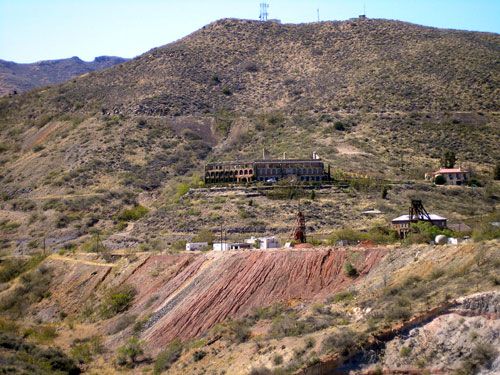
Remnants of mining in Jerome, Arizona by Kathy Alexander.
With no work, families moved in masses. Many, with no buyers for their homes, left them, complete with furnishings, before making their way to other opportunities. With only about 100 residents left in the town, buildings began to deteriorate, continued to slip down the hill, or suffered vandalism over the next two decades, despite the efforts of the Jerome Historical Society.
However, in the late 1960s, new residents, enchanted with the old town, began to move in once again. It soon developed into an artists’ community and tourist destination. On April 19, 1967, the Jerome Historic District was officially designated a Registered National Historic Landmark, and “That the past may live” became the town’s official motto.
The town began to promote itself as America’s newest and biggest ghost town. More and more tourists visited, and some decided to make it their home, gradually increasing the town’s population.
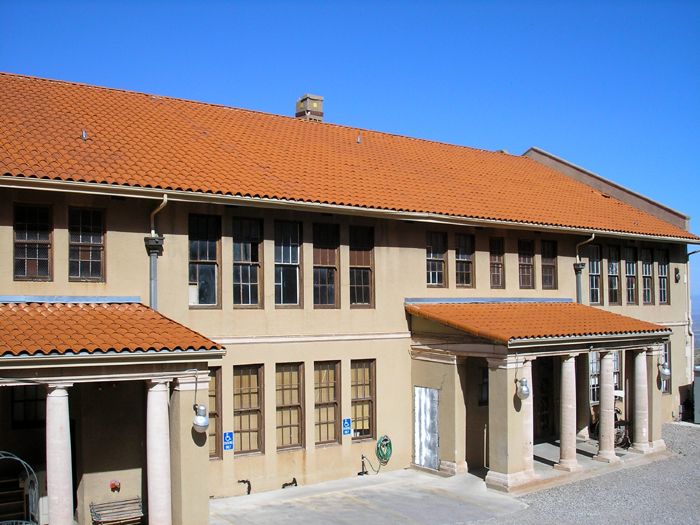
Civic Center in Jerome, Arizona by Kathy Alexander.
Today, this quaint town of about 400 residents offers tourists a view of the past through its numerous historic buildings, specialty shops, restaurants, and galleries. Take a walking tour of Jerome, where you’ll see restored historic structures and others with plans for restoration.
One interesting area is the “Crib District” across the street from the English Kitchen, in a back alley where all the buildings are part of Jerome’s infamous “prostitution row.” Mother Nature provides air conditioning, as the temperatures in Jerome are about 20 degrees cooler than in the Verde Valley.
In addition to its many photo opportunities, Jerome offers several attractions, including the Douglas Mansion State Park, a 1916 mansion and museum; carriage tours; and the Jerome Historical Society Museum. Nearby, ride the Verde Canyon Railroad, about ten minutes away; visit the Blazin’ M Ranch, a family entertainment center in Cottonwood; and explore Tuzigoot National Monument, a 12th-century Indian village.
Haynes and the Gold King Mine
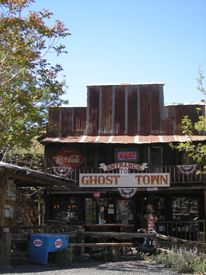
Haynes, Arizona, is located just one mile North of Jerome.
Just about a mile North of Jerome is another old mining camp called Haynes. In 1890, it was the home of the Gold King Mine and a bustling suburb of Jerome. Astride one of the richest copper deposits in history, the Haynes Copper Company sank a shaft 1200 feet into the mountain. Though they didn’t find copper, they got even luckier and discovered gold. In 1901, it boasted a population of 301 people. Even though it was so close to Jerome, it boasted its own post office from 1908 to 1922.
But, like Jerome and other area mines, Haynes’s ore wouldn’t last forever. By 1914, it was home to only 14 people and soon emptied. In the 1960s, it was sold and turned into a “ghost town” tourist attraction. Today, it is filled with several old buildings, a petting zoo, a walk-in mine, antique vehicles, and old machinery, much of which still operates today.
Some buildings are original, including the 1901 blacksmith shop, the clapboard hilltop home, once used as a boarding house and briefly as a bordello, and a 1914 sawmill that still fills lumber orders. Other buildings were brought in from the area, and some were reconstructed utilizing old lumber. The “town” offers demonstrations of antique mining equipment, the world’s largest gas engines, dozens of classic cars and trucks, and a billion-dollar view of the Verde Valley.
Haynes is located at 1000 Perkinsville Road just North of Jerome. If that isn’t enough to pique the usual tourist’s interest, it shouldn’t surprise you that Jerome is allegedly haunted. But that’s a whole ‘nother story. Click HERE!
Jerome, Arizona, is located between Prescott and Flagstaff on AZ Alternate 89.
©Kathy Alexander/Legends of America, updated October 2026.
See our Jerome-Haynes Photo Gallery HERE
Also See:
Arizona Ghost Towns & Mining Camps
Mining on the American Frontier
See Sources.