
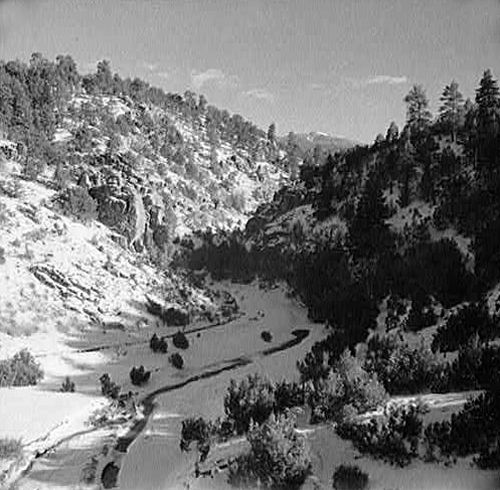
Sangre de Cristo Mountains.
By Andy Adams in 1906
In early September 1891, the eastern overland express on the Denver & Rio Grande Railroad was held up and robbed at Texas Creek. The place was little more than a watering station on that line, but it was an inviting place for hold-ups.
Surrounded by the front range of the Rocky Mountains, Peg-Leg Eldridge and his band selected this lonely station as best fitted for the transaction in hand. The Sangre de Cristo Range lay to the southwest, where the band had rendezvoused and planned this robbery. Farther to the southwest arose the snow-capped peaks of the Continental Divide, whose silent solitude an army might have taken refuge and hidden.
It was an inviting country to the robbers. These mountains offered retreats that had never known the tread of human footsteps. Emboldened by the thought that pursuit would be almost a matter of impossibility, they laid their plans and executed them without a single hitch.
At about ten o’clock at night, as the train slowed up as usual to take water, the engineer and fireman were covered by two robbers. The other two cut the express car from the train, and the engineer and fireman were ordered to decamp.
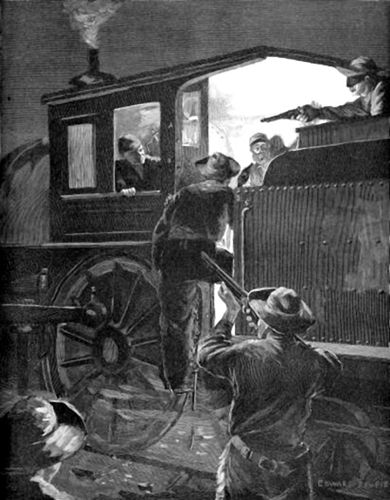
Train Robbery.
The robbers ran the engine and express car out nearly two miles, where, by the aid of dynamite, they made short work of a safe that the messenger could not open. The express company concealed the amount of money lost to the robbers, but smelters, aware of certain retorts in transit by this train, were not so silent. These smelter products were in gold retorts of such a size that they could be made away with as easily as though they had reached the mint and been coined.
There was scarcely any excitement among the passengers, so quickly was it over. While the robbery was in progress, the wires from this station flashed the news to headquarters. United States Marshal Bob Banks lived at a railroad division 156 miles from the robbery scene, whose success in pursuing criminals was not bounded by the state in which he lived. His reputation was in considerable measure due to the successful use of bloodhounds. This officer’s calling compelled him to be both plainsman and mountaineer. He had the well-deserved reputation of being as unrelenting in the pursuit of criminals as death is in marking its victims.
Within half an hour after the robbery was reported at headquarters, an engine had coupled to a caboose at the division where the marshal lived. He was equally hasty. Gathering his arms and getting his dogs aboard the caboose required a few moments.
Everything ready, they pulled out with a clear track to their destination. Heavy coal traffic had almost ruined the roadbed, but the engine and caboose flew over it regardless of its condition. Halfway to their destination, the marshal was joined by several railway and express officials. From there, the train turned westward, up the valley of the Arkansas River. A track and an occasion gave the most daring engineer license to throw the throttle wide open.
The climax of this night’s run was through the Grand Canyon of the Arkansas River. Into this gash in the earth’s surface plunged the engineer as though it were an easy stretch of downgrade prairie. As the engine rounded turns, the headlight threw its rays up serried columns of granite half a mile high—columns that reared their height in grotesque form and Gothic arch, polished by the waters of ages.
As the officials agreed, after a full discussion with the marshal of every phase and possibility of capture, the hope of this night’s work and the punishment of the robbers rested almost entirely on three dogs lying on the floor, and, as the rocking of the car disturbed them, growling in their dreams. In their helplessness to cope with this outrage, they turned to these dumb animals as a welcome ally.
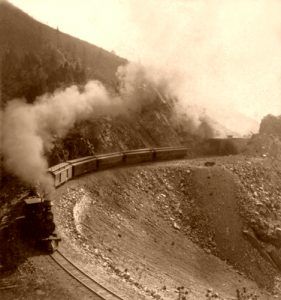
Denver and Rio Grande Railroad in Colorado, 1898.
Under the guidance of their master, they were an aid whose value he well understood. Their sense of smell was more reliable than the sense of seeing in man. You can believe the dog when you doubt your own eyes. His opinion is unquestionably correct.
As the train left the canyon, it was but a short run to the scene of the depredation. During the night, the few people who resided at this station were kept busy getting saddle horses together for the officer’s possession. This was not quickly done, as few horses were at the station, while the horses of nearby ranches were turned loose in the open range for the night. However, upon the train’s arrival, Banks and the express people found mounts awaiting them to carry them to the place of the hold-up.
After the robbers had finished their work, the train crew went out and brought the engine and express car back to the station.
The engine was unhurt, but the express car was severely shattered, and the through safe was ruined by the successive charges of dynamite that were used to force it to yield its treasure. The local safe was unharmed, the messenger having opened it to save it from the fate of its larger and stronger brother. The train proceeded on its way, losing a few hours and the treasure of its express.
The day was breaking in the east as the posse reached the scene. The marshal wasted no time circling about until the trail leaving was taken up. Even the robbers’ temporary camp was found near the chosen spot. This officer’s experienced eye soon determined the number of men, though they led several horses. It was a cool, daring act of Peg-Leg and three men. Afterward, his leadership in this raid was established when his history was learned.
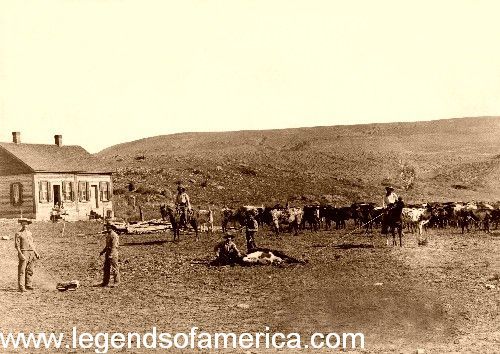
Branding Cattle in 1891.
Peg-Leg Eldridge was a product of that unfortunate era succeeding the Civil War. During that strife, the southwest herds were neglected, so thousands of cattle grew to maturity without earmarks or brands to identify their owner. A good amount of horses, a rope, and a running iron in the hands of a capable man were better than capital. The good old days when an active young man could brand annually fifteen calves–all better than yearlings–to every cow he owned are looked back to this day, from cattle king to the humblest of the craft, in pleasant reminiscence, though they will come no more. Eldridge was of that time, and when conditions changed, he failed to change with them. This was because he frequently got his brand on some other man’s calf under the changed condition of affairs. This resulted in his losing a leg from a gunshot at the hands of a man he had thus outraged.
Worse, it always branded him as a cattle thief, with every man’s hand against him. Thus, the steps that led up to this September night were easy, natural, and gradual. This child of circumstances, a born plainsman like the Indian, read in plain, forest, and mountain, things which were not visible to other eyes.
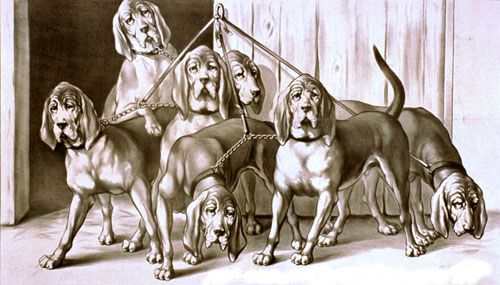
Bloodhounds.
By night, the stars were his compass, and the heat waves of the plain warned him of the tempting mirage. The cloud on the mountain’s peak or the wind in the pines that sheltered him spoke to him, and he understood.
The robbers’ trail was followed only a few miles when their course was well established. They were heading into the Sangre de Cristo Mountains. The pursuing party lost several hours here as they were compelled to await the arrival of several pack horses, so when the trail was taken up in earnest, they were at least twelve hours behind the robbers.
In the ascent of the foothills, the dogs led the posse, six in number, a merry chase. As they gradually rose to higher altitudes, the robbers’ trail became more compact and easy to follow, except for the roughness of the mountain slope. Frequently, the trail was but a single narrow path. The robbers had followed old game trails where the elk and deer, drifting in the advance of winter, crossed the range. These game trails were sure to lead to the passes in the range. Thus, by the instinct given to the deer and elk against the winter’s storm, the humblest of His creatures had blazed an unerring pathway to the mountain’s pass for these train robbers.
Along these paths, the trail was so distinct that the dogs were an unnecessary adjunct to the pursuing party. These hounds, one of which was a veteran in the service, while the other two, being younger, were without that practice, which was perfect, and showed an exuberance of energy and ambition in following the trail. The ancestry of the dogs was Russian. Hounds of this breed never give mouth, thus warning the hunted of their approach. Man-hunting is an exciting sport. Though the trail may look hours old, the possibility that any turn of the trail may disclose the fugitives keeps every nerve of the pursuer at the highest tension.
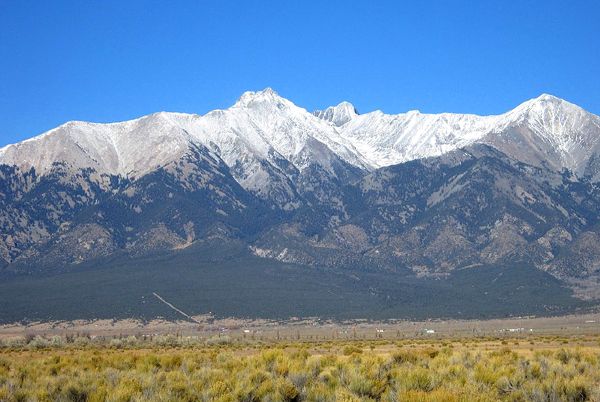
Sangre de Cristo Range, courtesy Wikipedia.
All day, the marshal and posse climbed higher and higher on the rugged mountainside. Night came on as they reached the narrow plateau that formed the mountain’s crest and found several small parks. Here, they made their first halt since the start of the morning. The necessity of resting their saddle stock was very apparent to Banks, though he would gladly have pushed on. The only halt he could expect of the robbers was to save their horses, and he must do the same. Forcing a tired horse an extra hour has left many an amateur rider afoot. He realized this. Knowing the necessity of being well mounted, the robbers had no doubt splendid horses. This was a reasonable supposition.
Near midnight, the marshal and posse set out again on the trail. He was compelled to take it afoot now, depending on his favorite dog under leash, the posse following with the mounts. The dogs led them several miles southward on this mountain crest. Here was where the dogs were valuable. The robbers had traveled, in some places, an entire mile over lava beds, not leaving as much as a trace that the eye could detect. Having the advantage of daylight, the robbers selected a rocky cliff, over which they began the descent of the western slope of this range. The ingenuity displayed by them to throw pursuit from their trail marked Peg-Leg as an artist in his calling. But with the aid of dogs and the dampness of night, their trail was as quickly followed as though it had been made in the snow.
This declivity was rough, and every one was compelled to dismount in places. Progress was extremely slow, and when the rising sun tipped the peaks of the Continental Range before they lay the beautiful landscape where the Rio Grande in a hundred mountain streams has her fountainhead. With only a few hours of rest for men and animals during the day, night fell upon them before they reached the mesa at the foothills on the western slope. An hour before nightfall, they came upon the first camp or halt of the robbers. They had spent a short time here, and there was no indication that they had slept. Criminals are inured to all kinds of hardship. They have been known to go for days without sleep, while smugglers, well mounted, have put 100 miles of country behind them in a single night.
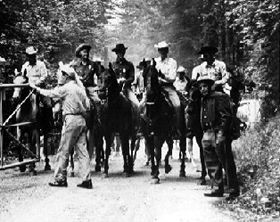
Posse in the Old West.
The marshal and party pushed forward during the night, making the country more favorable. When morning came, they had covered many a mile, and it was believed they had made time as the trail seemed fresher. There were several ranches along the mainstream in the valley, which the robbers had avoided with well-studied caution, showing that they had passed through in the daytime. Several railroad lines are running through this valley section. These crossed at points between stations, where observation would be almost impossible by day or night. Inquiries at ranches failed because of the lack of accurate means of description. The posse was maintaining a due southwest course that was carrying them into the fastnesses of the main range of the western continent. Another full day of almost constant advance and the trail had entered the undulating hills forming the approach of this second range of mountains. Physical exertion was beginning to tell on the animals, and they were compelled to make frequent halts in the ascent of this range.
The fatigue was showing in the two younger dogs. Their feet had been cut in several places when crossing the first range of mountains. During the past nights in the valley, though their master kept a sharp lookout, they encountered several places where sand burrs were plentiful. These burrs in the tender inner part of a dog’s foot, if not removed at once, soon lame it. The poor creatures often lain down, licking their paws in anguish. On examination during the previous night, their feet were found to be webbed with this burr. Now, on climbing this second mountain, they began to show the lameness which their master so much feared until it was almost impossible to make them take any interest in the trail. The old dog, however, seemed nothing the worse for his work.
On reaching the first small park near the summit of this range, the pursuers were so exhausted that they lay down and took their first sleep, having been over three days and a half on the trail. The marshal slept several hours but was the last to go to sleep and the first to wake. Before going to sleep and on arising, he was particular about bathing the dogs’ feet. The nearest approach to a liniment he possessed was a lubricating tube for guns, which he fortunately had with him. This afforded relief.
It was daybreak when the pursuers took up the trail. The plateau on the crest of this range was, in places, several miles wide, having a luxuriant growth of grass upon it. The course of the robbers continued to the southwest. The pursuers kept this plateau for several miles, and before descending the western slope of the range, an abandoned camp was found, where the pursued had evidently made their first bunks. Indications of where horses had been picketed for hours and where both men and horses had slept were evident. The trail where it left this deserted camp was in no wise encouraging to the marshal, as it looked at least 36 hours old. As the pursuers began the descent, they could see below them where the San Juan River meanders to the west until her waters, mingling with others, find their outlet into the Pacific. It was a trial of incessant toil down the mountain slope, wearisome alike to man and beast. Near the foothill of this mountain, they were rewarded by finding a horse that the robbers had abandoned because of an accident. He was an extremely fine horse but so lame in the shoulders, apparently owing to a fall, that it was impossible to move him. The robbers’ trail kept in the foothills, finally doubling back an almost due east course. Now and then, ranches were visible on the mesa, but the pursued carefully avoided them.
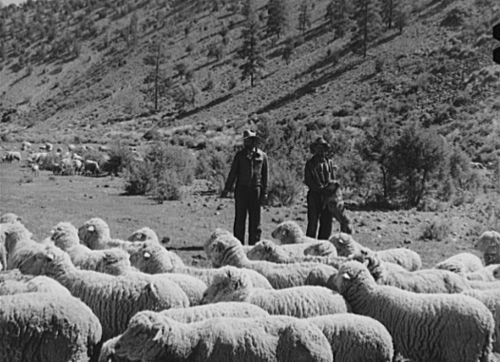
Sheepherder.
Spending a night in these hills, the posse prepared to start early. Here, however, they met their first serious trouble. The younger dogs had feet so badly swollen that it was impossible to make them take any interest in the trail. After doing everything possible for them, their owner sent them to a ranch that was in sight several miles below in the valley. Several hours were lost to the party by this incident, though they were not deterred from following the trail, still having the veteran dog. Late that afternoon, they met a shepherd who gave them a description of the robbers.
“Yesterday morning,” said the shepherd, in broken Spanish, “shortly after daybreak, four men rode into my camp and asked for breakfast. I gave them coffee, but as I had no meat in my quarters, they tried to buy a lamb, which I have no right to sell. After drinking the coffee, they tendered me money, which I refused. On leaving, one of them rode into my flock and killed a kid. Taking it with him, he rode away with the others.”
This simple shepherd provided a good description of the robbers, including a full description of men, horses, colors, and the condition of the pack. The next day, nothing of importance developed, and the posse hugged the shelter of the hills skirting the mountain range, crossing into New Mexico.
It was late that night when they went into camp on the trail. They had pushed forward with every ounce of energy, hoping to lessen the intervening distance between them and the robbers. The following morning, upon awakening, to everybody’s surprise and mortification, the old dog could not stand on his feet. While this was considered a serious drawback, it did not necessarily check the chase.
In bringing to bay over 30 criminals, one of whom had paid the penalty for his crime on the gallows, master, and dog, he had heretofore been an invincible team. Old age and physical weakness had overtaken the dog in a critical chase, and the sympathy he deserved was not withheld, nor was he deserted. Tenderly as a mother would lift a sick child, Banks gathered him in his arms and lifted him to one of the posse on his horse.

Trail in the Colorado mountains.
To the members of the posse, it was a touching scene: they remembered him but a few months before pursuing a flying criminal, when the latter–seeing that escape was impossible and turning to draw his weapon upon the officer, whose six-shooter had been emptied at the fugitive, but who with a drawn knife was ready to close with him in the death struggle — immediately threw down his weapon and pleaded for his life.
Yet this same officer could not keep the tears from his eyes as he lifted this dumb comrade of other victories to a horse. With an earnest oath, he brushed the incident away by assuring his posse that unless the earth opened and swallowed up the robbers, they could not escape. A few hours after taking up the trail, a ranch was sighted, and the dog was left, the instructions for the Good Samaritan being repeated. They bought two fresh horses at this ranch, which proved a valuable addition to their mounts.
Now, it had become a hunt of man by man. Keeping the trail was a little difficult for an experienced trailer like the marshal. The fact that the robbers kept to the outlying country was an advantage. Yet the latter traveled night and day, while pursuit must be by day only. With the fresh horses secured, they covered a stretch of the country hardly credible.
During the day, they found a place where the robbers had camped for at least a full day. A trail made by two horses had left this camp and returned. The marshal had followed it to a rather pretentious Mexican rancho, where a small store was kept. Here, a second description of the two men was secured, though neither was Peg-Leg. He was so indelibly marked that he was crafty enough to keep out of sight of so public a place as a store.
These two had tried unsuccessfully to buy horses at this rancho. The following day, the representative of the express company left the posse to report progress. He could give such an exact description of the robbers that the company, through their detective system, was not long in locating the leader. The marshal and posse pushed on with the same unremitting energy. The trail was now almost due east. The population of the country was principally Mexican, and even Mexicans, the robbers avoided as much as possible. They had, however, bought horses at several ranches and were always liberal in the use of money but very exacting regarding the quality of horseflesh they purchased; the best was none too good for them. They passed north of old Santa Fe town, and entering a station on the railway line by that name late at night, they were liberal patrons of the gaming tables that the town tolerated. The following day, they had disappeared.
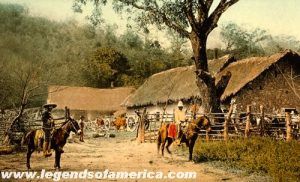
Mexican Hacienda.
At no time did the pursuers come within two days of them. This was because they traveled by night as well as day. At the last-mentioned point, messages were exchanged with the express company with little loss of time. Banks had asked that specific points on the railway be watched in the hope of capture while crossing the country, but the effort was barren of results. Following the trail, the marshal had re-crossed the continuation of the first range of mountains they had crossed to the west ten days before, or the morning after the robbery, 300 miles southward. There was nothing difficult in the passage of this range of mountains, and now before them stretched the endless prairie to the eastward. Here, Banks seriously felt the loss of his dogs. This was a country that could be used to a good advantage. It would then be a question of the endurance of men and horses. As it was, he could work only by day. If the band held its course, two railway lines were yet to be crossed. The same tactics were resorted to as formerly, yet this vigilance and precaution availed nothing as Peg-Leg crossed them carefully between two of the watched places. He knew the country better by night than day because of his occupation.
The officials of the express company met Banks on one of these railroad lines. The exhaustive amount of information they had collected regarding this fascinating man with the wooden leg was astonishing. Out of the abundance of the data, a few items interested the officer. Several of Eldridge’s haunts, when not actively engaged in his profession, were located. In one of these haunts was a woman, and toward this one, he was heading, though it was many a weary mile distant.
At the marshal’s request, the express people brought bloodhounds. The dogs proved worthless, and the second day were abandoned. The robbers were three days ahead when the trail crossed the Gulf Railway. The posse had now been fourteen days on the trail. Banks followed them one day farther, himself alone, leaving his tired companions at a station near the line of the Panhandle of Texas. This extra day’s ride was to satisfy himself that the robbers were making for one of their haunts. They kept, as he expected, down between the two Canadians.
After following the trail until he was thoroughly satisfied with their destination, the marshal retraced his steps and rejoined his posse. The first train carried him and the posse back to the express company headquarters.
Two weeks later, there was a horse race of considerable importance at a country store in the Chickasaw Nation. The countryside was gathered to witness it. The owners of the horses had made large wagers on the race. Outsiders wagered money and livestock for a large amount. There were several strangers present, which was nothing unusual.
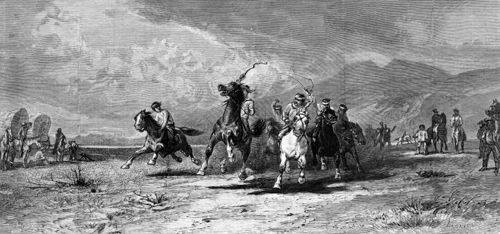
Indian Horse Race.
As the race was being run and every eye was centered on the outcome, a stranger present put a six-shooter to a very interested spectator’s ear and informed him that he was a prisoner. Another stranger did the same thing to another spectator. They also snapped handcuffs on both of them. One of these spectators had a peg leg. They were escorted to a waiting rig, and when they alighted from it, they were on the line of a railroad 40 miles distant. One of these strangers was a United States marshal, who, for the past month, had been very anxious to meet these same gentlemen.
Once safe from the rescue of friends of these robbers, the marshal regaled his guest with the story of the chase, which had now terminated. He was even able to give Eldridge a good part of his history. But when he attempted to draw him out as to the whereabouts of the other two, Peg was sullenly ignorant of anything. They were never captured, having separated before reaching Mr. Eldridge’s haunt.
Eldridge was tried in a Federal court in Colorado and convicted of train robbery. He went over the road for a term of years far beyond the lease of his natural life. With the companion captured simultaneously, he was taken by an officer of the court to Detroit, Michigan, for confinement. When within an hour’s ride of the prison—his living grave–he raised his ironed hands and, twisting from a blue flannel shirt, which he wore a large pearl button, said to the officer in charge:
“Will you please take this button back and give it, with my compliments, to that human bloodhound and tell him I’m sorry I didn’t anticipate meeting him? If I had, it would have saved you this trip with me. He might have got me, but I wouldn’t have needed a trial when he did.”
Andy Adams, 1906. Compiled and edited by Kathy Alexander/Legends of America, updated March 2025. About the Author: The Passing of Peg-Leg was written by Andy Adams in 1906 and included in his book Cattle Brands: A Collection of Western Camp-Fire Stories. As it appears here, the story is not verbatim, as it has been edited for the modern reader.
Also See:
Bad Medicine – The Story of a Cattle Drive by Andy Adams