
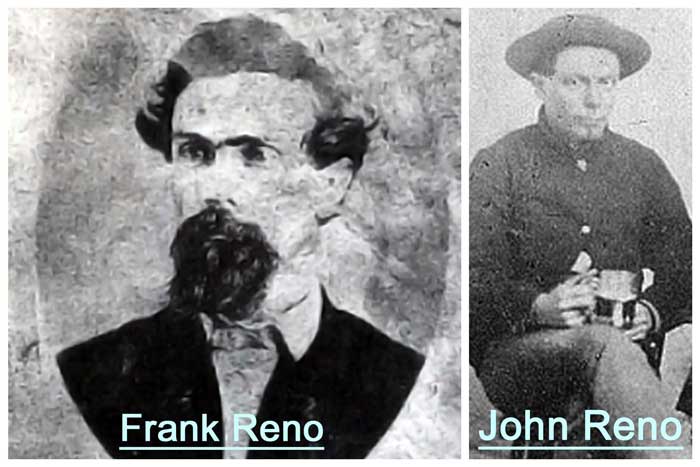
Outlaws Frank Reno and his brother John.
During the years after the Civil War, much of the nation suffered unemployment and lawlessness, spawning several notorious desperadoes and outlaw gangs. It was during this time that the Reno Gang from Indiana began to terrorize the Midwest and was involved in one of the first train robberies in America.
One of the first outlaw brotherhoods in the United States, the Reno Gang was primarily made up of four brothers—Frank, John, Simeon, and William Reno —who all came from the small rural community of Rockford, two miles north of Seymour, Indiana.
The Reno family, comprised of five sons and one daughter, was headed up by J. Wilkison and Julia Ann Reno, who owned a 1,200-acre farm. Frank was the first son born in 1837, followed by John in 1838, Simeon (“Sim”) in 1843, Clinton in 1847, William in 1848, and Laura in 1851.
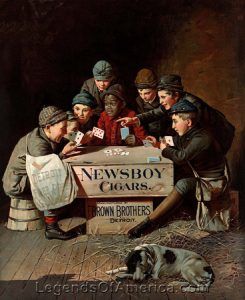
Boys Playing Cards,
Strictly religious, the children were required to study the bible for hours on Sundays, attend school, and work on the farm. Perhaps resenting their stringent religious upbringing, all but Clinton, called “Honest Clint,” rebelled and found trouble at an early age. Even the daughter, Laura, was known to have been as wild as her four brothers, who would later form the Reno Gang.
The older boys began to play crooked card games along the farm road when they were still very young, bilking travelers as they passed by. The trouble increased with several small burglaries and a rash of horse thefts. But by 1851, the bunch had become out-right criminals when several retailers’ businesses were set ablaze, and the Renos were suspected of arson.
When the Civil War began, Frank and John became “bounty jumpers.” At this time, federal recruiting officers paid a cash bounty to any man who signed up for military service, so the Renos joined, pocketed the cash, and deserted. Later, they would turn up in another area and go through the whole process again. Then, when the draft began, they would make money from prosperous draftees who wanted to avoid the war. After taking the money from the man to be drafted, they would then appear as demanded, only to desert days later.

A bounty was offered to join the Cavalry.
In 1864, the pair returned to Rockford, followed by several other “bounty jumpers” and lawless types they had met during their travels. Forming a gang, Frank, John, Sim, and William, along with the other miscreants, were headquartered in the burned-out buildings of Rockford.
Late in 1864, Frank and two other gang members by the names of Grant Wilson and Dixon robbed the post office and Gilbert’s Store in nearby Jonesville, Indiana. Before long, they were captured by U.S. Marshals but could post bond and be released, with a trial date pending.
The next year, two more post offices were robbed in Dudleytown and Seymour, along with several retail burglaries.
In the meantime, Grant Wilson, who had been involved in the Jonesville robbery, turned state’s evidence, agreeing to testify against Frank Reno. However, before the trial was scheduled, Wilson was murdered, and without his testimony, Frank was acquitted.
Next, the Reno Gang made their headquarters in a Seymour Hotel called the Radar House, where unfortunate travelers who stayed there often left penniless. They also orchestrated several robberies across the Midwest and operated a counterfeit ring from here.
Various members of the gang were arrested several times, but they were always released. The brothers bragged that they had “political clout,” but the real story was that they were bribing or terrorizing officials into silence.
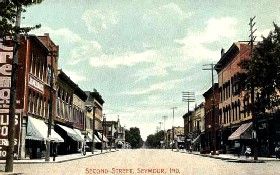
Seymore, Indiana.
By July 27, 1865, things had become so bad in the Seymour area that the Seymour Times issued a warning stating: “Be wary of thieves and assassins that infest the place.” A week later, on August 3, the paper ran an editorial condemning the lawlessness and calling for vigilantes to restore order, stating: “Nothing but Lynch law will save the reputation of this place and its citizens.”
Despite the feelings of area citizens, the crime spree continued. In early 1866, a Radar House guest’s beheaded body was found floating in the White River, and the Courtland post office was robbed on January 11. More murders occurred in February and July 1866, and the ruthless gang of cutthroats continued to rob travelers who passed through Jackson County, as well as branching out to neighboring communities, where they raided numerous merchants and county treasuries.
By this time, they were so well organized that no law official dared to arrest them, and witnesses kept silent in fear of their lives.
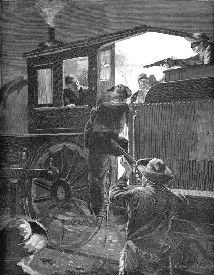
Train Robbery.
Soon, the gang conceived of a new idea — to rob a train, opening the door to a “new” form of outlawry for years to come. On the night of October 6, 1866, John and Simeon Reno, along with Frank Sparks, boarded the east-bound Ohio & Mississippi train at the Seymour depot. Once onboard, the three masked men made their way to the express car, held a gun on the messenger, and stole some $12,000. Afterward, they pulled the bell rope to signal the engineer to stop the train, then jumped off into the darkness as it slowed. The first recorded peacetime train robbery had occurred in just a matter of minutes.
On September 28, 1867, a “copycat” holdup occurred at Seymour when another train was robbed. Authorities at first suspected the Reno brothers, but later it was found that Walker Hammond and Michael Colleran robbed the train. Pulled off in the same manner as the Reno hold-up the previous year, the pair heisted about $8,000. Though Hammond and Colleran were “associates” of the Renos, John Reno tracked them down, beat them up, and turned them in, without the money, of course.
The next major holdup by the gang occurred when John Reno traveled to Missouri with gang member Val Elliott. They robbed the Daviess County Courthouse in Gallatin on November 17, 1867, making off with more than $23,000 in cash and bonds. John, who had been recognized, was soon hotly pursued by the Pinkertons, who finally caught up with him in Seymour on December 4, 1867, and returned him to Missouri for trial. As a lynch mob formed outside the courthouse, John Reno pled guilty on January 18, 1868, and was sentenced to 25 years of hard labor at the Missouri State Penitentiary in Jefferson City.
In the meantime, Frank stayed back in Indiana, where several Indiana treasuries were burglarized. Though he was arrested for the Clinton County robbery, he was found not guilty. Obviously, brother John’s hard time was no deterrent to the rest of the gang.
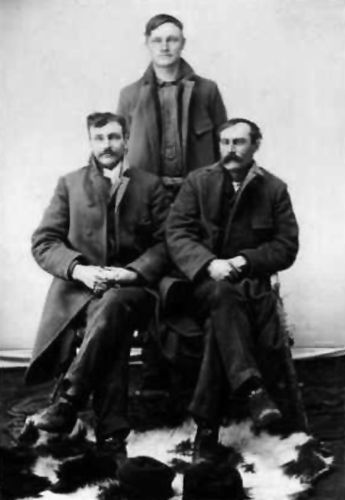
Pinkerton Agents.
On February 18, 1868, the gang robbed the Harrison County treasury in Magnolia, Iowa, netting some $14,000. The very next week, the gang robbed the Louisa and Mills County, Iowa, treasuries for about $18,000, soon followed by another robbery of the Howard County treasury in late March.
Hiding out at the home of Michael Rogers in Council Bluffs, gang members Frank Reno, Albert Perkins, and Miles Ogle were tracked down by the Pinkertons. William Pinkerton led a raid on the house where they arrested the trio and recovered about $14,000. However, not long after the bandits had been jailed, they managed to break through a hole in the cell wall and escape on April 1, 1868, leaving a note on the wall stating: “April Fools.”
Heading back to their “home base” in Seymour, Frank and the gang planned their next big heist. On May 22, 1868, they struck another train in Marshfield, Indiana, some 17 miles south of Seymour. After forcing their way into the Express car, they threw the messenger from the train and robbed it of some $96,000 in cash and government bonds. After the loot was divided, the gang went into hiding with Frank Reno, Charlie Anderson, Albert Perkins, Michael Rogers, and Miles Ogle heading for Windsor, Canada, just across the border from Detroit. Sim and William Reno hid out in Indianapolis, where they liked to gamble. Frank Sparks, Volney Elliott, John Moore, Charles Roseberry, Henry Jerrell, and Theodore Clifton returned to Jackson County, Indiana, where they immediately began to plan yet another train robbery. But the Pinkertons were quickly on the trail of every member of the gang.
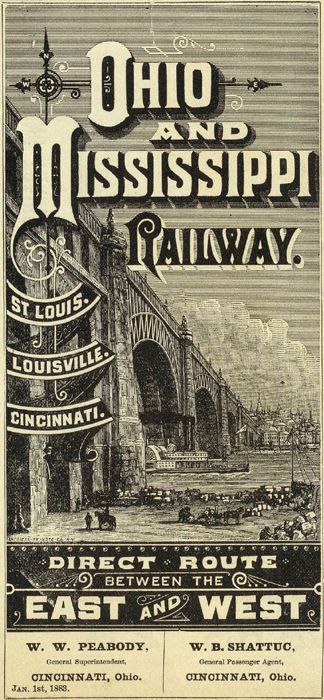
Ohio & Mississippi Railway.
On July 9, 1868, the six members of the Reno Gang, who had returned to Jackson County — Sparks, Elliott, Moore, Roseberry, Jerrell, and Clifton, attempted to rob an Ohio & Mississippi train at the Shields watering station near Brownstown, west of Seymour. However, when the outlaws attempted to enter the express car, they were met with a volley of gunfire. The ten Pinkerton detectives hidden in the express car wounded Henry Jerrell, Volney Elliott, and John Moore. However, all the gang members except Elliott escaped. Soon, though, Theodore Clifton and Charles Roseberry were arrested near Rockford, and all three prisoners were taken to the Seymour jail. On the night of July 20, 1868, the prisoners were to be moved by train; however, three miles west of Seymour, the train was stopped by a group of hooded men who called themselves the Jackson County Vigilance Committee. Forcing the officials to give up the prisoners, the vigilantes lynched Elliott, Clifton, and Roseberry from a nearby tree.
The other three bandits who had gotten away were soon tracked to Coles County, Illinois, where they were hiding at a friend’s farm. The day after the trio was lynched by the vigilante committee, Henry Jerrell, Frank Sparks, and John Moore were captured and brought to Seymour by train. However, while the lawmen were escorting the prisoners to the Brownstown jail in a wagon on July 25, they were again stopped by the vigilantes who lynched them from the same tree as three previously hanged.
The same month, lawmen were beginning to catch up with the Reno brothers, who had so far eluded the law. William and Simeon were soon captured by Pinkertons in Indianapolis and taken to the Scott County Jail in Lexington. Upon their arrest, the vigilantes announced that they would raid the jailhouse and hang these two as well. However, Laura Reno soon offered to pay all expenses if the county would transfer her brothers to the sturdier New Albany jail, an offer that was quickly accepted. Secretly moved in the middle of the night, the outlaw pair was turned over to Sheriff Thomas Fullenlove of Floyd County on July 29.
In the meantime, the Pinkertons had tracked Frank Reno and Charlie Anderson in Canada and worked diligently to secure their extradition. However, the gang had different plans, concocting a scheme to murder Allan Pinkerton, but the crafty detective could thwart two different attempts on his life. The outlaws then resorted to bribery, but this too failed. Finally, after several delays and political maneuverings, Pinkerton was given custody of the prisoners on October 6, 1868.
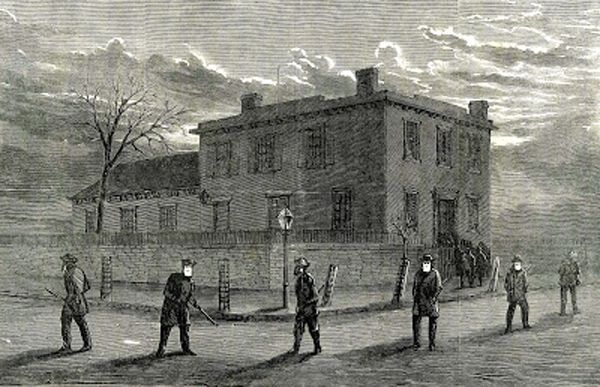
The Reno Gang was held at the jail in New Albany, Indiana.
The next day, Pinkerton and his heavily armed men boarded a steamer bound for Cleveland, where they traveled by train to Cincinnati, Ohio, then finally delivered the pair to the New Albany, Indiana jail, where Frank Reno was unhappily reunited with his brothers, Sim and William. Pinkerton then inspected the jail and urged Sheriff Thomas Fullenlove to remove his prisoners to an even stronger jail at Indianapolis, but Fullenlove refused.
When the New Albany citizens heard that two more of the Reno Gang had been ensconced in the town jail, they were terrified. It was no secret that the vigilantes had already tried to hang Sim and William, and they were sure to make more concerted efforts to follow through now that the jail held even more members. In response, what was left of the gang soon contacted a Fort Wayne newspaper, which reported that if the Renos were hanged, the rest of the gang would lay Seymour in ashes. In addition, several newspapers publicly ridiculed Sheriff Fullenlove and Scott County for imprisoning the outlaws in New Albany, a move that was sure to incite violence.
In response, Sheriff Fullenlove made a public announcement, “We do not believe that there is any danger of the Jackson County Vigilance Committee extending their visit to New Albany. They would be sure to meet a hot reception here, and they had better keep their distance. These men were sent here for safekeeping, and they will be safely kept if it is in the power of the authorities to do so.”
But Fullenlove’s statement would prove to be as flimsy as his jail. In the pre-dawn hours of December 12, 1868, more than 50 hooded men crept up upon the New Albany jail, cutting the telegraph wires and seizing outside guard Chuck Whitten, who patrolled the grounds. They then forced their way into the building that housed both the jail and the sheriff’s residence, where they seized Sheriff Fullenlove and his wife. When the Sheriff refused to hand over the keys to the Renos’ cells, the vigilantes beat him and shot him in the right arm. Mrs. Fullenlove then surrendered the keys, and the determined men proceeded to the cells, where they dragged out the three Renos and Anderson. Hauled to the top of the iron stairway on the second story of the jail, the vigilantes first hanged Frank, then William, then Simeon, and lastly, Anderson, who actually had to be strung up twice because the first rope broke. The time was approximately 4:30 a.m.
After the bodies were cut down, they were displayed in pine coffins in the jail as the doors were opened for thousands of people to stream by and gawk at the remains of the notorious Reno Gang.
A Chicago, Illinois newspaper would say of that evening: “one of the most violent nights in the history of our country.”
Afterward, there was a half-hearted investigation into the lynching, but nothing came of it.
Laura Reno made arrangements for her brothers’ bodies to be returned to the Seymour City Cemetery, where they were buried. Charlie Anderson’s widow also buried her husband in the New Albany area.
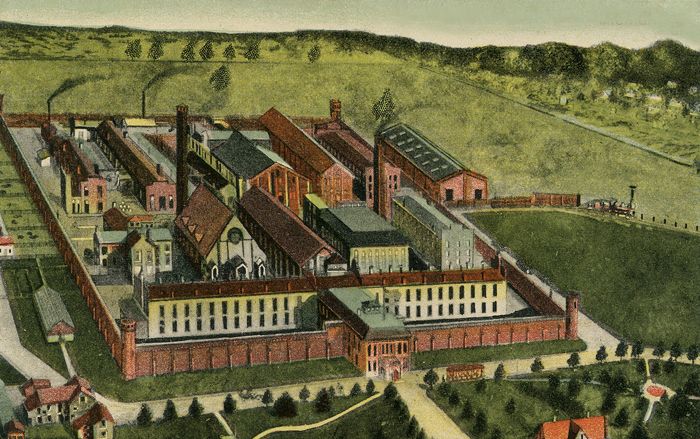
Indiana State Prison in Michigan City, Indiana.
John Reno was finally released from prison in February 1878 and returned to Seymour. Seven years later, he would be sentenced to three years in the Indiana State Prison at Michigan City for passing counterfeit bills. Once again, after his release, he returned to Seymour, where he died at home on January 31, 1895.
Though Reno brother Clinton, who was labeled as “honest,” never participated in the Reno Gang’s activities, he too was in trouble with the law over the years, indicted for assault and battery in 1874, accused of selling liquor to a minor in 1878, and arrested twice for keeping a gambling house in 1885 and 1890. Later, he moved west and died in a Topeka, Kansas, insane asylum in 1921, reportedly after suffering from religious delusions for several years.
Laura Ellen Reno, who always supported her brothers, eventually married and became a respectable citizen.
“Jackson County contains more cutthroats to the square inch than Botany Bay.”
– Indiana newspaper account
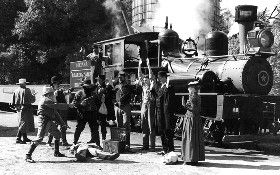
Train Robbery.
©Kathy Alexander/Legends of America, updated April 2026.
Also See:
Outlaws and Scoundrels Photo Gallery
Pinkerton Detective Agency – For 150 Years
The Railroad Blasts Across America
See Sources.