
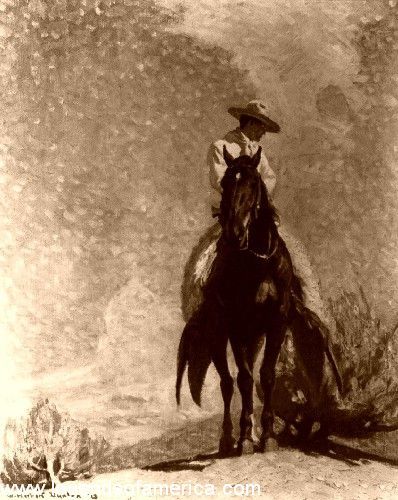
Range Rider.
By Emerson Hough in 1918.
The Great West, vast and rude, brought forth men also vast and rude. Today [1918], over parts of that matchless region, we see the red hills and ragged mountain fronts cut and crushed into huge indefinite shapes, to which even a small imagination may give a human or more than human form. It would almost seem that the same great hand which chiseled out these monumental forms had also laid its fingers upon the people of this region and fashioned them rude and iron-like, in harmony with the stern faces set about them.
Of all the babes of that primeval mother, the West, the cowboy was perhaps her dearest because he was her last. Some of her children lived for centuries; this one was not a triple decade before he began to be old. What was really the life of this child of the wild region of America, and what conditions of the experience bore him, can never be fully known by those who have not seen the West with wide eyes — for the cowboy was simply a part of the West. He who does not understand the one can never understand the other.
If we truly care to see the cowboy as he was and seek to give our wish the dignity of a real purpose, we should study him in connection with his surroundings and in relation to his work. Then we shall see him not as a curiosity but as a product, not as an eccentric driver of horned cattle but as a man suited to his times.
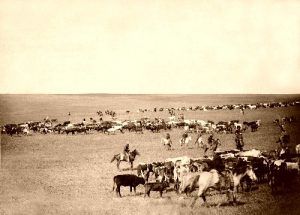
Cattle Roundup near Belle Fourche, South Dakota, 1887.
Large tracts of that domain where once the cowboy reigned supreme have been turned into farms by the irrigator’s ditch or by the dry farmer’s plan. The farmer in overalls is, in many instances, his own stockman today. On the ranges of Arizona, Wyoming, and Texas, and parts of Nevada, we may find the cowboy, it is true, even today, but he is no longer the Homeric figure that once dominated the plains. In what we say as to his trade, therefore, or his fashion in the practice of it, we speak in terms of 30 or 40 years ago, when wire was unknown, when the roundup still was necessary, and the cowboy’s life was indeed that of the open.
By the costume, we may often know the man. The cowboy’s costume was harmonious with its surroundings. It was planned upon lines of such stern utility as to leave no possible thing that we may call dispensable. The typical cowboy costume could hardly be said to contain a coat and waistcoat. The heavy woolen shirt, loose and open at the neck, was the common wear in all seasons except winter. One has often seen cowboys in the wintertime engaged in work about the ranchyard or corral, wearing no other covering for the upper part of the body but one or more of these heavy shirts. If the cowboy wore a coat, he would wear it open and loose as much as possible. If he wore a “vest,” he would wear it slouchily, hanging open or partly unbuttoned most of the time. There was a reason for this slouchy habit. The cowboy would say that the vest, closely buttoned about the body, would cause perspiration so that the wearer would quickly chill upon ceasing exercise. If the wind blew keenly when the cowboy dismounted to sit on the ground for dinner, he would button up his waistcoat and be warm. If it were very cold, he would also button up his coat.
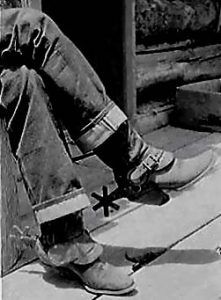
Cowboy’s Boots.
The cowboy’s boots were of fine leather and fitted tightly, with light, narrow soles, extremely small, and high heels. Surely, a more irrational form of foot-covering was never invented, yet these tight, peaked cowboy boots had great significance and may indeed be called the insignia of a calling.
There was no prouder soul on earth than the cowboy. He was proud of being a horseman and had contempt for all human beings who walked. He was lost on foot in his tight-toed boots, but he wished it to be understood that he never was on foot. If we rode beside him and watched his seat in the big cow saddle, we found that his high and narrow heels prevented the foot from slipping forward in the stirrup, into which he jammed his feet nearly to full length. The cowboy’s foot never hung in the stirrup if there was a fall. In the corral roping, afoot, his heels anchored him. So he found his little boots not so unserviceable and retained them as a matter of pride. Boots made for the cowboy trade sometimes had fancy tops of bright-colored leather. The Lone Star of Texas was not infrequent in its ornamentation.
The curious pride of the horseman extended also to his gloves. The cowboy was very careful in selecting his gloves. They were made of the finest buckskin, which wetting could not injure. Generally, they were tanned white and cut with a deep cuff or gauntlet from which hung a little fringe to flutter in the wind when he rode at full speed on horseback.
The cowboy’s hat was one of the typical and striking features of his costumes. It was a heavy, wide, white felt hat with a heavy leather band buckled about it. No other head covering has been devised so suitable as the Stetson for the uses of the Plains, although high and heavy black hats have in part supplanted it today among stockmen. The board-like felt was practically indestructible. The brim flapped a little and, in time, was turned up and perhaps held fast to the crown by a thong.

Cowboy chaps and hat.
The wearer might sometimes stiffen the brim by passing a thong through a series of holes pierced through the outer edge. He could depend upon his hat in all weathers. In the rain, it was an umbrella; in the sun, a shield; in the winter, he could tie it down about his ears with his handkerchief.
Loosely thrown about the cowboy’s shirt collar was a silk kerchief. It was tied in a hard knot in front, and though it could scarcely be said to be devoted to the uses of a neck scarf, it was a great comfort to the back of the neck when one was riding in a hot wind. It was sure to be of some bright color, usually red. Modern would-be cowpunchers do not willingly let this old kerchief die, and right often, they overplay it. However, for the cowboy of the “movies,” let us register an unqualified contempt. The real range would never have been safe for him.
A peculiar and distinctive feature of the cowboy’s costume was his “chaps” (chaparejos). The chaps were two very wide, full-length trouser legs made of heavy calfskin and fastened with a narrow belt or strap. They were cut away entirely at the front and back to cover only the thigh and lower legs, and did not heat the body as a complete leather garment would. They were intended solely as protection against branches, thorns, briars, and the like, but they were prized in cold or wet weather. Sometimes, more often on the southern range, a cowboy was seen wearing chaps made of skins tanned with the hair on; for the cowboy of the Southwest early learned that goatskin left with the hair on would turn the cactus thorns better than any other material. Later, the chaps became a sort of affectation on the part of new men on the range, but the old-time cowboy wore them for use, not as a uniform. In hot weather, he laid them off.
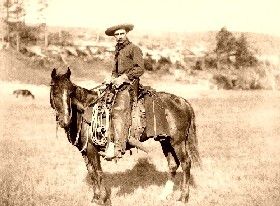
Cowboy on Horse.
In times when some men needed guns, and all men carried them, no pistol of less than 44 calibers was tolerated on the range, the solid-framed 45 calibers being the ones almost universally used. The barrel was eight inches long, and it shot a rifle cartridge of 40 grains of powder and a blunt-ended bullet that made a terrible missile. This weapon hung from a loose belt, resting upon the left hip and hanging low down on the right hip so that no weight came upon the abdomen. This was typical, for the cowboy was neither a fancy gunman nor an army officer. The latter carries the revolver on the left, the butt pointing forward.
An essential part of the cowpuncher’s outfit was his “rope.” This was carried in a closed coil at the side of the saddle horn, fastened by one of the many thongs scattered over the saddle. In Spanish, it was called reata, and even today, it is sometimes seen in the Southwest made of rawhide. In the South, it was called a lariat. The modern rope is a well-made three-quarter-inch hemp rope about thirty feet long, with a leather or rawhide eye.
The cowboy’s quirt was a short, heavy whip, the stock of wood or iron, covered with braided leather, and carrying a lash of two or three heavy, loose thongs. The spur in the old days had a very large rowel with blunt teeth that were an inch long. It was often ornamented with little bells or oblongs of metal, the tinkling of which appealed to the childlike nature of the Plains rider. Their use was to lock the rowel.
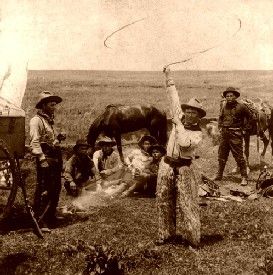
Fancy roping in Oklahoma.
His bridle — for, since the cowboy and his mount are inseparable, we may as well speak of his horse’s dress also — was noticeable for its tremendously heavy and cruel curbed bit, known as the “Spanish bit.” But in the ordinary riding and even in the exciting work of the old roundup and in “cutting out,” the cowboy used the bit very little, nor exerted any pressure on the reins. He laid the reins against the neck of the pony opposite to where he wished it to go, merely turning his hand in the direction and inclining his body in the same way.
He rode with the pressure of the knee, the inclination of the body, and the light side-shifting of both reins. The saddle was the most important part of the outfit. It was curious; the cattle trade developed this saddle, and the world has no other saddle like it. Its great weight — from 30 to 40 pounds — was readily excusable when one remembers that it was not only a seat but a workbench for the cowman. A light saddle would be torn to pieces at the first rush of a maddened steer, but the sturdy frame of a cow saddle would throw the heaviest bull on the range.
The high cantle would give firmness to the cowboy’s seat when he snubbed a steer with a sternness sufficient to send it rolling heels overhead. The high pommel, or “horn,” steel-forged and covered with cross braids of leather, served as an anchor post for this same steer, a turn of the rope about it accomplishing that purpose at once. The saddle tree forked low down over the pony’s back so that the saddle sat firmly and could not readily be pulled off. The great broad cinches bound the saddle fast till horse and saddle were practically one fabric. The strong wooden house of the old heavy stirrup protected the foot from being crushed by the impact of the herd. The form of the cow saddle has changed but little, although today, one sees a shorter seat and smaller horn, a “swell front” or roll, and a stirrup of open “ox-bow” pattern.
The roundup was the harvest of the range. The calf roundup was in the spring, after the grass had grown well and the calves had grown large enough for branding. The State Cattle Association divided the entire State range into several roundup districts. Under an elected roundup captain were all the bosses in charge of the different ranch outfits sent by men having cattle in the roundup. Let us briefly sketch this scene as it was.
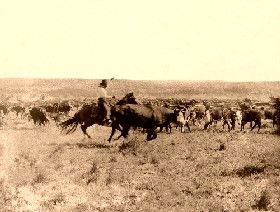
Cutting out from the herd in 1907.
Each cowboy would have eight or ten horses for his own use, for he had now before him the hardest riding of the year. When the cow-pcowpuncher entered the herd to cut out calves, he mounted a fresh horse, and every few hours, he again changed horses, for there was no horse that could long endure the fatigue of the rapid and intense cutting work. Before the rider stretched a sea of interwoven horns, waving and whirling as the densely packed ranks of cattle closed in or swayed apart. There was no prospect for a weakling, but the cow-pcowpuncheris determined little horse went into it, heeding not the excited cattle’s plunging, crushing, and thrusting. Down under the bulks of the herd, half hidden in the whirl of dust, he would spy a little curly calf running, dodging, and twisting, always at the heels of its mother, and he would dart in after, following the two through the thick of surging and plunging beasts. The sharp-eyed pony would see almost as soon as his rider which cow was wanted, and he needed small guidance from that time on. He would follow hard at her heels, edging her constantly toward the flank of the herd, at times nipping her hide as a reminder of his own superiority. Despite herself, the cow would gradually turn out toward the edge and, at last, would be swept clear of the crush, the calf following close behind her. There was a whirl of the rope, and the calf was laid by the heels and dragged to the fire, where the branding irons were heated and ready.
Meanwhile, other cowpunchers were rushing calves to the branding. The hubbub and turmoil increase. Taut ropes cross the ground in many directions. The cutting ponies pant and sweat, rear and plunge. The cowboy’s garb is now one of white alkali, which hangs gray in his eyebrows and mustache. Steers bellow as they surge to and fro. Cows charge at their persecutors. Fleet yearlings break and run for the open, pursued by men who care not how or where they ride.
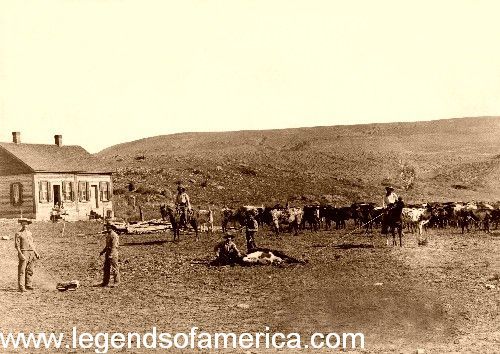
Branding Cattle in 1891.
We have spoken in terms of the past. There is no calf roundup of the open range today. The last roundup was held in Routt County, Colorado, several years ago, so far as the writer knows, and it had only to do with shifting cattle from the summer to the winter range.
After the calf roundup came the beef roundup, the cowman’s final harvest. This began in July or August. Only the mature or fatted animals were cut out from the herd. This “beef cut” was held apart and driven on ahead from place to place as the roundup progressed. It was then driven in by easy stages to the shipping point on the railroad, whence the long trainloads of cattle went to the great markets.
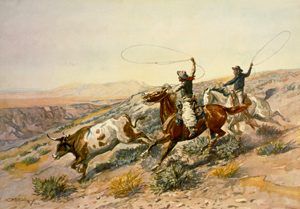
Buckaroos by Charles M. Russell, 1905.
In the heyday of the cowboy, it was natural that his chief amusements should be those of the outdoor air and those more or less in line with his employment. He was accustomed to the sight of big game and so had the edge of his appetite for its pursuit worn off. Yet he was a hunter, just as every Western man was a hunter in the times of the Western game. His weapons were the rifle, revolver, and rope; the latter two were always with him. He sometimes captured the coyote with the rope, and under special conditions, he took deer and even antelope in this way. However, this was the most unusual and only possible under chance conditions of ground and cover. Elk have been roped by cowboys many times, and it is known that even the mountain sheep have been so taken, almost incredible as that may seem. The young buffalo were easy prey for the cowboy, and he often roped and made them captive. In fact, the beginnings of all the herds of buffalo now in captivity in this country were calves roped and secured by cowboys, and these few scattered individuals of a grand race of animals remain as melancholy reminders of both a national shiftlessness and an individual skill and daring.
The cowboys on the range sometimes saw the grizzly, and if it chanced that several cowboys were together, it was not unusual to give him chase. They did not always rope him, for it was rarely that the nature of the country made this possible. Sometimes, they roped him and wished to let him go, for a grizzly bear is uncommonly active and straightforward in his habits at close quarters. However, the extreme difficulty of such a combat gave it its chief fascination for the cowboy. Of course, no one horse could hold the bear after it was roped, but, as one after another came up, the bear was caught by neck and foot and body until, at last, he was tangled and tripped and hauled about till he was helpless, strangled, and nearly dead. It is said that cowboys have brought a grizzly bear into camp, forcing him to half walk and half slide at the end of the ropes. No feat better than this could show the courage of the plainsman and of the horse that he so perfectly controlled.
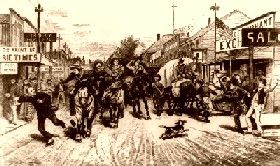
“Painting The Town Red” – A wood engraving by R.F. Zogbaum, in Harper’s Weekly, October 16, 1886.
Of such wild and dangerous exploits were the cowboy’s amusements on the range. It may be imagined what his amusements were when he visited the “settlements.” The cowpunchers in the free life of the open air, under circumstances of the utmost freedom of individual action, perhaps came off the drive or roundup after weeks or months of unusual restraint or hardship and felt that the time had arrived for them to “celebrate.” Merely great rude children, as wild and untamed and untaught as the herds they led, they regarded their first look at the “settlements” of the railroads as a glimpse of a wider world.
They pursued the uttermost avenues of new experience as lay before them, almost without exception, avenues of vice. Strangely, the records of those days should be chosen by the public to be held as the measure of the American cowboy. Those days were brief, and they are long since gone. The American cowboy atoned for them with a quarter of a century of faithful labor.
The amusements of the cowboy were like the features of his daily surroundings and occupation — they were intense, large, and Homeric. Yet, judged by his work, no higher type of employee ever existed, nor one more dependable. He was the soul of honor in all the ways of his calling. The very blue of the sky, bending evenly over all men alike, seemed to symbolize his instinct for justice. Faithfulness and manliness were his chief traits; his standard was to be a “square man.”
Not all the open range will ever be farmed, but much that was long thought to be irreclaimable has gone under irrigation or is being more or less successfully “dry farmed.” The man who brought water upon the arid lands of the West changed the entire complexion of a vast country and, with it, its industries. Acres redeemed from the desert and added to the realm of the American farmer were taken from the realm of the American cowboy.
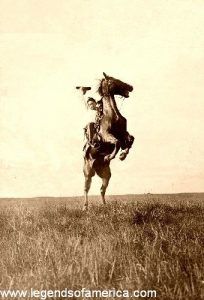
Bad Hoss – A bucking Bronco.
The West has changed. The curtain has dropped between us and its wild and stirring scenes. The old days are gone. The house dog sits on the hill where, yesterday, the coyote sang. There are fenced fields, and in them stand sleek, round beasts deep in crops that their ancestors never saw. In a little town nearby, there is the hurry and bustle of modern life. This town is far out upon what was called the frontier, long after the frontier had really gone. Guarding its ghost here stood a little army post, once one of the pillars, now one of the monuments of the West.
Out from the tiny settlement in the dusk of evening, always facing toward where the sun is sinking, might be seen riding, not so long ago, a figure we should know. He would thread the little lane among the fences, following the guidance of hands other than his own, a thing he would once have scorned to do. He would ride as lightly and as easily as ever, sitting erect and jaunty in the saddle, his reins held high and loose in the hand whose fingers turn up gracefully, his whole body free yet firm in the saddle with the seat of the perfect horseman. At the boom of the canyon, when the flag dropped, fluttering down to sleep, he would rise in his stirrups and wave his hat to the flag. Then, toward the edge, out into the evening, he would ride on. The dust of his riding would mingle with the dusk of night. We could not tell which was which. We could only hear the hoof beats passing, boldly and steadily still, but growing fainter, fainter, and fainter.
Emerson Hough, 1918. Compiled and edited by Kathy Alexander/Legends of America, updated April 2026.
Excerpted from the book The Passing of the Frontier, A Chronicle of the Old West, by Emerson Hough, Yale University Press, 1918. (now in the public domain). Emerson Hough (1857–1923).was an author and journalist who wrote factional accounts and historical novels of life in the American West. His works helped establish the Western as a popular genre in literature and motion pictures. For years, Hough wrote the feature “Out-of-Doors” for the Saturday Evening Post and contributed to other major magazines.
 Also See:
Cowboy & Trail Blazer Photo Gallery
List of Trail Blazers, Riders, & Cowboys
The Range of the American West
Tales & Trails of the American West
I wish I could find words to express the trueness, the bravery, the hardihood, the sense of honor, the loyalty to their trust and to each other of the old trail hands.
— Charles Goodnight