
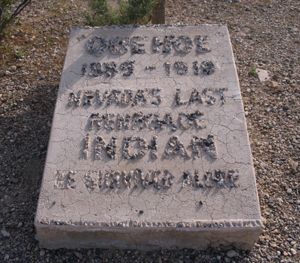
Queho’s grave marker in Pahrump Valley, by Nevada Bob via Find A Grave.
The mystery and legend of the renegade Indian Queho (pronounced Key-Ho) continues to be debated today: was he a scoundrel or a scapegoat? Was the Southern Nevada Indian a true outlaw killer, or did law officers merely blame him for an abundance of unsolved crimes?
Thought to have been born around 1880 at Cottonwood Island near the town of Nelson, Nevada, Queho’s Cocopah mother died shortly after giving birth. Though the identity of his father remains a mystery, various theories have been presented, including a Paiute brave from a neighboring tribe, a white soldier from Fort Mohave, or a Mexican miner. Though the answer will never be known, Queho was an outcast from the start because of his “shameful” mixed blood. Adding to this, the boy was born with a club foot, which further caused the local tribes to reject him.
Raised on a reservation in Las Vegas, he worked from an early age as a ranch laborer and wood gatherer in several of the nearby mining camps. Always known to be sullen, moody, and quick-tempered, he soon ran into trouble with the law.
Some stories, though unconfirmed, tell of him being involved in the death of another Indian in 1897, but newspaper accounts of his exploits did not begin until November 1910. The first report tells of Queho being the main suspect in the slaying of another Indian during a brawl on the Las Vegas reservation. Allegedly, he and the other man, named Harry Bismark, were drinking when the dispute began. Queho went on the run and, according to some accounts, murdered two Paiute Indians when he stole their horses in his escape.
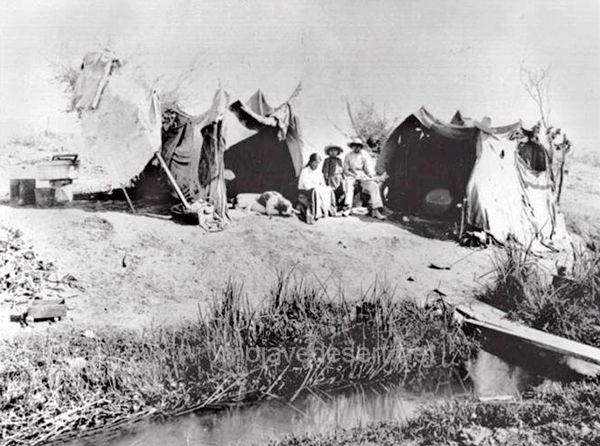
Southern Paiute in Las Vegas Valley
On his flight, he stopped for supplies in Las Vegas and was confronted by a shopkeeper named Hy Von, which resulted in Queho breaking both the man’s arms and fracturing his skull with a pick handle. Fleeing South to Nelson, he took shelter in Eldorado Canyon.
Before long, word came from Searchlight that a Queho had beaten to death a woodcutter named J.M. Woodworth. According to the tale, he beat the man with a piece of timber after Woodworth refused to pay him for helping cut timber.
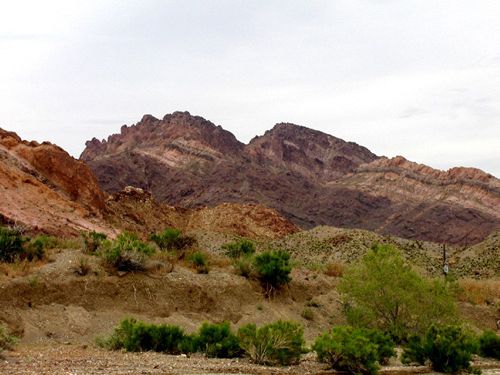
Nelson area in Eldorado Canyon by Dave Alexander.
Deputy Sheriff Howe formed a posse, and the group first went to the scene of Woodworth’s killing, where they found a distinctive print left by Queho’s clubfoot. From there, they tracked the fugitive to Eldorado Canyon, which led to the Gold Bug mine. There, they found the body of the watchman, L.W. “Doc” Gilbert. Shot in the back, Gilbert’s special deputy badge No. 896 had been stolen. Continuing to track Queho to the Colorado River, they lost the trail. Though the lawmen searched a 200-mile area from Crescent to Nipton, they found nothing but trace footprints. They thought Queho would be easy to track and capture because of his clubfoot, but they couldn’t have been more wrong. After some time, they finally gave up the chase.
However, Nevada State Police Sergeant Newgard soon took over the search along with several Indian trackers and two experienced hunters. Although they also found signs of Queho’s presence, they, too, finally gave up when they ran short of supplies. Frustrated and exhausted, the lawmen returned to Las Vegas empty-handed in February 1911.
Over the next several years, Queho’s sightings continued, and his legend grew. Up and down the length of the Colorado River, miners and settlers told of missing cattle, unexplained thefts, and mysterious murders. They attributed it all to the phantom renegade, a constant source of embarrassment for local lawmen.
In 1913, local newspapers attributed the death of a 100-year-old blind Indian known as Canyon Charlie to Queho. Allegedly, Charlie’s few provisions, which included little more than food, were gone, prompting everyone to believe that Queho would kill for almost anything. However, others disputed the murder as being Queho’s responsibility, as the old Indian was known to be the fugitive’s friend and confidant.
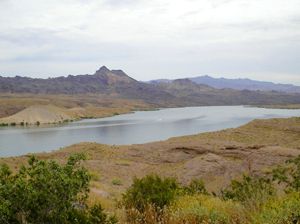
Eldorado Canyon, Nevada by Amy Stark.
A few months later, when two more miners working claims at Jenny Springs were found shot in the back, and their provisions were stolen, these murders, too, were blamed on the illustrious outlaw. An Indian woman found dead a short time later was also blamed on the renegade.
The hysteria continued to grow until rewards reaching $2,000 were offered for his capture, “Dead or Alive.” The Searchlight Bulletin was quick to remind its readers of the reward while screaming, “A good Indian is a dead Indian.”
Though the furor died down for several years, area settlers still worried whenever someone went missing for an hour or two. Queho became a legend and a bogeyman used to scare children into behaving.
In 1919, the murderous tales would begin again when two prospectors named William Hancock and Eather Taylor were found dead upstream from Eldorado Canyon. Both had been shot in the back, and Taylor’s head had been smashed in with an ax handle. He immediately became the prime suspect, with his supplies missing and Queho’s footprints allegedly found at the site.
About a week later, on January 21, 1919, Maude Douglas, the wife of an Eldorado Canyon miner, was awakened in the night by a commotion in the larder at the rear of the cabin. When her husband heard a shotgun blast, he found her shot in the chest and surrounded by canned goods. When authorities arrived at the cabin near the Techatticup Mine, they pronounced it to have been yet another crime committed by Queho, as they allegedly found his footprints around the cabin. Though a four-year-old boy in Maude’s care said that the woman had been killed by her husband, no one listened, immediately resuming the chase for the elusive Indian renegade once again.
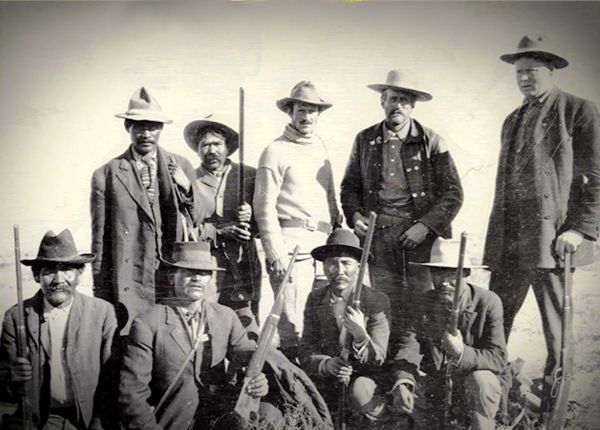
Queho Posse.
The reward for Queho’s capture was increased to $3,000, and southern Nevada Sheriff Sam Gay ordered Deputy Frank Wait to round up a posse and hire the best trackers to kill or capture Queho once and for all. Though they tracked the outlaw North to Las Vegas Wash., they soon lost his trail into the Muddy Mountains. Gathering up yet more men, Wait split the group into two parties who continued the search. The manhunt lasted almost two months despite freezing rain and snow. Though they didn’t find Queho, the lawmen did find the skeletons of two miners who had disappeared several years before. Though there was no proof whatsoever, Queho took the blame for these murders as well.
As sightings of Queho continued over the next several years, Undersheriff Frank Wait periodically resumed his search in the area where Boulder Dam would later be built, as far South as Searchlight. But when no further murders were committed, interest in the elusive Indian faded.
The last time the renegade was reportedly seen was when a Las Vegas policeman spotted him walking down Fremont Street in February 1930. The officer immediately summoned reinforcements, but by the time they arrived, Queho was gone once again.
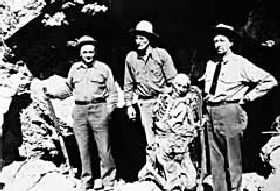
Posse, who recovered Queho’s remains, stands at the mouth of his cave hideout. From left, Clarke Kenyon, Frank Wait, and Art Schroeder.
As the legend was finally beginning to die, three prospectors by the names of Charles Kenyon and brothers Art and Schroder found the remains of a dead Indian on February 18, 1940. High in a cave on the side of Black Canyon, the mummified body was found along with a Winchester 30/30 rifle, clothing, cooking utensils, tools, and a “special Deputy badge, No.896”.
Frank Wait, then Chief of Police for Las Vegas and original posse member in 1910, rushed to the scene and positively identified the remains as belonging to Queho. A few days later, on February 21, 1940, the headlines in the Las Vegas Review-Journal read “Body of Indian Found.”
Queho’s remains were taken to Palm Funeral Home in Las Vegas, and Charles Kenyon, who had first found the body, demanded the reward. However, when the rewards offered more than a decade earlier were ignored, Kenyon demanded that the body be turned over to him.
When he threatened to sell it to the Las Vegas Elks Club for exhibition purposes, a court order was issued to prevent him from doing so. Meanwhile, several Indians came forward, claiming to be Queho’s heirs. As the corpse lay in storage at the funeral home, charges were accumulating, and the facility was demanding that the body be moved and the bill paid. Suddenly, Kenyon and those claiming to be heirs “disappeared,” and the judge ruled that the funeral home had all rights to the body. All this haggling had taken three years, and the funeral home issued an ultimatum that if the body wasn’t retrieved and the charges paid, it would cremate the corpse and scatter the ashes over the desert.
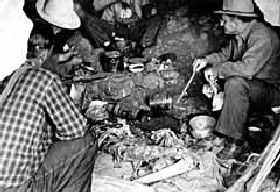
Queho’s mummified remains were found surrounded by all his possessions.
Queho’s old nemesis, Frank Wait, paid the bill and gave the remains and artifacts to the Las Vegas Elks Club, which produced what was then the city’s biggest public celebration, “Helldorado.” The club then built a glassed-in case and recreated a “cave” to exhibit the body and artifacts at Helldorado Village in Las Vegas. The Indian’s remains stayed on public display until the early 1950s, and on at least one occasion, they even rode in one of the famous Las Vegas Helldorado parades.
When the Elks Club no longer wanted responsibility for Queho’s remains, they passed through several private hands before landing at the Museum of Natural History at the University of Nevada, where they remained until the mid-1970s. Finally, a retired Las Vegas attorney by the name of Roland H. Wiley secured the remains from the museum, and on November 6, 1975, Queho was finally laid to rest. In a small ceremony on Wiley’s Pahrump Valley ranch, Frank Wait attended and told the local press he was relieved his old adversary had finally received a proper burial.
During his lifetime, Queho was credited with the deaths of 23 people, was declared Nevada’s “Public Enemy No. 1,” and was the state’s first mass murderer. While many believe that the Indian was little more than a brutish killer, others see him as an abused man who was hounded his entire life and blamed for dozens of atrocities that he did not commit. The truth remains a mystery.
© Kathy Alexander/Legends of America, updated September 2026.
Also See:
Eldorado Canyon – Lawlessness on the Colorado River
Hell Dogs of Eldorado Canyon – Ghostly Canine Apparitions