
By Art Saborio
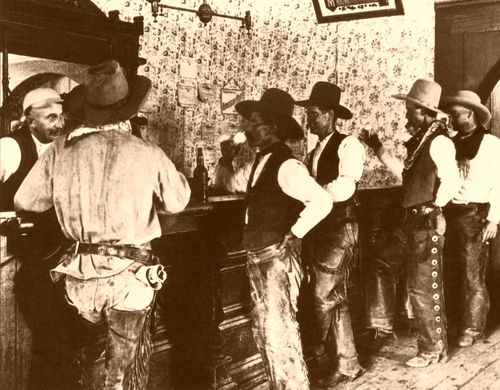
Cowboys at Tascosa, Texas.
Movies and books depict the saloon cowboy. The Old West made them the icons that they are today. Saloons were common in almost all cities, yet a few areas already had Mexican-style cantinas.
Saloons mostly looked the same throughout the West. They had a common wooden front with a wooden boardwalk. They always had a few hitching posts to tie a horse. Often, a water source sat nearby for horses to drink. The front doors always consisted of two swinging doors that would brush up against a cowboy as he walked into the main bar area. The bar itself was very long to accommodate many standing customers. The floor area consisted of wooden tables and chairs.
It was common to see a group of men playing a friendly poker game or telling long stories of their travels. Most of the violence started in the saloon and, at times, spilled into the roadway.
The first saloons to open were not the typical saloons that we all know from the movies and books. They were primarily tents or square wooden structures with tent material thrown over the top. The material was enough to keep rain off their customers’ heads. The floors were not made of wood. Tent saloons never had floors of any type. If it rained, the floors were muddy, and if it was dry, they were dusty. Early saloons offered only whiskey and a place to sit and rest.
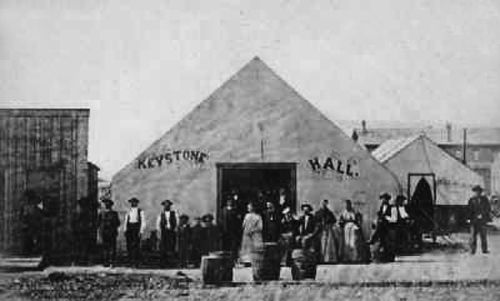
Keystone Hall, Laramie, Wyoming, 1868.
The first whiskey ever served in a saloon wasn’t the fine whiskey New Yorkers or Chicagoans would sip. This stuff was raw and made right in the camp or town. The simple ingredients included raw alcohol, burnt sugar, and a little pouch of chewing tobacco. Whiskey with terrible names like “Coffin Varnish,” “Tarantula Juice,” “Red Eye,” and others was common in early saloons.
Later, people used the word “Firewater” to describe whiskey. It took on the name during trading with Indians. To explain what Whiskey was to the Indians, the cowboy would pour it over the fire to show its potency. With enough proof, whiskey acted like gasoline on fire. Soon, the drink was called firewater. If you were a lightweight and sipped your whiskey, you could be sure to find yourself drinking a 5th of Whiskey at gunpoint. Sipping was considered a weakness and not tolerated!
Beer was not as common as whiskey, yet some drank it. Since pasteurization had not yet been invented, a cowboy had to drink his beer warm. Otherwise, the beer would warm up and go flat. Whiskey kept its taste and potency no matter the temperature. It wasn’t until the 1880s that Adolphus Busch invented artificial refrigeration and pasteurization methods for the brewing process, soon after Budweiser launched as a U.S. national brand.
In the late 1820s ′s, Bent’s Fort, Colorado, opened what we know as the first saloon in the West. A few little towns already had cantinas, but they did not compare to saloons that would soon spread like wildfire throughout the West.
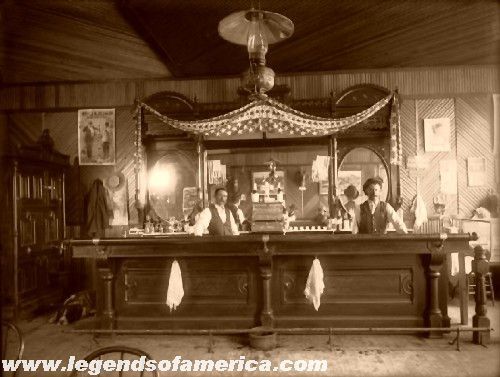
Meeker, Colorado Saloon.
Striking gold was a big indicator that a saloon would pop up in that town. In 1848, Santa Barbara, California, only had one cantina. Yet after the discovery of gold, the town soon grew to 30 saloons. Towns like Livingston, Montana, with its 3,000 residents, had no less than 33 saloons. Back then, it was easy to open a business. Innovation and growth were on the incline. Salons were profitable and had a large customer base.
©Art Saborio, 2010, updated September 2026.
About the Author: Born and raised in San Diego, California, Art Saborio has always been passionate about family, writing, history, gaming, and law. As he grew up, his interests expanded to include international travel and photography. Art describes himself as a family man with a desire and interest to help others. He is married with children and enjoys traveling the world and writing. He also runs several websites. Click here to find out more about the saloon cowboy. The saloon cowboy provides a look into how the West was born.
Also See:
Saloon Art, Advertising, and Photo Prints
Playing Poker
Saloon Museums of the American West
Speakeasies of the Prohibition Era
Cowboys, Trail Blazers, & Stagecoach Drivers