

Battle Mountain Mines, Victor, Colorado, 1900, by the Detroit Photographic Co.
A
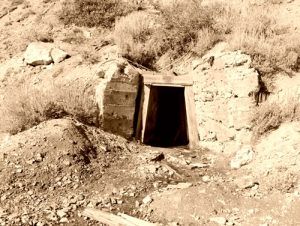
Adit at the Lucky Tiger Mine, Humboldt County, Nevada.
Adit – An entrance to a mine, generally a horizontal tunnel.
Alluvial or Bench Deposits – Ancient river-washed rock and gravel bars that may be thousands of feet from the nearest stream, creek, or river. Alluvial or bench deposits contain untapped potential for finding gold because such areas have never been worked. The hydraulic giants generally worked alluvial deposits.
Alluvium – A deposit of loose gravel between the superficial covering of vegetable mold and subjacent rocks.
Amalgam – Gold or silver combined with quicksilver.
Amalgamation – The technique of using mercury to attract small particles of crushed gold and join them in an amalgam or alloy. Gold may be recovered by distilling off the mercury.
Ancient Riverbed Claims – Gold found in the beds of now-extinct rivers.
Arastra – A mill consisting of one or more large stones dragged around on a circular bed used to grind the ore.
Argentiferous – Bearing or producing silver.
Assaying – Finding the percentage of a given metal in ore or bullion.
Assessment – Amount levied on capital stock.
B
Bar Claims – Gold is found in low concentrations of sand or gravel, in rivers, and exposed to low water.
Barren Contract – A contract vein or a place in the contract vein with no mineral.
Base Bullion – Precious metals contained in lead.
Bedrock – The formation underlying pay dirt.
Bench Claims – Minerals found in a narrow tableland on a hillside above a river.
Blende – An ore of zinc consisting of zinc and sulfur.
Blind Lode – A lode having no outcrop.
Blossom Rock – Float ore found upon the surface or near where lodes or ledges outcrop, and from which they have become detached.
Bonanza – Fair weather; a mine said to be in bonanza when yielding a profit. A Spanish term meaning good luck.
Breasting Ore – Taking ore from the face, breast, or end of a tunnel. Bullion. Precious metals (gold, silver, etc.) are not coined.
Bucket Line Dredge – Unlike modern dredges, bucket line dredges were massive. Instead of sucking up water and gravel using water pressure, bucket-line dredges scooped it up and ran it through a long sluice box.
C
Cage – An elevator used to hoist and lower ore cars, men, and mine materials.
Cap Rock – Formation overlaying the ore or vein stone.
Carbonate is a geological formation that carries silver ore from 5 to 70 percent of lead.
Carboniferous – Containing coal.
Chilean Mill – A machine, similar to the arrastra, where heavy stone wheels turn around a central shaft and crush ore.
Chlorides – A compound of chlorine and silver.
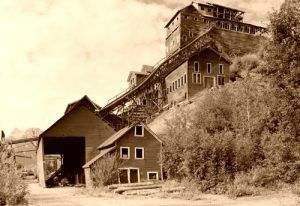
A large chute at the Kennecott Copper Mine in Alaska.
Chute – An inclined channel through which ore slides.
Chopping – The rock that appears on the surface, indicating the presence of a lode.
Claim – A piece of land 25 to 300 feet wide and 1,500 feet long that the government sells to the person who finds minerals within its limits.
Conglomerate – Pudding stones composed of gravel and pebble cemented together.
Contact – A touching, meeting, or junction of two kinds of rock, porphyry and slate.
Contact Vein – A vein along the contact plane of, or between, two dissimilar rock masses.
Cord of Ore – 128 cubic feet of broken ore; about seven tons in quartz rock.
Cornish Pump – A type of pump developed in Cornwall, England, and commonly used in 19th-century deep mines to raise underground water.
Crosscut – A horizontal tunnel driven perpendicular to the main direction of a vein.
Country Rock – Rock on either side of a lode or ledge, usually barren; the permanent rock enclosing a vein.
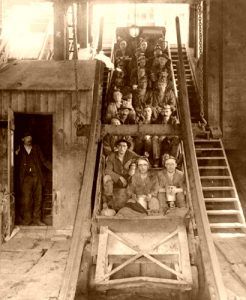
Copper miners in Michigan, Keystone View Co., 1916.
Coyote – Digging in river-borne gravel by tunneling until bedrock is hit. The tunnel is dug to find a rich bedrock deposit deep in the gravel bar.
Crevice – A narrow opening resulting from a crack, a fissure.
Cribbing – A timber or plank lining of a shaft; the confining of a wall-rock.
Crosscut – A level driven across the course of a vein.
Cupriferous – Containing copper.
D
Debris – Sediment from mines.
Denudation – Rocks laid bare by running water or other agencies.
Deposit – A body of ore distinct from a ledge.
Diggings – Name applied to placers being worked.
Diluvium – A deposit of superficial sand, loam, gravel, pebbles, etc.
Dip – The slope, pitch, or angle a vein makes with the horizontal plane.
Dredge – A common piece of mining equipment; the dredge sucks up dirt and gravel from within a stream bed using water pressure.
Drift – A horizontal underground passage excavated along a rich ore vein. Used in hard rock mining.
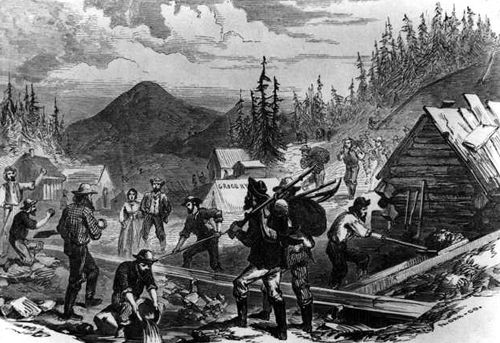
Gregory gold diggings, Central City, Colorado, N. Orr Co., 1859.
Dry Diggings – Earth excavated in the summer and held to be washed in Winter when water was more plentiful.
Dry Washing – Fine soil is blown away, leaving the gold.
Drywasher – A common desert mining tool similar to a high banker but doesn’t need water. It operates using wind. The light junk material is blown off the top of the sluice in the dry washer, and the gold stays on the bottom.
Dump – The pile of ore or debris taken from mines or tailings from sluicing.
E
End Lines – The lines bounding the ends of a claim.
F
Face – End of level or tunnel against the ore or rock.
Fathom – Six feet square on the vein.
Feeder – A small vein joining a larger one.
Feldspar – A group of crystalline minerals consisting of aluminum silicates with either potassium, sodium, calcium, or barium, an essential constituent of nearly all crystalline rocks.
Fissure Vein – A fissure or crack in the earth’s crust filled with mineral matter.
Flat Claims – Minerals found on flats.
Flour Gold/Gold Dust – Gold that is so fine that it looks and feels like flour or dust.
Float – Loose rock or isolated masses of ore or ore detached from the original formation.
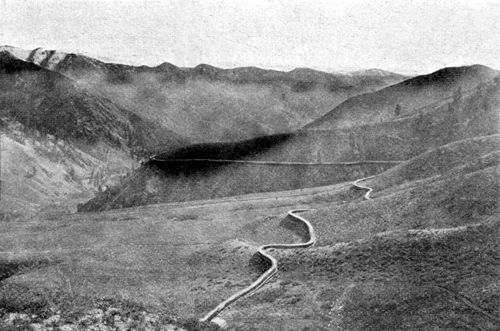
Ten-mile-long flume, Twin Springs, ID, W.E. Pierce and Co., real estate dealers, 1898.
Flume – A box or piping for carrying water. It is similar to sluice boxes but lacks riffles and is used solely to transport water in areas where a ditch would be impossible, such as cliffsides and rocky hillsides.
Flux – The flow of the ore in the furnace of the smelter.
Footwall – The layer of rock immediately under the vein.
Forfeiture – Failure to comply with laws prescribing the quantity of work.
Free Gold – Gold easily separated from the quartz or dirt.
G
Galena – Lead ore; sulfur and lead
Gangue – The worthless rock in a vein that holds valuable metals.
Gash Vein – A vein wide above and narrow below.
Geode – A cavity lined with crystals or mineral matter; a rounded stone containing such a cavity.
Geology – The science or study of rocks in the earth.
Grizzly – Bars set in a flume to strain out the large stones used in hydraulic mining.
Gulch – A ravine.
Gulch Claims – Minerals found in gullies that are usually dry during part of the year
H
Hanging Wall – The layer of rock or wall over a lode.
Hard Rock Mine – A tunnel dug into solid rock solely to find valuable rocks, minerals, or metals.
Heading – The vein above the drift.
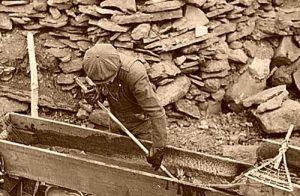
Miner Sluice.
Headings – In placer mining, the mass or gravel above the head of a sluice.
Highbanker – A mobile sluice box. Instead of being put in the creek, it uses water to pump and transport the water and minerals to another location. It can also run more material in less time than the sluice.
High-Grade Ore – Ore that contains more than 20 ounces of silver per ton, with 50 percent or more lead.
High Grading – A high-grader was a man who stole any big nuggets he saw in the sluice boxes.
Hill Claims – Minerals found in or under a hill.
Horse – A mass of rock matter occurring in or between the branches of a vein.
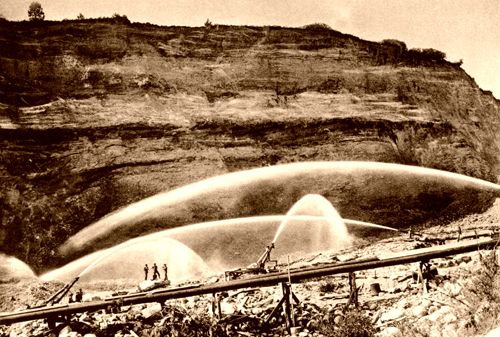
Hydraulic Mining, Twin Springs, Idaho, Horace C. Myers, 1901.
Hydraulic Claims – Claims worked by hydraulic power.
Hydraulic “Giant” or Monitor – Firehose-type nozzles that sprayed vast amounts of water on hillsides to recover gold.
I
Inch of Water – About two and a half cubic feet per minute; the water will run out of an opening one inch square.
Incline – A slanting shaft.
J
Jumping a Claim – Relocating a claim on which the required work has been done.
K
Knife Claims – Minerals dug from crevices with a knife or spoon.
Kibble – Iron Cornish bucket used to hoist ore and miners to the surface.
L
Level – A tunnel cut on the vein from the main tunnel. A drift.
Ledge – A vein or lode.
Little Giant – A movable nozzle attached to hydraulic pipes.
Locate – To establish the possessory right to a mining claim.
Lode – A metallic vein.
Long Tom – Similar to a sluice box, but longer and skinnier.
Low-grade Ore is ore that contains below 20 ounces of silver per ton, with 50% of the ton being lead.
M
Metamorphism – A pronounced change in the constitution of rock caused by pressure, heat, and water that results in a more compact, highly crystalline condition.
Mill Run – A test of ore quality after reduction.
Mineral – A substance that may or may not be of economic value that occurs naturally on Earth. It is homogeneous, has a specific chemical makeup, and usually appears in crystal or grain form.
Mother Lode – Where the gold is trapped inside veins of quartz on mountainsides. Land erosion causes the gold to break away from this source and eventually wash into the river.
O
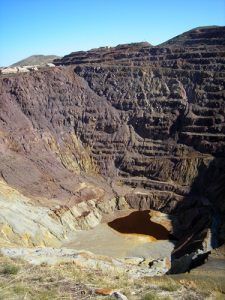
The Lavender Open Pit Mine in Bisbee, Arizona, by Kathy Alexander.
Open Pit Mine – Because of the danger associated with drifts, open-pit mines are dug from the ground down, never tunneled, and are the most common form of hard-rock mining today.
Ore – Any natural combination of minerals. Especially one from which a metal or metals can be profitably extracted. Commonly a mixture of one or more of the following: quartz, gold, copper, silver, sulfur, iron, and nickel.
Outcrop – The portion of a vein that appears at the surface.
P
Pack Train – Pack trains were used in the 19th Century to transport the bare necessities to miners and loggers. They usually consisted of five or more horses or mules and a few men.
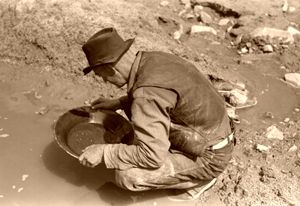
Gold panning in Pinos Altos, New Mexico by Russell Lee, 1940.
Pan or Panning – A pan, usually an ordinary milk pan, used to wash dirt from free gold.
Patch – A small placer claim.
Petering or Peter Out – The ore giving out.
Pitch – The same as a dip.
Piping – Washing gravel in a hydraulic claim by discharging water upon it through a nozzle.
Placer – Gold embedded in clay, sand, and gravel; includes all mineral deposits except veins. These claims were mined using water.
Pocket – A cavity filled with ore or a rich deposit of precious metal.
Porphyry – A rock consisting of a compact base from which crystals of feldspar are disseminated.
Primary or Primitive Rocks – Consist of the various kinds of slate, quartz, serpentine, granite, and gneiss; they are the lowest group of rocks, are irregularly crystallized, and contain a few animal relics. Prospecting – Hunting for mineral lodes or placers.
Pulp – Pulverized ore in the lixiviation process.
Q
Quartz – Metal encased in rock.
R
Reducing – Separating from foreign substances; reducing ores consists of extracting the metals they contain.
Retort – A vessel in which substances are distilled or decomposed by heat.
Riverbed Claims – Minerals found in riverbeds accessed by turning the river from its natural course.
Rocker Box or Cradle – Like a sluice box, the rocker box has riffles to trap the gold. It was designed for areas with less water than a sluice box. The process involves pouring water from a small cup and then rocking the small sluice box like a cradle, hence the name rocker box or cradle.
S
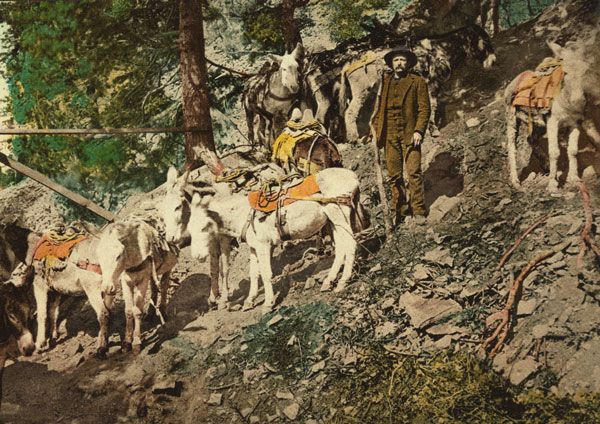
Prospector with burros, Detroit Photographic, turn of the 20th Century.
Salting a Mine – Placing mineral or ore in barren places to swindle.
Shaft – A vertical or inclined excavation for prospecting or working mines.
Shaker Table – Like a giant gold pan, an engine drives a belt that vibrates a huge bucket.
Side Lines – The lines that bound the sides of a claim.
Slag – Waste left as a residue from smelting metallic ore.
Slimes – The finest of the crushed ore and gangue from mills.
Sluice Box – Boxes or troughs through which gold-bearing gravel is washed. It was the most commonly used tool in mining other than the pan and shovel.
Sluice Claims – A claim worked with sluices.
Smelting – Reducing the ores in furnaces to metals.
Soft Carbonate – A silver-bearing mineral so soft it can be readily taken out with a pick and shovel. It is usually sand impregnated with minerals that have been carbonated or oxidized.
Sourdough – A highly experienced miner who has prospected for many years.
Square Set – A set of timbers used for support in underground mining.
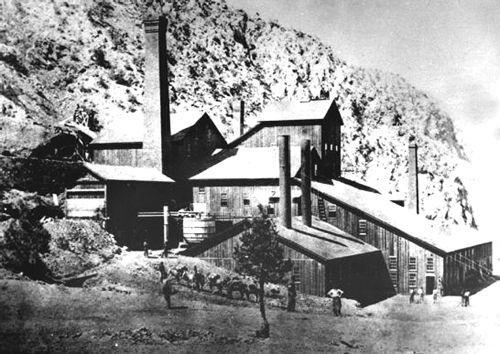
Panamint, California Stamp Mill.
Stamp or Stamp Mill – Machines for crushing ores.
Stope – A step-like excavation formed by removing ore around a mine shaft.
Stoping – The act of breaking down a stope and excavating it with a pick.
Strata – A series of rock beds.
Stull – Platforms of timbers between levels are used to strengthen the mine by supporting the walls, storing ore, and depositing wall rock and waste material.
Stull Timbers – Large timbers placed across the vein or lode from one wall to another to support the lagging on which the ore or waste is placed.
Strike – A find; a valuable mineral development made unexpectedly.
Sulphuret – Combination of sulfur with a metallic, earthy, or alkaline base.
Sump or Sumph – A pit sunk at the bottom of a mine to collect the water. It can be the bottom of a shaft.
T
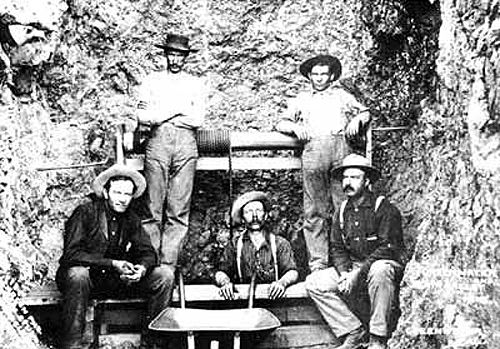
Miners in the Greenwater Mining District of California.
Tailings – Gravel, dirt, and rocks left behind after extracting the minerals.
Tunnel – A level, driven at right angles to the targeted mineral vein.
Tunnel Claims – Gold-bearing earth removed from tunnels and subsequently washed.
V
Vein – Aggregations of mineral matter in rock fissures.
W
Walls – The sides next to the lode.
Wash – The first geological formation, composed of earth, sand, gravel, and other minerals, “washed” down from the mountains during a long series of ages.
Waste – Rock containing no ore but removed during mining operations.
Whim – A winding machine used for hoisting ore out of a shaft.
Windlass – A device smaller than a whim to raise ore from a shaft.
Winze or Wizen – A shaft sunk from one level to the other.
Compiled and edited by Kathy Alexander/Legends of America, updated October 2026.
Also See:
Mining History in the United States
Mining on the American Frontier
Ghost Towns & Mining Camps Across America
Western Slang, Lingo, and Phrases – A Writer’s Guide to the Old West
See Sources.