

Accusing Witches.
One of the most unique and unjust cases from the Connecticut witch trials is the story of Lydia Gilbert of Windsor, the seventh person to be convicted wrongly in Connecticut for witchcraft in November of 1654. Although there exists only a record of her conviction, in all probability, she was hanged.
Even though there has been past confusion about the identity of Lydia Gilbert and little is known about her, most historians are confident that Lydia Gilbert would have been the wife of Thomas Gilbert Jr. A record from the Particular Court of March 2, 1642, states, “Will Rescue [Roscoe] is to take into his custody James Hullett, Tho. Gybbert [Gilbert], Lidea Blisse, and George Gybbs, and to keep them in gyves [shackles], and give them coarse diet, hard work, sharp correction.” William Roscoe was the jailer in Hartford at the time. The Court’s request that the jailer take Lydia and the others into custody shows they were imprisoned and punished for unnamed crimes.
This passage is also the closest documentation that supports the assumption that she was the wife of Thomas Gilbert Jr., who bought property from Francis Stiles, the brother of bachelor Henry Stiles, on January 24, 1644, at about age 24. He and his wife, Lydia, became caretakers to Henry, providing room and board. The Bliss family had immigrated first to Hartford and then to Springfield, but Lydia is not listed among the Bliss children. We do not know whether she was overlooked in the records, or whether she was a cousin, stepdaughter, another relation, or from another family not previously mentioned in early colonial records.
The events leading to Lydia’s conviction began with the accidental death of her boarder, Henry Stiles, in 1651. The men in the Windsor militia were practicing their drills on the town green when nineteen-year-old Thomas Allyn accidentally mishandled his musket, causing it to fire and killing 58-year-old Henry Stiles. The authorities called Allyn to court following the incident. He was reprimanded for carelessness and found guilty of what is today called involuntary manslaughter. He was not allowed to carry a gun for a year, and the court fined him £20. His powerful father, Matthew Allyn, a wealthy landowner, had to ensure his son’s good behavior.
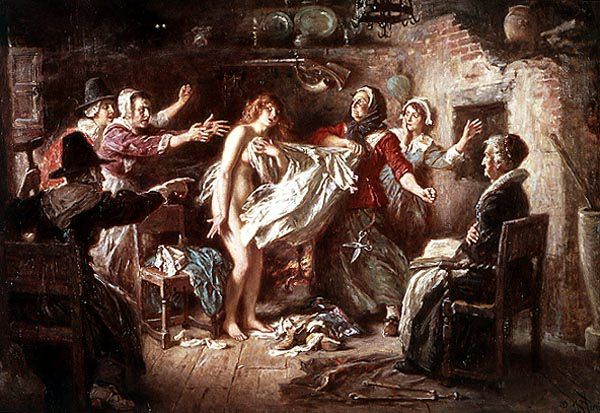
Witch Hunt by Jean Leon Gerome Ferris, 1650.
The stain of conviction on Thomas Allyn and his family was only removed after Lydia Gilbert was blamed and convicted for Henry Stile’s death three years later. We don’t know the particulars of why the authorities turned against her. The only official records that remain are Henry Stiles’ probate record, which shows he owed Thomas Gilbert debts for board, and the record of Lydia’s conviction. Some speculate that the size of the debts owed to the Gilberts and Stiles’s failure to pay might have led to arguments and disagreements between the Gilberts and their boarder, providing a possible explanation for why Lydia would want Henry dead.
In essence, the Puritan authorities indicted and convicted Lydia Gilbert of bewitching the gun that killed Henry Stiles, thereby causing his murder through supernatural means! To be clear, Lydia likely would not have been present on the green at the time of the shooting, as only men served in town militias. And secondly, supernatural speculations such as this would never hold up in any modern court. The fines the Allyn family had paid were refunded, and Thomas Allyn’s name was cleared, allowing him to marry the minister’s daughter several years later.
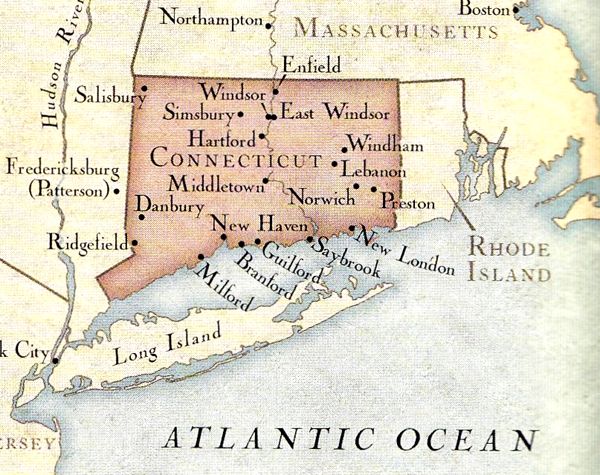
Connecticut Colonies
Thomas Gilbert must have been anxious to quickly leave the tragic events that began in Windsor behind. Soon after Lydia’s conviction and probable death, Thomas Gilbert received a land grant on January 30, 1655, in Springfield, Massachusetts, slightly upriver from Windsor, Connecticut. Settling into his new life, Thomas married into the Bliss family again on July 31, 1655, when he took the widow of Nathaniel Bliss, Catherine Chapin Bliss, as his new wife. She was already a mother to Nathaniel’s four children. On March 23, 1656, Thomas Gilbert was admitted as a freeman in Springfield.
Thomas Gilbert Jr. died in Springfield a few years later, in 1662. In his will, he not only names the four children he fathered with Catherine Chapin Bliss, but also refers to Catherine’s four other children from her previous family. Some have speculated wrongly that the former family he referred to in his will was his and Lydia’s children. That would not have been the case, since there are no birth records in Windsor or elsewhere indicating that Thomas Gilbert Jr. and Lydia had any children together. It refers to his wife’s first children with Nathaniel Bliss. In the Springfield documentation for Thomas Gilbert Jr., they often refer to him as “formerly of Windsor”.
Lydia Gilbert may have been an easy target for witchcraft accusations in the face of the powerful Allyn family because she was childless and had a previous criminal record. Perhaps she was also a woman whose demeanor was more confident or at odds with traditional gender roles of the time. Lydia may have also been related to Mary Bliss Parsons, Nathanial Bliss’s sister, who was first called a witch in Springfield, Massachusetts, before Lydia’s accusations in Windsor. Later, she was formally accused of witchcraft in Northampton on two different occasions after Lydia’s death. Witchcraft accusations often led to further accusations against other family members, spreading suspicion and blame like wildfire whenever anything went wrong. Therefore, previous familial accusations may have been another reason that either woman was targeted by her community.
 ©Beth M. Caruso, for Legends of America, July 2024, updated April 2026.
Sources:
Burt, Henry M., ed. The First Century of the History of Springfield: The Official Records from 1636 To 1736, with an Historical Review and Biographical Mention of the Founders, Springfield, MA. (Burt, H.M. 1898-1899).
Chapin, Gilbert Warren, compiler. The Chapin Book of Genealogical Data: With Brief Biographical Sketches, of the Descendants of Deacon Samuel Chapin, Volume 1. (Chapin Family Association, 1924), p. 4.
Trumbull, James Hammond ed. The Public Records of the Colony of Connecticut, Volume 1, 1636-1665. (Hartford: Hartford, Brown and Parsons, 1850).
Ross, Richard III. Before Salem: Witch Hunting in the Connecticut River Valley, 1647-1663. (Jefferson, NC: McFarland & Co., 2017).
Town of Windsor, Connecticut, Windsor Land Records. Volume I, page 81.
About the author: Beth Caruso is a researcher and the author of the Connecticut Witch Trial Trilogy. Her third book in the series, Between Good & Evil: Curse of the Windsor Witch’s Daughter, tells the story of Lydia Gilbert as seen through the eyes of Alice Young Jr., daughter of the first witch-trial victim, Alice ‘Alse’ Young of Windsor.
Also See: