

Aurora, Nevada, early to mid-1900s.
“Three-Fingered” Jack McDowell was an Irishman who worked as a soldier, prospector, and saloon operator before becoming a violent outlaw.
In the 1840s, McDowell immigrated from Ireland to New York and fought in the Mexican-American War. After that, he joined the California Gold Rush. When gold and silver were discovered in Nevada, he moved there, starting his journey in the mining camps of Tuolumne County. From there, he continued to Virginia City and eventually followed the gold to Aurora, Nevada.
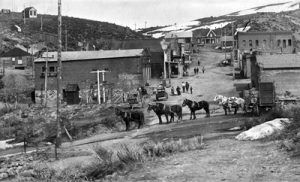
Aurora, Nevada.
During the 1860s, Aurora was a booming mining camp known for its share of bandits and other unsavory characters. McDowell fit right in, operating a saloon in the camp. He teamed up with John Daly, a notorious gunslinger, and together, they ran a rogue saloon and led the Daly Gang, which terrorized the Nevada goldfields between Aurora and Carson City. The duo employed scare tactics known as “criminal vigilantism,” including lynching anyone who dared to resist them.
The saloon quickly became known as a place where beatings, gunfights, mayhem, and murder were the norm. McDowell, Daly, and two other men, William Buckley and Jim Masterson, bullied the town and cheated any card players who were foolish enough to frequent McDowell’s saloon. However, after the gang cut a man’s throat and threw him into Aurora’s dusty street, the fed-up citizens formed a vigilante group and attacked McDowell’s saloon on February 5, 1864. Dragging McDowell, Daly, Buckley, and Masterson from the saloon, they locked them up while quickly constructing gallows. A short time later, all four men were hanged outside Armory Hall in Aurora.
Aurora, Nevada, is now a ghost town near the California border in Mineral County.
©Kathy Alexander/Legends of America, updated March 2026.
Also See:
See Sources.