

A.I. Generated image of Ehyophsta based on this article.
Ehyophsta (Yellow Haired Woman) was a Cheyenne woman who is well noted in tribal legends. One legend tells of how she was a hero to a tribe, but then broke a promise, and the tribe paid the price. The following is based on the 1926 book By Cheyenne Campfires by George Bird Grinnell, an American anthropologist, historian, naturalist, and writer who became a prominent early conservationist and student of Native American life
The Legend:
A long time ago, the Cheyenne people were in crisis. Their camp was surrounded by dry land and shallow lakes, and food was scarce. The children were crying from hunger, and the elders were weak. There was little left to eat except a few fish and birds. Something had to change—or the people wouldn’t survive.
One morning, the village crier called out for two strong, fast young men. The chiefs told them to search every nearby lake and not return until they had found food. The two scouts searched for four days and came back empty-handed.
The decision was made: the village must move. That night, after they set up camp again, the chiefs called two new young men—both sons of leaders. The elders said, “Our people are starving. You must go out and not return until you’ve found help.” The two boys promised to try, knowing the lives of many depended on them. They set out, heading north.
They traveled for eight days with nothing to eat. Finally, they saw a tall mountain in the distance and a blue shimmer below it – maybe water. But one of the boys was too weak to continue.
“I can’t go on,” he said. “Let’s go to that mountain and die there. At least it will be our resting place.” The other agreed, and together they walked toward it.
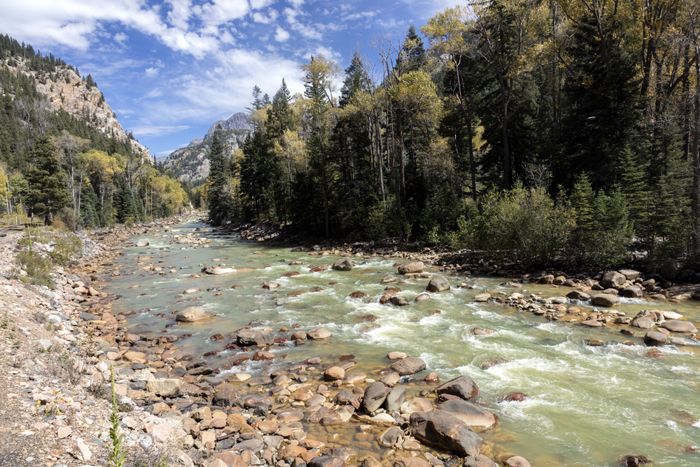
Animas River, high in the San Juan Mountains of San Juan County, Colorado, by Carol Highsmith.
At the base of the peak was a wide river. As they crossed it, something unseen grabbed the weaker boy’s legs. He shouted, “I’m trapped! I can’t move! Some power has me—tell my people not to mourn me.”
He asked his friend for one last handshake. They wept, embraced, and then the stronger boy continued alone, heartbroken.
Suddenly, a mysterious figure appeared—an old man wearing a coyote skin, carrying a large knife. The boy ran to him and cried, “My friend is trapped in the water!”
The Coyote Man ordered him to stay put, then dove into the river. He battled the unseen force, slicing off the head of a massive serpent. The river thrashed wildly as the creature died.
The Coyote Man called to the boy: “Go to the mountain. There’s a rock door. Tell the old woman inside that her husband has finally killed the serpent.”
The boy found the rock, which opened like a door. Inside, an old woman nodded solemnly. “Yes,” she said. “He’s been trying to kill that serpent for a long time.” She brought ropes and followed the boy back.
Together, they pulled the trapped boy from the river. Though he was too weak to walk, his friend carried him on his back. The Coyote Man helped, and they brought him into the mountain, which was no ordinary peak. Inside was a warm, welcoming lodge and a sweat house.
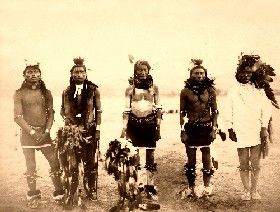
Cheyenne Dancers by John Graybill, 1890.
The Coyote Man performed a healing ceremony, consisting of four songs and four sprinkles of water on hot stones. After the fourth song, the young man stood — he was healed.
The old woman cooked for them in white stone bowls. She served meat with white flint knives and told them to eat as much as they wanted. The young men had not eaten in days and were grateful.
Then the Coyote Man asked, “Do you want that woman over there as your sister — or will one of you marry her?” She was beautiful, sitting quietly in the lodge.
The elder boy said, “My friend is less fortunate. Let him marry her.” The Coyote Man nodded. “That is good. You have chosen wisely.”
He showed them visions: to the north, fields of corn; to the east, great herds of buffalo; to the south, deer, elk, and horses; to the west, birds of every kind. “All this,” he said, “will follow my daughter. Take her back to your people. She will bring life.”
Before they left, the Coyote Man warned his daughter: “If you ever feel sorry for an animal – if you ever say, ‘My poor buffalo’ or ‘My poor bird’— everything will disappear. This is very important. Do not pity what must feed the people.”
The three returned to the Cheyenne camp, and the people rejoiced. When they saw the woman, they welcomed her with songs and robes and carried her to the chief’s lodge. That night, the elder boy told the story of what had happened.
He ended with, “This woman comes with great power. Tomorrow, you will see it.” And they did. The next morning, buffalo surrounded the village. People killed only what they needed, and the village was full of food and skins for clothing and shelter.

White buffalo in Dogwood Canyon Nature Park in Missouri. Photo by Dave Alexander.
The woman became deeply respected. The Chiefs came to thank her and asked if they could repay her or her parents. She said, “I cannot accept favors unless my father says I may.”
Years later, her husband asked to return to the mountain to deliver the chiefs’ message. At first, she refused. But seeing his desire, she agreed.
One night, they left secretly with the husband’s friend. The woman asked them to close their eyes – and when they opened them, they were back at the mountain.
Inside, the Coyote Man welcomed them but reminded them, “I didn’t call you. You should not have returned.” He said only one thing: “Remember – never say ‘Poor animal.’”

Northern Cheyenne Painting.
They returned home once more, but years later, a group of boys dragged a buffalo calf into camp and began tormenting it. The woman cried out, “My poor calf,” and then stopped herself. But it was too late.
That day, the buffalo disappeared. She knew what must happen. She called her husband and his friend. “I’m leaving,” she said. “If you come with me, I’ll be glad. If not, your life here will be hard.” They chose to go with her. The village wept as the three of them disappeared—never to be seen again.
Her name was Ehyophsta, meaning Yellow-Top-to-Head, for her hair was light in color. The animals did not return until they were brought back by two other sacred figures in Cheyenne tradition—Standing-on-the-Ground and Sweet Medicine—many years later.
©Dave Alexander, Legends of America, October 2025.
Also See:
Ehyophsta: Yellow Haired Warrior Woman of the Cheyenne
The Battle of Beecher Island, Colorado
Cheyenne – Warriors of the Great Plains
Native American Mythology & Legends
Sources:
Grinnell, George Bird; Cheyenne Campfires, Yale University Press, 1926.
World History Encyclopedia