

Cerbat Mountains near North Kingman. Courtesy of Wikimedia Commons.
In the Cerbat Mountains North of Kingman, Arizona, gold and silver deposits were discovered in the 1860s. Several small towns sprang up quickly as prospectors and miners headed to the hills in search of their fortunes.
These camps were extremely isolated, and the trip to the settlements was often fraught with danger. To access the Cerbat Mountains, prospective miners were required to take a riverboat 300 miles upstream from Yuma to Hardyville (now underwater near Bullhead City). After their riverboat journey, they had to cross 38 miles of unforgiving desert and were often accosted by hostile Indians.
In 1863, one story was told of Hualapai Indians who commandeered three miners’ weapons while working in their mining shaft. The Indians then shot one of the miners. The remaining pair were killed when the Indians began raining heavy rocks down the shaft upon the miners’ heads.
Undaunted by the tales of danger, determined fortune seekers kept coming.
Cerbat

Old mine at Cerbat, Arizona, courtesy of Kurt Wenner.
The area that would become Cerbat began to attract miners in the 1860s, and when rich enough veins were found to support larger mines, a settlement was born in the early 1870s. Named for the mountain range, Cerbat is an Indian word meaning bighorn sheep, which were once common in the area.
Soon, three mines were developed: the Esmeralda, the Golden Gem, and the Vanderbilt. Before Cerbat even had a post office, it was named the county seat of Mohave County in 1871. On December 23, 1872, the town could finally send and receive mail from its post office. In 1873, it lost its short-lived county seat status to nearby Mineral Park. Cerbat never had more than a hundred residents in its isolated location, yet it did have a doctor and a lawyer.
Mining continued into the 19th Century, but the town began to die. By 1912, its post office had closed.
The Golden Gem Mill and the head frame still stand among scattered debris today. Nothing else is left of this once vibrant city.

Old road in the Cerbat Mountains, Kathy Alexander.
Cerbat is nine miles northwest of Kingman on U.S. 93 at a historical marker near Milepost 62. From there, you get off the highway onto a dirt road, head east for 0.7 miles, turn left for 0.6 miles, then turn right again for another two miles. The last stretch requires a high-clearance vehicle or a willingness to walk. Update 2023: We’ve been notified that the Cerbat ghost town and Golden Gem Mine are now on private property, and the owner is discouraging visitors.
Mineral Park
Named for the rich minerals in the juniper-filled basin at the foot of Ithaca Peak, Mineral Park was founded in 1871. The settlement grew quickly and soon had almost 700 residents, becoming the county’s most significant community. A post office was established on December 31, 1872. Just a year later, Mineral Park took the title of county seat from nearby Cerbat.
In addition to the area’s mines, the town became a supply point for more distant mines and a growing number of cattle ranches. The town soon had an assay office, five smelters, a hotel, a restaurant, several stores, and several saloons. Mineral Park had two stagecoach stations, and in 1882, a weekly newspaper called the Mohave County Miner began. In 1883, Mineral Park prospered further when the Atlantic and Pacific Railroad was completed just 20 miles to the South. This dramatically cut the costs of transporting ore and supplies.

Mineral Park, Arizona, 1880.
However, Mineral Springs didn’t count on the small settlement of Kingman, built to service the railroad, which would begin to grow so fast. Despite the Mohave County Miner’s best efforts to downplay the possibility of Kingman ever amounting to much, over the next five years, Kingman continued to prosper as a supply center for the area mines and a commercial center for travelers through the area.
Soon, Mineral Park faced more civic embarrassment when a county-wide vote made Kingman the new county seat in 1887. Kingman got 271 votes to Mineral Park’s 93. Hackberry, located about 30 miles northeast of Kingman, got more votes than Mineral Park, with 132. Many speculated that Mineral Park merchants, who already had economic connections with Kingman, wanted to reduce costs by being closer to the railroad.

Mineral Park, Arizona Headframe
Despite the polls’ conclusiveness, Mineral Park officials refused to give up the county records. Outraged, Kingman citizens raided the town hall and made off with the county documents, literally “taking” the county seat.
The Mohave County Miner, once the most prominent critic of moving the county seat to Kingman, gave in to economic reality and moved from Mineral Park to Kingman.
Losing the county seat was just the beginning of the end for Mineral Park. After 1887, some of the mines began to close. Though some were reopened briefly in the early 1900s, the town never recovered, and its post office closed for good on June 15, 1912.
Today, Mineral Park has all but vanished and sits on private mining property where turquoise and copper are still being mined.
An open-pit mine, formerly operated by the Cypress-Bagdad, has caused once-prominent Ithaca Peak to disappear completely. The area is scattered with debris from earlier days, where headframes, mill foundations, and tattered cabins can still be seen among the mine tailings.
Mineral Park’s small cemetery is one of Arizona’s best-preserved. Although it is within mine property, it can still be viewed by contacting the current mining operation.
To get to Mineral Park, travel about 14 miles northwest of Kingman on U.S. 93 to a turnoff between Mileposts 58 and 59. Here, there is a historical marker where you will turn east for 4.3 miles on a paved road, then left 0.3 miles on a well-used gravel road (the turn is just before the fenced-in modern mine)
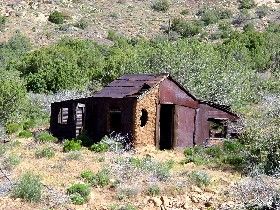
Mineral Park, Arizona Ruins.
©Kathy Alexander/Legends of America, updated October 2026.
Also See:
Arizona Ghost Town Photo Galleries
Arizona – The Grand Canyon State
See Sources.