
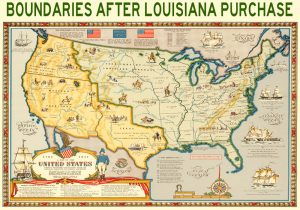
Boundaries after the Louisiana Purchase and the Florida Acquisition by Karl Smith, 1958.
The colonies of East Florida and West Florida remained loyal to the British during the American Revolution. However, the Treaty of Paris in 1783 returned them to Spanish control. After 1783, American immigrants began to move into West Florida.
Spain had long rejected repeated American efforts to purchase Florida.
In 1810, these American settlers in West Florida rebelled, declaring independence from Spain. President James Madison and Congress used the incident to assert their claim to the region.
Spain had been exhausted by the Peninsular War (1807–1814) against Napoleon in Europe and needed to rebuild its credibility and presence in its colonies. Revolutionaries in Central America and South America had been waging wars of independence since 1810. The U.S. government knew these conflicts had seriously weakened the Spanish government. By this time, Spain was unwilling to invest further in Florida, which American settlers were encroaching on, and it was concerned about the border between New Spain (today’s Mexico, Central America, and much of the current U.S. western states) and the United States.
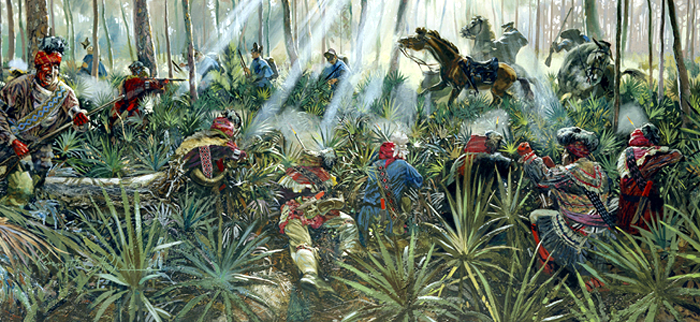
With a minor military presence in Florida, Spain was not able to restrain the Seminole warriors who routinely crossed the border and raided American villages and farms, as well as protected southern slave refugees from slave owners and traders of the southern United States.
The United States asserted that the portion of West Florida from the Mississippi River to the Perdido River was part of the Louisiana Purchase of 1803. Negotiations over Florida began in earnest when Don Luis de Onís traveled to Washington, D.C., in 1815 to meet Secretary of State James Monroe.
The issue was not resolved until Monroe was president and John Quincy Adams was his Secretary of State. Although U.S.-Spanish relations were strained over suspicions of American support for the independence struggles of Spanish-American colonies, the situation became critical when General Andrew Jackson seized the Spanish forts at Pensacola and St. Marks in his 1818 authorized raid against the Seminole Indians and escaped slaves who were viewed as a threat to Georgia. Jackson executed two British citizens on charges of inciting the Indians and runaways.
Monroe’s government seriously considered denouncing Jackson’s actions, but Adams defended Jackson, citing the necessity to restrain the Indians and escaped slaves since the Spanish failed to do so. Adams also sensed that Jackson’s Seminole campaign was popular among Americans, which strengthened his diplomatic hand with Spain.

Adams-Onis Treaty Map, courtesy of Wikipedia.
John Quincy Adams used Jackson’s military action to demand that Spain either control the inhabitants of East Florida or cede it to the United States. By this time, the troubling colonial situation that ceded Florida made sense to Spain had already developed. Minister Onís and Secretary Adams agreed that Spain would cede East Florida to the United States and renounce all claim to West Florida. Spain received no compensation, but the United States agreed to assume liability for $5 million in damage done by American citizens who rebelled against Spain. Under the Onís-Adams Treaty of 1819, the United States and Spain defined the western limits of the Louisiana Purchase, and Spain surrendered its claims to the Pacific Northwest. In return, the United States recognized Spanish sovereignty over Texas.
©Kathy Alexander/Legends of America, updated September 2026.
Also See:
Discovery and Exploration of Florida
Sources: