
The Siege of Port Hudson, Louisiana, was the final engagement in the Union campaign to recapture the Mississippi River during the Civil War. While Union General Ulysses Grant besieged Vicksburg, Mississippi, upriver, General Nathaniel Banks was ordered to capture the lower Mississippi River Confederate stronghold of Port Hudson to aid Grant. When the initial assault failed, Banks settled into a 48-day siege, the longest in U.S. military history up to that point. A second attack also failed, and only after the fall of Vicksburg did the Confederate commander, General Franklin Gardner, surrender the port. The Union gained control of the river and navigation from the Gulf of Mexico through the Deep South and to the river’s upper reaches.
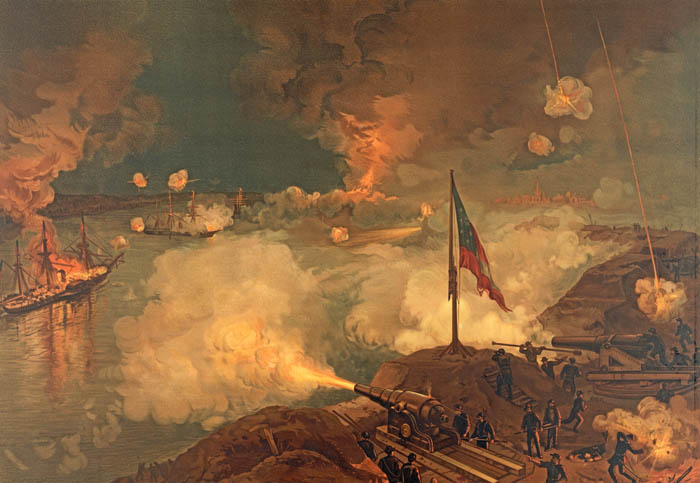
Battle of Port Hudson, Louisiana by Prang & Co.
Plains Store – May 21, 1863 – Part of the Siege of Port Hudson, this battle occurred when Major General Christopher C. Augur’s Union division advanced from Baton Rouge. Early on the morning of May 21, 1863, they reached the intersection of Plains Store and Bayou Sara roads while moving to secure a landing on the river for Major General Nathaniel Banks. Colonel Benjamin H. Grierson’s cavalry, in the lead, encountered Confederate forces under Colonel Frank P. Powers, and skirmishing ensued. As the morning progressed, the Union infantry approached the crossroads and came under fire, bringing on a general engagement. Colonel W.R. Miles set out for Plains Store with Confederate reinforcements at noon. By the time Miles arrived late in the day, the fighting had ceased, the Rebel forces had retreated, and the Federals were preparing camps for the night. Miles attacked the Union forces and, at first, drove them back, but they regrouped and counterattacked. Miles could not stand against the overwhelming Union force and retired into the Port Hudson perimeter. The battle ended, and the last Confederate escape route from Port Hudson was closed. The Union victory resulted in 150 Union casualties and 100 Confederate casualties.
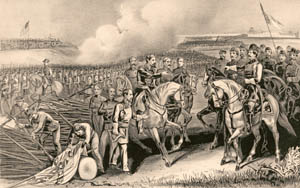
Port Hudson, Louisiana surrenders to the Union in the Civil War. Image by Currier & Ives.
Port Hudson – May 21-July 9, 1863 – Called the Siege of Port Hudson, this was fought with Major General Ulysses S. Grant’s offensive against Vicksburg. Union Major General Nathaniel P. Banks’ army moved against the Confederate stronghold at Port Hudson on the Mississippi River. On May 11, Banks learned that some Confederates had been moved from Port Hudson to support the forces defending Vicksburg. Dividing his forces into two columns, one group approached from the North while the other advanced from the North from Baton Rouge. By May 21, the columns had combined, and Banks’ force of about 30,000 men surrounded Port Hudson, outnumbering the Confederates four to one. He delayed for nearly a week to organize his forces. This gave Confederate Major General Franklin Gardner time to reinforce his lines and move additional artillery into place.
Banks, supported by U.S. Navy gunships, finally made a series of uncoordinated attacks on May 27 that were unsuccessful. After the Federals repelled their frontal assaults, they settled into a siege that lasted 48 days. Banks renewed his assaults on June 14, but the defenders repelled them successfully. On July 9, 1863, after hearing of the fall of Vicksburg, the Confederate garrison of Port Hudson surrendered, opening the Mississippi River to Union navigation from its source to New Orleans. Though the battle was a Union victory, the losses were staggering. Of the 30,000-40,000 Union soldiers involved, 5,000 were killed or wounded, and another 5,000 died of disease. The Confederates suffered 750 killed and wounded, and 250 died of disease. The other 6,500 men surrendered.
©Kathy Alexander/Legends of America, updated September 2026.
Also See:
Civil War Timeline & Leading Events
Port Hudson State Commemorative Area
Sources:
Battlefields.org
National Park Service Battle Descriptions (no longer available online)
National Park Service Civil War
Wikipedia