
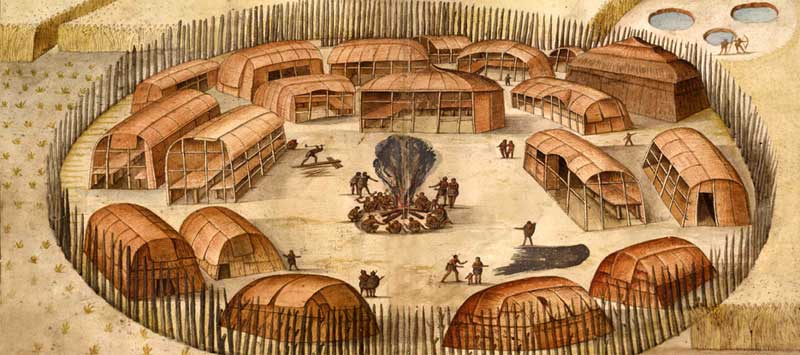
Middle Woodland Period.
The Woodland period, lasting from about 3,000 BC to 1000 AD, is an archaeological classification of Native American cultures of North America before European contact.
The term “Woodland Period” was introduced in the 1930s as a generic term for prehistoric sites falling between the Archaic hunter-gatherers and the agriculturalist Mississippian cultures.
Within this era, the classification is further divided into three additional periods based on changes in how people lived, including their settlement patterns, trade activities, subsistence practices, tools used, and mortuary practices.
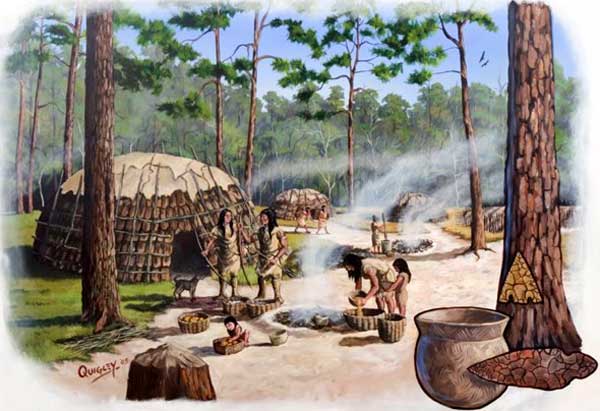
Woodland Period by Dean Quigley, National Park Service.
These three additional eras include:
- Early Woodland Period – 3000 BC to 200 BC
- Middle Woodland Period – 200 BC to 500 AD
- Late Woodland Period – 500 to 1000 AD
By the beginning of the Woodland period, climatic conditions had reached a state similar to the modern-day climate. This era is a developmental stage characterized by increasing cultural complexity and population growth. During this time, people widely adopted horticulture, pottery-making, the bow and arrow, and complex ceremonies surrounding death and burial.
The manufacture of ceramic vessels marks the Woodland period, as does the construction of mounds, the rise and fall of a vast exchange network, the unequal distribution of exotic raw materials and finished goods, and horticultural activity.
Early Woodland Period – 3000 BC to 200 BC
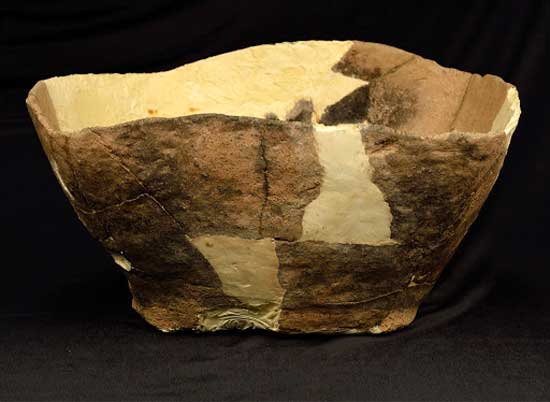
Woodland Period Pottery.
Until quite recently, the onset of the Woodland period was assumed to mark the initial appearance of pottery vessels, the beginnings of mound ceremonialism, the emergence of sedentary village life with well-defined structures and settlements, and the intensive cultivation of crops. However, it is now clear that the beginnings of these developments lie deeper in the past by a thousand years or more. Mound construction dates back to at least 3000 BC. Intensive cultivation of native food crops such as chenopodium, sunflowers, and gourds was widespread by 1000 BC. And in some regions, pottery predates the onset of Woodland cultures by over 1000 years.
The Early Woodland lasted from about 3000 BC to 200 BC. The transition from the Late Archaic to the Early Woodland is marked by increased cultural developments that can be traced to the Middle and Late Archaic. Although pottery, horticulture, and earthen mounds were familiar to some people living during the Archaic period, these innovations became widespread across Eastern North America after about 1000 BC.
The Early Woodland period continued many trends that began during the Late Archaic period, including extensive mound-building, regional distinctive burial complexes, the trade of exotic goods across a large area of North America, the reliance on both wild and domesticated plant foods, and a mobile subsistence strategy in which small groups took advantage of seasonally available resources such as nuts, fish, shellfish, and wild plants. Pottery manufactured during the Archaic period became widespread in limited quantities across the Eastern Interior, the Southeast, and the Northeast. The Far Northeast, the Sub-Arctic, and the Northwest/Plains regions widely adopted pottery somewhat later, about 200 BCE.
The people of this era lived in small bands of related families who shared a base camp most of the year. However, they would leave to hunt or fish in the surrounding areas as needed. Unlike the Late Archaic people, Early Woodland peoples generally did not travel long distances from their base camps. As a result, the long-distance exchange networks that developed during the Late Archaic broke down. Another result of people not moving around as much was that the various bands did not often see each other or share ideas. Hence, styles of making pottery and tools became very distinct from region to region.
The earliest pottery included some made from plant fibers that were more typical of the Archaic period. However, this pottery was not widespread, and most was made from clay tempered with crushed rock or limestone. Between 1500 and 1000 BC, people began using sand to temper the clay and pottery-making became much more common and widely distributed. Various types of pottery were made, including bowls, jars, serving storage, and cooking containers. Many were decorated with stamped, punctuated, pinched, or brushed designs, and some were painted. The pottery was sometimes traded with other groups.
The stone tools of this period were similar to those made during the Archaic period. People continued to make stemmed points with broad blades, but they were slightly smaller. Stone was used from nearby sources to make tools, and tubular stone pipes, likely used for ritual and ceremonial smoking, first appeared during his period.
A remarkable development of the Early Woodland was the widespread construction of earthen mounds. Though this practice seems to have originated in the Archaic Period in Louisiana, by about 1000 BC, the tradition was adopted by people across eastern North America. These mounds, varying in size and shape, were generally built over burial pits or tombs of important individuals. Many graves included rich goods such as copper bracelets, beads, and art objects made from mica, hematite, banded slate, and other stones. Other items included projectile points, natural pigments such as ocher, and special trade items.
Middle Woodland – 200 BC to 500 AD

Middle Woodland Period.
The Middle Woodland period, lasting from about 200 BC to 600 AD, is marked by changes in settlement and subsistence patterns as populations increased and people began to spread into other areas to take advantage of diverse food resources. As populations grew, people settled into larger villages, and group territories became more defined.
By this point, the people were tending gardens and gathering shellfish from the local rivers, enabling them to live in one place for long periods without having to hunt for food as often. However, an increase in exotic artifacts at Middle Woodland sites indicates greater interaction between regions than during the Early Woodland. Some artifacts and materials were not local to the people, such as copper from the Great Lakes area, mica from the southern Appalachians, and shells from the Gulf coast.
The most remarkable aspect of Middle Woodland culture is the development of the Hopewell Culture, which was characterized by large, geometric earthworks and conical mounds that contained elaborate tombs with many exotic grave offerings, including jewelry and art pieces made of copper, mica, obsidian, and ocean shells, as well as long, stemless, stone projectile points. The elaborate tombs are significant because they indicate that the person buried there had a higher or special status. The Hopewell culture first developed in what is now the Ohio Valley and other parts of the Midwest and gradually spread southward.
Late Woodland – 500 to 1000 AD
The Late Woodland period began about AD 500 and lasted about 500 years, ending in AD 1000. During this time, populations increased, and settlements filled the landscape, spreading northward up small streams. People continued to live in base camps, but their increased numbers led to competition for resources and increased warfare. This period was also characterized by a lack of non-local artifacts and materials, unlike the previous 500 years.
Despite the apparent reduction in interregional exchange, the Late Woodland period was a time of critical cultural changes, including the appearance of the bow and arrow around AD 700. The bow and arrow made hunting less communal than in the past, and individual families became more self-sufficient. People began making shorter, thinner, more triangular stone projectile points so they could be attached to arrows.
Middle Woodland people still hunted, fished, and gathered wild foods, but they also spent increasing amounts of time tending their plots of maize, squash, and other plants. Because they now grew food that could be stored, people developed large, rounded jars for storage.

Bow & Arrow.
As the Hopewell culture declined, mortuary practices became more variable and simplified. Small amounts of exotic items still occurred in Late Woodland graves, but they did not appear to be part of an elaborate mortuary complex. The decline in ceremonialism may indicate the development of a new form of religion that focused on a reverence for the ancestors of specific lineages. Evidence shows that many small groups occasionally gathered to build mounds and maintain long-range ties. As a result of these regional gatherings, pottery from different places developed widespread similarities in form and decoration. Additionally, the mound centers expanded their functions from burial sites to civic and ceremonial centers.
And these changes set the stage for developments in the Mississippian period.
©Kathy Alexander/Legends of America, updated November 2025.
Also See:
Native American Archaeological Periods
Native Americans – First Owners of America
Native American Photo Galleries
Sources:
Encyclopedia of Alabama
National Park Service
United States Department of Agriculture
Wikipedia