
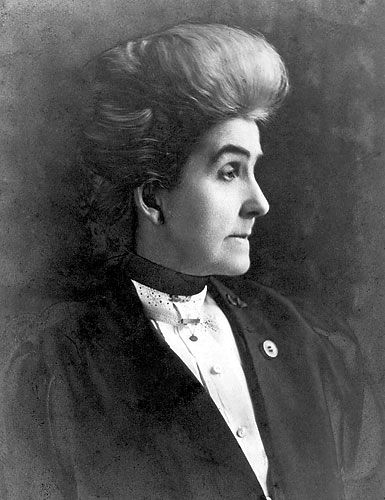
Phoebe Couzins.
One of the first female lawyers in the United States, the first woman appointed U.S. Marshal, and a well-known suffragist, Phoebe Couzins was a trailblazer for women’s rights and equality.
Phoebe was born to Adaline and John E.D. Couzins on September 8, 1842, in St. Louis, Missouri. Her father was an architect and builder, and her mother was active in charity work. From her parents, Phoebe learned early on the value and importance of public service. In 1849, when she was just six years old, a terrible cholera epidemic swept through St. Louis. Thousands of the city’s residents died. John and Adaline Couzins led the local relief organization that helped cholera victims.
During the Civil War, her father served as the St. Louis Chief of Police and as a member of the Committee of Public Safety, a group that sought to keep Missouri in the Union. Her mother volunteered as a nurse during the war and served in the Ladies Union Aid Society. After the war, Adaline and Phoebe joined the St. Louis Woman Suffrage Association, an organization that promoted women’s right to vote and hold political office.
In 1869, Phoebe began her studies at Washington University in St. Louis law school, one of the first schools in the country to offer a woman education in jurisprudence. The same year, Couzins served as a delegate to the American Equal Rights Association convention in St. Louis, where she met influential suffragists Susan B. Anthony and Elizabeth Cady Stanton. Unsatisfied with existing women’s Spirituality organizations, Stanton and Anthony formed the National Woman Suffrage Association, which Couzins joined. Phoebe also began writing articles for Stanton and Anthony’s publication, “The Revolution,” and traveled across the country, giving speeches in favor of women’s rights. She was described as a riveting orator.
In 1871, Phoebe graduated from law school as the first woman to graduate from Washington University and the second woman in the nation to do so. At her graduation celebration, she explained her motivation for earning a law degree, saying she was spurred “solely by a desire to open new paths for women.” During her career, she was admitted to the bar associations of Missouri, Arkansas, Utah, and Kansas, as well as the Dakota Territory federal courts.

1876 Democratic Convention, St. Louis, Missouri.
On the opening day of the 1876 Democratic National Convention in St. Louis, Phoebe Couzins addressed male convention delegates on behalf of the National Woman Suffrage Association. Couzins urged the Democratic Party’s delegates to support women’s suffrage and include it in the party’s political platform, but to no avail. Although unable to vote and barred from participating in the political process, women did attend the convention, watching the proceedings from their seats in the balconies.
In 1884, she testified before the U.S. House Judiciary Committee on women’s legal status. That same year, her father was appointed U.S. Marshal for the Eastern District of Missouri and soon made his daughter one of his deputies. After her father died in 1887, President Grover Cleveland appointed Couzins interim U.S. Marshal, making her the first woman to serve in that position. Two months later, John W. Emerson replaced her.
During this time, both Phoebe and her mother, Adaline, were still members of the St. Louis Woman Suffrage Association and the Ladies’ Union Aid Society.
Couzins then moved to Washington, D.C., where she made a modest living as a writer.
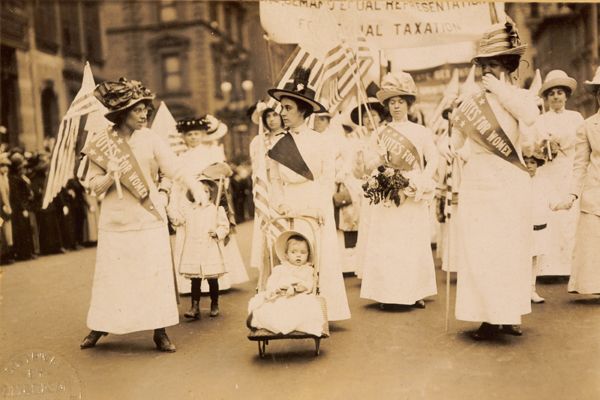
Suffragists Marching NYC 1912 American Press Association.
In 1890, the National Woman Suffrage Association (NWSA) and the American Woman Suffrage Association (AWSA) merged, and Phoebe was outspoken in her support of the NWSA leadership. This antagonized women in both organizations, locally and nationally.
She also ruffled feathers as a Missouri representative on the Board of Lady Managers for the 1893 World’s Columbian Exposition in Chicago. She served as board secretary but tried to dominate meetings and was fired. She sued for reinstatement but lost.
As she grew older, Couzins’s ambitious, outspoken personality alienated friends in the women’s suffrage movement at a time when she could ill afford it. Battling poor health and being disillusioned with younger, wealthier members of the suffragist movement, she denounced the cause, became a national lecturer and lobbyist for the United Brewers Association, and actively protested prohibition.
As a lobbyist, Couzins opposed the temperance movement, which sought to prohibit the sale and consumption of alcohol. Her actions upset acquaintances in the women’s movement, as temperance was a favorite cause of many suffragists. In 1902, Couzins experienced a change of heart and again supported the suffrage movement.
Phoebe Couzins, the first professional woman lawyer in the United States. Missouri State Historical Society
Couzins lost her job as a lobbyist in 1908. At 68, she found herself penniless, in failing health, and unable to work. She returned to St. Louis and appealed to the federal government for a job and the Brewers Association for aid. She also solicited friends for help.
She died in St. Louis on December 6, 1913. She was buried in Bellefontaine Cemetery wearing her U.S. marshal’s badge. Only her brother and a few friends mourned her. Only six people attended her funeral. Her grave remained unmarked until 1950, when members of the Women’s Bar Association of St. Louis placed a headstone on her final resting place in memory of her accomplishments.
©Kathy Alexander/Legends of America, updated October 2026.
Also See:
Lady Marshals of Indian Territory
Women’s Suffrage in the United States
Sources:
State Historical Society of Missouri
Wikipedia
Women’s Council