
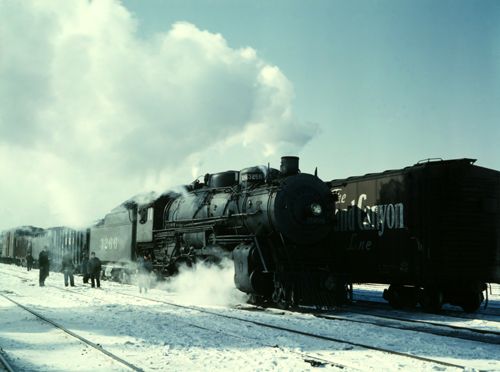
Atchison, Topeka & Santa Fe Railroad.
The period of westward railroad expansion along the Santa Fe Trail, from its eastern terminus in 1865 to its arrival in Santa Fe in 1880, matters because it marked a shift in the character of overland trade along the Trail. By 1865, territorial and state boundaries had become more formalized and would soon be further refined to provide the basis for the continued formation of the United States.
Although the Mountain Route of the Santa Fe Trail had been in common use since the 1840s, its terrain provided many obstacles to wagon movement. One such obstacle was the tortuous 8,000-foot, axle-breaking Raton Pass. The Raton Mountains were a series of high mesas, separated by narrow, precipitous canyons, adjoining the Sangre de Cristo Mountains at right angles and extending eastward for over 100 miles along the Colorado–New Mexico border. Raton Pass was by no means the only route over this mountainous terrain. Another route Lay West of it, and four routes lay East—San Francisco Pass, Manco de Burro Pass, Trinchera Pass, and Emery Gap —that could accommodate the passage of traders. Some of these routes remained difficult, if not impassable, for wagons. Recorded use of Raton Pass as an avenue of communication dates back to the early 18th Century when Ulibarri (1706), Valverde (1719), and probably Villasur (1720), en route from Santa Fe via Taos, went over the Taos-Palo Flechado Pass through the Sangre de Cristo Mountains onto the plains of northeastern New Mexico and from there, through Raton Pass into southeastern Colorado.” Antonio Valverde y Cosio, Governor of New Mexico, who led an expedition through Raton Pass in 1719, documented the route’s difficulties.
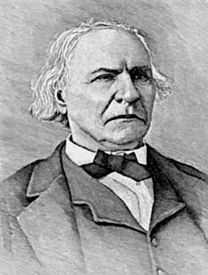
Richens “Uncle Dick” Wooten.
In 1865, Richens Lacy “Uncle Dick” Wootton assembled a group of Mexican laborers and began blasting overhangs and hairpin curves on the Trail at Raton Pass. Wootton had obtained charters from the Colorado and New Mexico legislatures to build a toll road over Raton Pass from Trinidad to the Red (Canadian) River. After completing the work that year, the toll road opened, giving wagons easier access to the Mountain Route. This venture proved highly profitable, with more than 5,000 wagons using the toll road in 1866. In a single one-year, three-month, and nine-day period in the 1860s, Wootton made $9,163.64 on receipts alone. The Sangre de Cristo Pass fell into disuse, while Wootton’s road became the main artery between Colorado and New Mexico until the railroad arrived.
On September 21, 1865, the first train arrived in Kansas City over the Missouri Pacific Railroad. Even though individuals left Kansas City for Santa Fe as late as 1868, the last wagon trains left Kansas City in the spring of 1866. As the eastern terminus of the Trail moved westward, former locations on the Santa Fe Trail that relied on the influx of traders and trading suffered. On August 31, 1867, the Junction City Union reported:
“A few years ago, the freighting wagons and oxen passing through Council Grove were counted by thousands, the value of merchandise by millions. But the shriek of the iron horse has silenced the lowing of the panting ox, and the old trail looks desolate.”
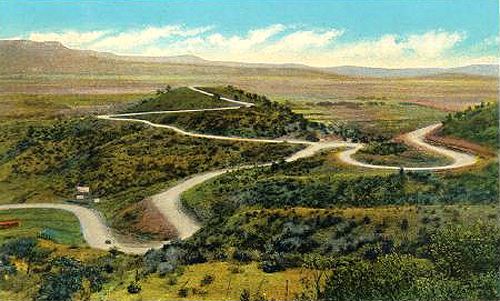
Raton Pass, New Mexico.
The Kansas Pacific Railroad (formerly the Union Pacific Railroad, Eastern Division) and the Atchison, Topeka & Santa Fe Railroad shortened the Trail as their steel rails raced for Santa Fe: Sheridan (May 1868); Burlingame (September 1868); Cheyenne Wells (March 1870); Kit Carson (March 1870); Emporia (summer, 1870); Newton (July 1871); Hutchinson (June 1872), Great Bend (July 1872); and Larned, Kansas (August 1872). In 1878, Wootton sold out his toll road through Raton Pass to the Atchison, Topeka, and Santa Fe Railroad.
From before the Civil War and even after the railroad’s arrival, military freighting remained an important activity along the Santa Fe Trail. Because civilian contractors handled much of the military freight, this activity also created opportunities for military-civilian interaction. Despite delivery delays and damage to military freight, the transportation system that allowed civilian contractors proved cheaper and more manageable than providing government trains. The government’s lack of success with freighting during the Mexican-American War prompted it to experiment with contract freighting. The relative success of these civilian contracts led to more being awarded to supply the growing number of military outposts along the Trail. As competition among civilian contractors increased, the cost of transporting military supplies decreased. However, transported items cost five or six times their original value once transportation costs were included. The provision of a military escort and the westward advance of the Kansas Pacific Railroad in the late 1860s reduced the uncertainty, time, and expense of military freighting. In the 1870s, the principal arms-handling military freight companies for New Mexico were Otero, Sellar and Company, and Chick, Browne, and Company. As the railroad continued its westward advance to Santa Fe, these competing freight companies followed them. When the Atchison, Topeka, and Santa Fe Railroad finally reached the Trail’s western terminus in 1880, transportation costs declined, and wagon hauls grew shorter. Railroad transportation allowed for faster, more frequent shipment of supplies, resulting in less spoilage, loss, and deterioration of goods often characteristic of long wagon hauls.
The railroad’s effect on the overland Santa Fe trade is reflected in the repeated shortening of the Trail’s wagon segments. Some traders responded to the railroad’s impact on wagon transport by moving their trading operations westward ahead of it. One such trader was Don Miguel Antonio Otero, who moved the eastern headquarters of his trading operations westward seven times in eleven years from Kansas in 1868 to Las Vegas, New Mexico, in 1879. Since the Atchison, Topeka & Santa Fe Railroad had won the race for the right-of-way through Raton Pass, its trains thundered into Las Vegas on July 4, 1879, and eventually into Santa Fe on February 9, 1880. Soon after, wagon use of the Trail for long-distance transportation of goods and individuals proved inefficient, closing this chapter in the history of the Santa Fe Trail.
Compiled and edited by Kathy Alexander/Legends of America, updated October 2026.