
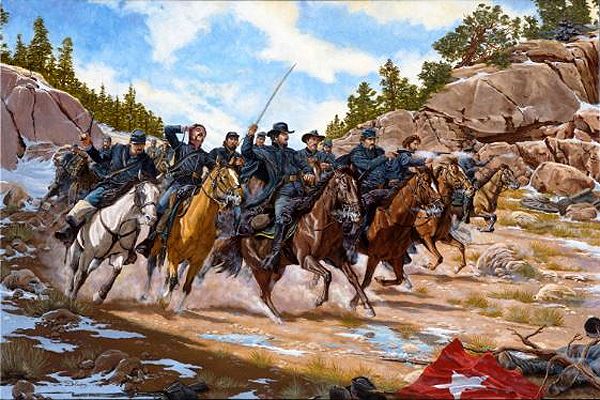
Battle of Glorieta Pass, New Mexico.
The Confederate plan for the West during the Civil War was to raise a force in Texas, march up the Rio Grande, take Santa Fe, turn northeast on the Santa Fe Trail, capture the stores at Fort Union, head up to Colorado to capture the gold fields, and then turn West to take California.
New Mexico, Utah, and Colorado were “giant recruiting grounds” for potential enlistees to the Southern cause. All three states had populations loyal to the Confederacy, and southern New Mexico had already effectively seceded from the government at Santa Fe and formed a separate territory to California.
War materials in New Mexico were rumored to be extensive, with 6,000-8,000 rifles and 25-30 cannons, and the morale of the Federal troops guarding the territory was said to be abysmal. Capturing these territories would mean more wealth for the Confederacy from Colorado’s rich mines. Slavery could be expanded, especially into fertile California, and Arizona could be used as a springboard to invade Mexico. Perhaps most importantly, the Confederacy would gain access to 1,200 miles of California coastline, with many open, blockade-free ports. Open trading ports meant a better chance of recognition and trading with European countries.
In 1861, Confederate President Jefferson Davis commissioned General Henry Hopkins Sibley to raise three regiments in West Texas, which eventually became the Fourth, Fifth, and Seventh Texas Volunteer Cavalry. By late Fall 1861, 3,500 men were prepared to invade New Mexico.
Led by Confederate Brigadier General Henry Hopkins Sibley, southern troops invaded northern New Mexico Territory beginning in February 1862 to gain control of the American Southwest, the gold fields of Colorado, and the ports of California. In one of the most ambitious Confederate campaigns in the Trans-Mississippi Theater, the rebels sought to control the American West and open an additional front in the war.
After the Confederates claimed victory in the Battle of Valverde in February 1862, they moved towards Santa Fe.

Civil War Battle at Pigeon’s Ranch, 1862.
Union and Confederate forces met at Apache Pass, about 10 miles to the Southeast of Santa Fe, on March 26, 1862. A strategic location, situated at the southern tip of the Sangre de Cristo Mountains on the Santa Fe Trail, Union troops came into contact with a Confederate force of 200-300 Texans under the command of Major Charles L. Pyron, who were encamped at Johnson’s Ranch, at one end of the pass. Union Major John M. Chivington led more than 400 soldiers in an attack on the morning of the 26th, capturing some Confederate advance troops before finding the main force behind them. Chivington advanced on them, but their artillery fire threw him back. He regrouped, split his force into the two sides of the pass, caught the Rebels in a crossfire, and soon forced them to retire.

Pigeon’s Ranch, Glorieta Pass, New Mexico, by Kathy Alexander.
Pyron and his men then retreated about a mile to a narrow section of the pass and formed a defensive line before Chivington’s men appeared. The Union troops flanked Pyron’s men again and fired heavily into their ranks. When the Confederates fled again, the Union cavalry charged and captured the Confederate rearguard. Chivington then retired to camp at Kozlowski’s Ranch. No fighting occurred the next day as reinforcements arrived for both sides. Lieutenant Colonel William R. Scurry’s troops swelled the Rebel ranks to about 1,100, while Union Colonel John P. Slough arrived with about 900 men.
Both Slough and Scurry decided to attack early on March 28. As Scurry advanced down the canyon, he saw the Union forces approaching and established a battle line, including his dismounted cavalry. Slough hit them before 11:00 a.m. The Confederates held their ground and then attacked and counterattacked throughout the afternoon. The fighting ended as Slough retired to Pigeon’s Ranch and then to Kozlowski’s Ranch.

Battle of Glorieta Pass Map.
Scurry soon left the field also, thinking he had won the battle. Meanwhile, Chivington’s men destroyed all Scurry’s supplies and animals at Johnson’s Ranch, forcing him to retreat to Santa Fe, the first step on the long road back to San Antonio, Texas. The Battle of Glorieta Pass was a pivotal turning point in the Civil War in the New Mexico Territory. In the end, it resulted in 331 total casualties – 142 Union and 189 Confederate.
The Confederates then moved South again to Albuquerque and found Edward Canby, recently promoted to brigadier general in the Union, outside the town with 1,200 men. Facing defeat and starvation, Sibley and his men began their retreat to Texas. Canby’s troops pursued them to Fort Craig but finally slipped away by a circuitous route. Nearly dead of thirst and starvation, 1,700 Confederate survivors eventually reached safety in El Paso, Texas, on May 4.
By July 1862, all Confederate Troops had vacated New Mexico Territory, and for the duration of the Civil War, New Mexico remained under Union control.
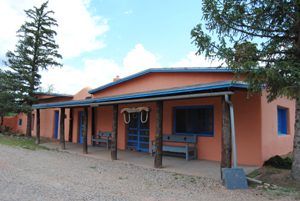
Kozlowski Stage Stop, Pecos National Park, New Mexico, by Kathy Alexander.
Had the Confederates won this campaign, it would have denied the Union a significant source of the gold and silver needed to finance its war effort. Additionally, the Union Navy would have faced the added difficulty of attempting to blockade several hundred miles of Pacific coastline.
©Kathy Alexander/Legends of America, updated October 2026.
Also See:
See Sources.