
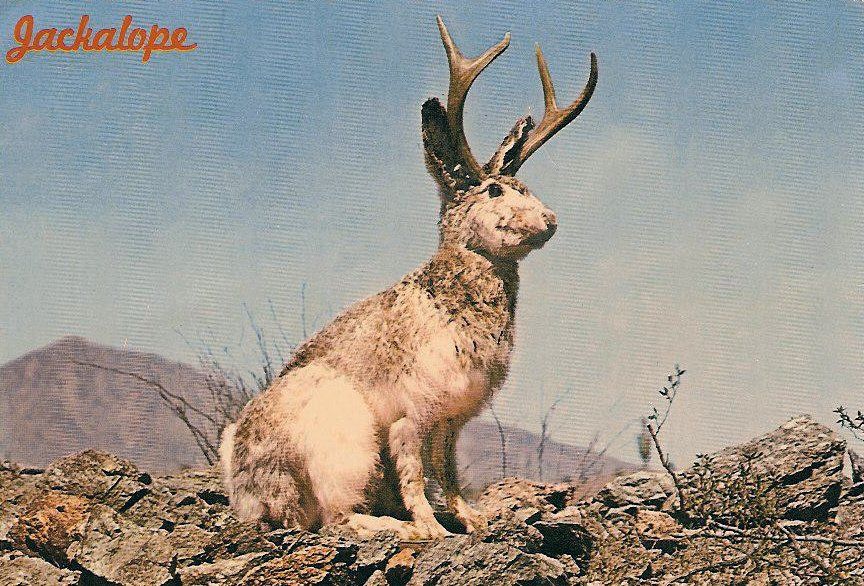
Though many think it’s a myth, the jackalope is alleged to exist in remote areas of Wyoming.
Whether the jackalope actually exists or is simply a hoax popularized by a Douglas, Wyoming, resident in 1939 is still hotly debated today.
For those who believe, the jackalope is said to be an antlered species of rabbit, sometimes rumored to be extinct. Allegedly one of the rarest animals in the world, it is said to be a cross between a now-extinct pygmy deer and a species of jackrabbit. However, occasional sightings of this rare creature continue, with small pockets of jackalope populations persisting in the American West. The antlered rabbit is brownish, weighs between three and five pounds, and moves at lightning speeds of up to 90 miles per hour.
They are said to be vicious when attacked and use their antlers to fight; thus, they are sometimes called the “warrior rabbit.”
John Colter, one of the first white men to enter what would one day be the State of Wyoming, first encountered the jackalope.
They also allegedly possess an uncanny ability to mimic human sounds and, when chased, will use these abilities to elude capture. In the Old West, when cowboys gathered by campfires to sing at night, jackalopes could often be heard mimicking their voices.
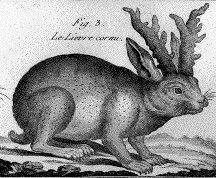
Jackalope drawing in the 1700s
Most commonly sighted in Wyoming, Colorado, Nebraska, and New Mexico, the jackalope also appears to have a European cousin in Germany, known as the wolpertinger, and in Sweden, a related species called the skvader. Illustrations of horned hares date back to the 16th Century in scholarly European works.
Some people do not believe a separate species exists, but rather that the jackalope is “real” only because of a virus called papillomatosis. Also called Jackalopism, the disease causes growths from a parasite to harden on the top of a rabbit’s head, resembling horns. This virus is what they attribute to the birth of the jackalope legend.
For others, the jackalope is thought to be nothing more than a mystical creature, perpetuated by Douglas Herrick, a resident of Douglas, Wyoming, in 1939. It all began after Douglas and his brother Ralph returned from hunting one day. When Ralph threw a dead jackrabbit onto the shop floor, it slid right up against a pair of deer horns. When Ralph declared that “it looked like a rabbit with horns on it,” Douglas, a taxidermist, decided to mount it. From there, the mounted jackalope was born, and the brothers began selling them to the public. Before long, they could be found everywhere, in homes and taverns all over the American West. At the same time, jackalope postcards became a popular Western souvenir.
The jackalopes of Douglas, Wyoming, became so popular that by the late 1940s the city had proclaimed itself the “Jackalope Capital of the World,” promoting the self-proclaimed title in brochures and other tourism advertising.
In 1965, the city erected an eight-foot concrete statue in downtown Douglas, and today billboards and jackalope images appear all over Douglas—on park benches, fire trucks, motel signs, and a 13-foot-tall jackalope cutout on a hillside. The city also does a good job warning visitors about the “vicious” animal’s propensity to attack, so tourists will see warning signs throughout town: “Watch out for the jackalope.”
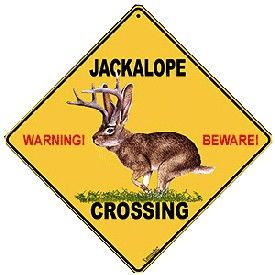
Jackalope Crossing
Every year, Douglas hosts an annual Jackalope Day in June, which includes a Mini-Monster Truck Obstacle Course, Mud Volleyball tournaments, a Motorcycle Show and Rally, the Greased Pig Run, and numerous other events for those hoping for a peek at a “real jackalope.”
Each year, the Douglas Chamber of Commerce also issues thousands of jackalope hunting licenses, despite rules specifying that the hunter cannot have an IQ higher than 72 and can hunt only between midnight and 2 a.m. each June 31.
In 2005, Wyoming legislators declared the jackalope as the state’s “Official Mythical Creature.”
© Kathy Alexander/Legends of America, updated October 2026.
A retired Military reader reached out to us in May of 2022 with this encounter:
Greetings,
Well…It ain’t mythical, and it ain’t extinct either. I wish I had a camera…but I am in Malatya, Turkey at the moment. I was driving down a treacherous mountain road 3 nights ago. I was going only about 30 KPH when something came down the hill into the road. At first, I thought it was a rock, so I slammed on the brakes, but then it hit my headlights.
I had NEVER heard of these before—the most fascinating creature I had ever seen—so naturally, I was curious what kind of animal it was. It was probably 3 feet tall at the back; it ran like a dog but looked like a rabbit… but it had a miniature antler rack on its head that would make the biggest, most majestic buck deer jealous.
I got home and decided to look this thing up on the internet; I was wondering if they were strictly found in this region of the world…only to be met by an onslaught of “it’s fake,” “legends,” “myths,” “cryptozoological” (<scientific terminology for “fake”.), and ONE collaboration site–sort of. This site claimed that all horns grown on a rabbit are cancerous and not calcium. They say that it is tumorous material instead. Whilst this site is correct about cancer causing tumors, the tumors are ALWAYS misshapen, saggy, and pathetic-looking. What I saw was DEFINITELY regal-looking calcified antlers.
So… I guess that I am officially one of the “nut-cases” and “embellished story tellers”…but I KNOW what I saw… I saw it very clearly, nothing in my way, not a foggy night; it was very, very clear, and very, very well lit up by my headlights.
Rick R. May 2022.
Also See:
Legends, Myths & Campfire Tales
See Sources.