

Abandoned in Cisco, Utah, 2008. Photo by Kathy Alexander.
Baking in the relentless desert sun just off U.S. Highway 6/Interstate 70 near the Colorado border is the crusty railroad town of Cisco, Utah. Truly looking like something out of a scary movie, where a driver’s car breaks down and he or she disappears forever, this now quiet town was not always so.
Cisco began as a much-needed watering stop for the Denver and Rio Grande Western Railroad’s steam engines in the 1880s. Slowly, a town grew up around the railroad station, which primarily supported nearby cattle ranchers and sheepherders. With the railroad, the settlement quickly became a provisioning and shipping center for the livestock in nearby Book Cliffs. In fact, at the turn of the century, over 100,000 head of sheep were sheared here before being shipped to market.
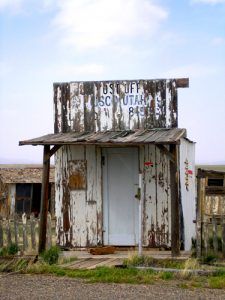
Cisco’s tiny post office is long closed, photo by Kathy Alexander, 2008.
On the main railroad line from Grand Junction, Colorado, to Salt Lake City, Utah, the railroad maintained a water tank for the locomotives, a depot, and several section buildings.
Though seasonal rains sometimes produced grassy fields and filled dry water tanks, most of the area’s water first had to be hauled in and later piped in from the nearby Colorado River.
In 1924, oil and natural gas were discovered in the region, which boosted the town. At one time, Cisco was the largest producer of oil and natural gas in the state. After World War II, when Americans began a love affair with the automobile and began to travel as never before, Cisco was a welcome respite for thirsty travelers headed through the arid desert. Situated on the main highway through the region at the time (US 6/50), several businesses sprouted up to serve those passing through, including restaurants, gas stations, and saloons. In the 1940s, the town was home to about 200 people.
In the 1950s, when the railroad began using diesel engines, replacing the coal-powered steam engines and the need for water stops, Cisco became a candidate for a ghost town. However, the small town was saved by the discovery of uranium and vanadium in the area, which drew prospectors by the thousands. Cisco catered to the desert prospectors for several years until the mining “craze” fizzled, and the prospectors moved on.
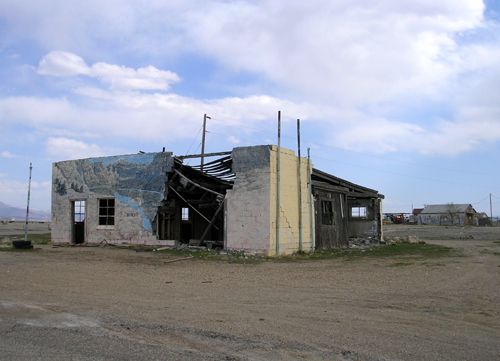
Old filling station and Garage in Cisco, Utah, that was operated by Ray Scott in the 1940s and 50s. Photo by Kathy Alexander.
Two decades later, however, Cisco would not be so lucky when I-70 barreled through the region, completely bypassing Cisco and its businesses. The economy immediately declined, and people moved away.
A combination gas station and restaurant was among the last businesses to survive in Cisco. After it closed, Cisco became a true ghost town, with numerous abandoned buildings and businesses, sitting amongst old railroad and oilfield junk and dozens of rusting cars. Nearly everything here is crumbling and vandalized except for a few new oil wells drilled nearby in 2005.
Though the Union Pacific Railroad continues to use the railroad tracks and the California Zephyr still “flies” through, the train ceased to stop here decades ago. During Legends of America’s visit, we saw nary a soul, not even a roaming dog. By 2018, it appears the town is now privately owned, with the owner fixing up at least the old post office as an Airbnb.
We weren’t wrong about the old town looking like something out of a movie, as scenes from the 1971 film Vanishing Point, Thelma and Louise in 1991, and Don’t Come Knocking in 2005 were filmed here.

Cisco, Utah Landing Store. Photo by Kathy Weiser-Alexander.
Cisco is 50 miles east of Green River, South of I-70 at exit 204 (State Highway 128) when traveling eastbound, or exit 214 if traveling westbound.
See our Cisco Utah Photo Print Gallery HERE
© KathyAlexand/Legends of America, updated August 2026.
Also See:
Sego Canyon, Utah – History & Ancient History
Thompson Springs, Utah – Dying in the Desert
See Sources.