
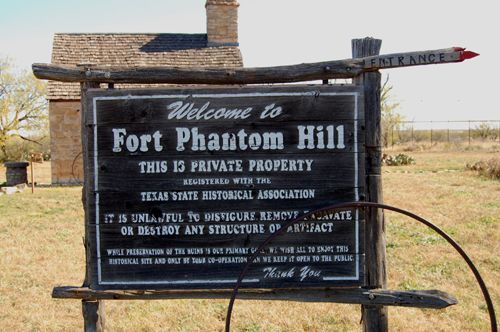
Fort Phantom Welcome.
Located in Jones County, Texas, Fort Phantom Hill is one of the most pristine historic sites in the Lone Star State. Built in the early 1850s to protect the westward-moving pioneers, the historic site not only provides today’s visitors with a rich historical view of the past but is also said to be extremely haunted.
In 1849, the federal government sent Captain Randolph B. Marcy to explore the vast region to the north and west of Austin, with the goal of establishing a route through the area. Long inhabited by the warlike Comanche Indians, the area was known as the Comancheria. Marcy’s exploration aimed to establish a safer passage for immigrants headed to the California goldfields. As a result of Marcy’s recommendations, a cordon of forts, including Fort Phantom Hill, were established on the new route through the Comancheria.
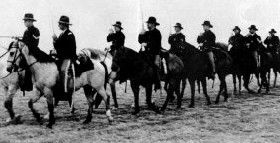
Fort Phantom, Texas, Soldiers.
Acting on orders from General Persifor F. Smith, Lieutenant Colonel John J. Abercrombie arrived at the Clear Fork of the Brazos River with five companies of the Fifth Infantry on November 14, 1851. His first impression was not good, as a wet snowstorm blew in, killing one teamster and 20 horses, mules, and oxen that froze to death.
Also, Abercrombie found, much to his dismay, that the site had neither wood for construction nor suitable water for the men and the animals. Though he sent word of the poor conditions, the orders were unchanged, and construction on the fort began. What was unknown to both Smith and Abercrombie was that the fort was being built at the wrong location. Smith had just recently taken command from his ailing General, who had been supervising the construction of the forts along the route.
The plan had been to build the fort at a site in Coleman County, but Smith, unfamiliar with the area, changed the locale to the Clear Fork near its junction with Elm Creek. This decision impacted the post’s future, as the fort was constructed in an area with inadequate water and timber supplies to meet the needs of the new garrison.
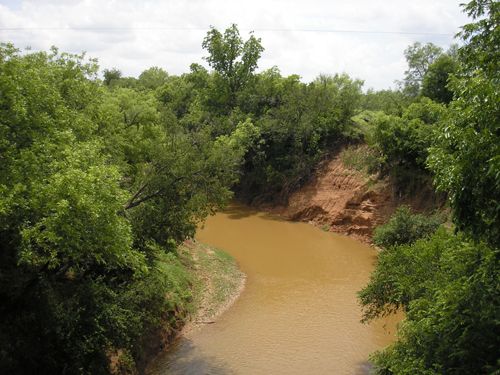
Clear Fork Brazos River
Stone was brought in from Elm Creek about two miles south of the fort, and oak logs for the officers’ quarters and the hospital had to be brought in by ox wagon from as far away as forty miles. The guardhouse, magazine, and commissary storehouse were built entirely of stone, whereas the other buildings were of the adobe style.
Fort Phantom Hill was never officially named. Instead, it was referred to as the “Post on the Clear Fork of the Brazos.” There are two legends about the origin of the unofficial designation Phantom Hill. The first of which is that the hill rises sharply from the plains when approached from a distance, but seems to level out as it is approached, vanishing like a phantom. The second account is that of a nervous sentry who fired on what he thought was an Indian on the hill. The investigation that followed failed to discover the presence of any Indians, and one of the troopers suggested that the man had seen a ghost.
Life at the fort was difficult for the soldiers as Elm Creek was often dry, and the waters of the Clear Fork were brackish. Early on, an 80-foot-deep well was dug near the guardhouse, but even it was not always reliable. More often than not, it was necessary to haul water barrels in wagons from a spring about four miles upriver from the post. Due to the lack of water, a post-garden could not be tilled, resulting in a shortage of vegetables in the men’s diet. As a result, the soldiers began to suffer from scurvy, fevers, dysentery, colds, and pneumonia. Desertions at the fort were said to have been common due to the monotony and loneliness at the isolated fort.
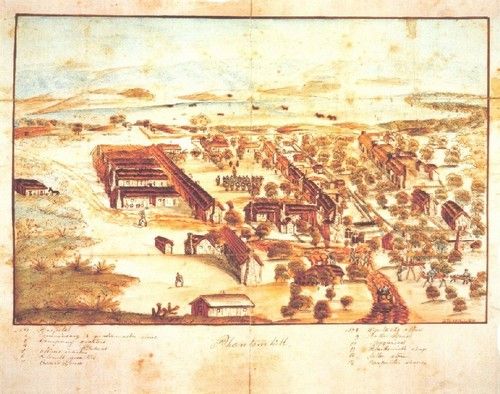
1853 watercolor of Fort Phantom Hill provided courtesy of the Fort Phantom Foundation.
One member of the garrison, Lieutenant Clinton W. Lear, wrote a letter to his wife in Fort Washita, Oklahoma, that described it this way:
“When I say to you that we have a beautiful valley to look upon, I have said everything favorable that could be said of this place.”… “Our camp is pitched in a small grove of ‘black jack’, of about 5 acres extent, within 200 or 300 yards of a creek the water of which is salt, or brackish & bitter.”… “Everybody is disgusted “… “Like the Dove after the Deluge, not one green sprig can we find to indicate man ever intended this to inhabit. Indeed, I cannot imagine that God ever intended for white men to occupy such a barren waste.”
Although the isolated fort was vulnerable to attacks, its garrison had only peaceful encounters with the Indians, including the Comanche, Lipan, Wichita, Kiowa, and Kickapoo. Because its occupation was relatively uneventful, the fort was abandoned on April 6, 1854. At the time of its evacuation, the Indian menace had been curbed due to the establishment of reservations on the upper Brazos and the Clear Fork to the northeast.
As the troops marched out of Fort Phantom, headed toward El Paso, they looked back to discover the fort was in flames. The event was blamed on the Indians or Confederate troops, but many said that it was the garrison members, because of their distaste for the post, who set the fire.
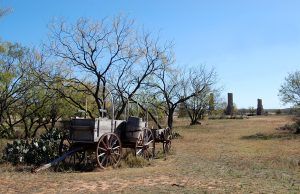
Fort Phantom by Kathy Alexander.
In 1858, the remaining structures of the fort were repaired and utilized as a way station for the Southern Overland (Butterfield) Mail Stagecoach Line. During the Civil War, Colonel James B. (Buck) Barry and some of his units used Fort Phantom Hill as a base of field operations. Beginning in 1871, the fort served as a subpost of Fort Griffin near present-day Albany, Texas.
After the Indian Wars subsided, a town grew up around the fort ruins. In 1876-77, it was a buying and shipping point for buffalo hides. By 1880, Fort Phantom had a population of more than 500 and was designated as the Jones County seat the following year, in May 1881. However, that was a short-lived title, as the county seat was moved just six months later, in November, to nearby Anson, Texas.
The Texas and Pacific Railway routed its tracks through Abilene, 14 miles to the south. A letter written to the San Antonio Express in 1892 commented that Fort Phantom contained nothing but “one hotel, one saloon, one general store, one blacksmith shop, and 10,000 prairie dogs.”
In 1928, John Guitar of Abilene, Texas, purchased the property. In 1969, his grandson, Jim Alexander, also of Abilene, deeded the property to the Fort Phantom Foundation to ensure its long-term preservation.
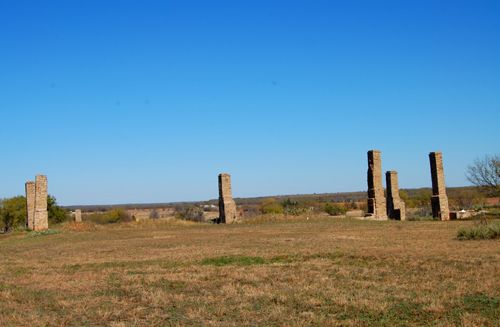
Fort Phantom by Kathy Alexander.
Today, Fort Phantom Hill is one of the most pristine historic sites in Texas. Besides a dozen or so chimneys sprouting up above the plains, the 22-acre site includes three intact stone buildings, including the powder magazine, a guardhouse, and the commissary. The site is open daily during daylight hours and is free to visitors. Although no accommodations are provided on-site, informational brochures are available, and the major structures are clearly marked. Visiting the site gives modern-day visitors a sense of what life must have been like in the 1850s, as people attempted to tame the unforgiving West Texas landscape. The fort is part of the Texas Forts Trail, a 650-mile highway tour of historic Texas.
The fort is located 11 miles north of Interstate 20, near Abilene, Texas, on FM 600. You can also access the fort on the Texas Forts Trail on FM 2833. Informational pamphlets are available on-site, and major structures are clearly marked.
Ironically, the Fort Phantom Hill Reservoir was built in 1937, two miles south of the old post that severely suffered from a lack of water. The reservoir supplies water for about 100,000 people in Taylor and Jones counties.
As for the hauntings of the Fort, its name alone suggests that it would only make sense for the place to be alive with spirits from the past.
Several legends exist that restless Indians haunt the place from frontier times, who are said to continue stalking their ancient grounds at night. Another says the fort is haunted by an innocent man who was wrongly hanged near the fort. After his life ended at the end of a rope, his accusers are all said to have died in mysterious ways.
A former Abilene psychic who visited the fort said that he suddenly saw the old officers’ quarters change into their former complete structure, and he found himself in the parlor. There, two men in officers’ uniforms stood before him. One man was described as tall and thin, while the other was a short, red-haired man with piercing eyes.
As the psychic stood there in fright, the men glared at him, seemingly unhappy at his intrusion. When he turned to flee, the apparitions and the restored building faded.
The nearby Lake Fort Phantom Hill is also said to be haunted by a watery spirit known as the “Lady of the Lake.”
This phantom woman has been seen numerous times, the first of which was almost 150 years ago, long before the lake existed. Dressed in a light-colored long gown or robe, the watery ghost is said to have been seen wandering around the lakeside. Others who have seen her described the apparition as floating over the lake, sometimes carrying a lantern and surrounded by a bluish glow.
Who is this restless spirit? The answer to this question provides as many legends as the spirit herself. The first legend says she was the wife of a pioneer who built a small cabin in the woods that are now filled with Lake Phantom. Amid the dangerous Comancheria, the cabin was often attacked by Indians.
To protect themselves, the couple made a pact that no one would enter the cabin without first speaking a secret password. If the code word wasn’t given, they were to shoot anything or anyone who tried to enter. One day, when the man had gone out hunting, he was ambushed by Indians as he approached his cabin. Injured, he managed to escape and began clawing at the door to his cabin. Forgetting about his password or being unable to say it, his wife shot him before he cleared the stoop. According to legend, the forlorn woman continues to wander the lake, cursed for eternity for killing her husband.
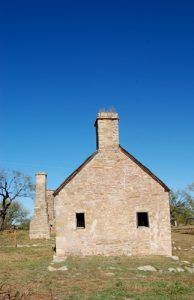
Fort Phantom Guardhouse, Kathy Alexander.
A second legend says that when a couple was to meet at a church near the lake in the mid-1940s to exchange wedding vows, the groom never arrived. After hours of waiting and sure that he would not have left her standing at the altar, she begged authorities to look for her groom. The next morning, he was found dressed in his finest suit, floating in a boat in the middle of the lake. Though the man’s face bore an expression of severe pain, doctors could not determine the cause of death. Some say the spirit was the bride searching for her fiancé’s killer. A third legend places the spirit much later, in the early 1980s. According to this tale, a young woman and her lover agree to meet at the lake for an evening of romance. However, when the young man arrived, he was enraged by a rumor he had heard about her, and the two began to quarrel. The disagreement grew worse, ending in the man drowning her in the lake. In this version, it is the murdered woman who wanders the lake. Finally, if you were to ask anyone of Hispanic descent, they would most assuredly tell you that the ghostly woman is that of La Llorona, who is often seen about the lakes and rivers of the southwest.
In any event, there have been hundreds of sightings throughout the years of the Lady of the Lake, who seemingly doesn’t keep her excursions only at the lakeside. She has also been said to have been seen at a nearby cemetery and along a dirt road called Lover’s Lane. One couple who saw her at Lover’s Lane described her as walking along the road; however, they could see that the apparition had no eyes when she grew closer.
Other strange phenomena around the lake include the sounds of screams, moaning, gunshots, and rapping upon vehicle windows. Others report smells of decaying flesh, perfume, and roses.
Dogs at the lake have been noticed to go into unprovoked snapping and barking at seemingly invisible visitors.
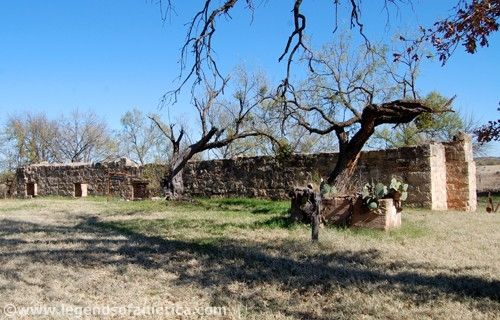
Fort Phantom Commissary-Storehouse, Kathy Alexander.
~~
On the breezy Texas border, on the prairies far away
Where the antelope is grazing and the Spanish ponies play;
Where the tawny cattle wander through the golden incensed hours,
And the sunlight woos a landscape clothed in royal robes of flowers;
Where the Elm and Clear Fork mingle, as they journey to the sea,
And the night-wind sobs sad stories o’er a wild and lonely lea;
Where of old the dusky savage and the shaggy bison trod,
And the reverent plains are sleeping ‘midst drowsy dreams of God;
Where the twilight loves to linger, e’er night’s sable robes are cast
‘Round grim-ruined, spectral chimneys, telling stories of the past,
Thereupon, upon an airy mesa, close beside a whispering rill
There today, you’ll find the ruins of Old Fort Phantom Hill.
– Larry Chitenden, 1938
©Kathy Alexander/Legends of America, updated September 2025.
Also See:
Texas Ghost Towns Photo Gallery
See Sources.