LEGENDS OF AMERICA

A Travel Site for the Nostalgic & Historic Minded


  Search


Legends Home

Site Map

What's New!!


Recommend this site


American History

Ghost Towns

Ghostly Legends

Historic People

Native Americans

The Old West

Photo Galleries

Roadside Attractions

Rocky Mtn Store

Route 66

Travel Destinations

Treasure Tales

Legends Blog


Free E-Newsletter


Legends of America's Exclusive Custom Products


P.O. Box 19423

Lenexa, KS 66285

913-708-5119


Please report broken links, missing pictures, or other problems online by clicking HERE or send us an email.  Thanks!


Nebraska Forts of the Old West


Advertise Here!


<< Previous  1 2  Next >>


Fort McPherson (1863-1880) - The fort was first established in October, 1863 in Cottonwood Canyon to protect the Overland Trail between Fort Kearny and Julesburg, Colorado. It was first known as Cantonment McKean, but was changed to Fort Cottonwood when construction began. However, it was soon moved closer to the town of Maxwell, Nebraska. It was renamed Fort McPherson on February 26, 1866 to honor General James B. McPherson, who had fallen while fighting with General W.T. Sherman against the Confederate forces in the battle for Atlanta. The main activities of the Fort during its 17 years of activity, were escorting stagecoaches and immigrant wagon trains; pursuing and punishing Indians for depredations; and protecting the mail and the telegraph lines.


Fort McPherson National Cemetery

Fort McPherson National Cemetery.

Fort McPherson played an important role in the Indian Wars from 1864 until its abandonment in 1880. Numerous important campaigns and expeditions were launched from the fort including that of General Eugene Carr which culminated in the defeat of the Cheyenne Indians at the Battle of Summit Springs. William F. Cody, the North Brothers, and the Pawnee Scouts all served at Fort McPherson during this period. Lieutenant Colonel George A. Custer led the 7th Cavalry from Fort McPherson on June 15th, 1867 for operations against Indians in Kansas.

On October 13, 1873, a tract of 107 acres was set aside as a national cemetery. Subsequent reductions have limited the size of the cemetery to twenty acres. Burials in the McPherson National Cemetery have included soldiers who served in the Indian Wars through the west, as well as those who have served in the Civil War, Spanish-American War, World Wars I and II, and the Korean War.


After providing nearly two decades of strong economic and developmental influences for hundreds of miles, the fort was abandoned by the Army in 1880. The following spring, the buildings were sold at auction. Today, all that's left is the National Cemetery, located at Maxwell, Nebraska.


Fort Mitchell (1864-1867)  - The fort was built and manned in the fall  of 1864 by Company "H" of the Eleventh Ohio Volunteer Cavalry under Captain J. S. Shuman. It was named in honor of General Robert B. Mitchell, who ordered the establishment of several sub-stations along the Great Platte River Road between Julesburg and South Pass. The post was surrounded by a stockade with a sally-port, firing loop-holes, and a sentinel tower. A nearby "road ranch" served as the Scott's Bluff stage station. In February 1865 they helped defend Mud Springs Station against an attack by Cheyenne. In June 1865 they rescued Fort Laramie troops ambushed by Sioux Indians near Horse Creek. Fort Mitchell was abandoned after the Fort Laramie peace conference of 1867. Today, there are no remains of the fort located about 1/2 mile south of the junction of Highways 92 and 29 east of Mitchell, Nebraska.


Fort Omaha, Nebraska

Fort Omaha

Fort Omaha (1863-Present) - The Post of Omaha came into being in 1863 to train Civil War Volunteers. Three years later it became headquarters of the Department of the Platte. In 1868, a new post was activated four miles northwest of the city. Known as Sherman Barracks the first year and then as Omaha Barracks, in 1878 it was redesignated as Fort Omaha. From 1875 to 1882 and from 1886 to 1888, as commander of the Department of the Platte, Brigadier General George Crook was stationed at the post when he was not in the field. He directed many major campaigns on the northern Plains, serving in which were numerous troops that had passed through Fort Omaha.


The Fort Omaha garrison moved in 1896 to Fort Crook, which had been activated 5 years earlier about 10 miles south of Omaha as the New Post of Fort Omaha. The first soldiers had arrived there in 1895. In 1905 the Army reactivated Fort Omaha, and during World War I used it for a balloon school. The Navy has had jurisdiction over the base since 1947, and still utilizes it along with other branches of the Armed Forces for recruiting. Reserve training, and administration.

Seven buildings from the 1870's and 1880's have survived. One of the oldest is the commanding officer's house, or Crook House, completed in 1879. Its first tenant was General Crook, and today the commander of Fort Omaha occupies it. A large two-story brick structure, asymmetrical in plan, Italianate in style, and crowned by hipped roofs, it is in good condition. A long one-story porch projects from its eastern facade. The interior has been altered over the years, but the exterior has changed little. Fort Omaha is not ordinarily open to the public. The fort is located in northern Omaha at 30th and Fort Streets.


Fort Robidoux (1822-1840s) - Established by the American Fur Company, the post was named for fur trapper Joseph Robidoux. Shortly after it was established, it was also known as French Company and Cabanne's Trading Post, for its operator, John Pierre Cabanne. Cabanne continued to operate the post until 1833 when  Joshua Pilcher assumed command of the post until it was abandoned in the early 1840s. Its success was in part due to its ability to supply provisions to nearby Fort Atkinson.  Shortly after 1840 operations moved to Fontenelle's Post in the Bellevue, Nebraska area and placed under the management of Peter A. Sarpy. Though nothing is left of the fort today, the site is listed on the National Register of Historic Places. It is located 10 miles north of Omaha, Nebraska, on the Lewis and Clark Scenic Byway near Florence, north of Dodge Park.


Fort Sidney (1867-1894) - First called Sidney Barracks, the post was established in 1867 with a primary function of protecting the Union Pacific Railroad workers against the threat of hostile Indians. In 1869 the post was relocated to the present site at Sidney, Nebraska, and the following year it was renamed Fort Sidney. In the mid 1870's the post became a major strategic point as the initial supply depot on the Sidney-Blackhills Trail. Throughout the mid 1870's, supplies and passengers traveled the trail to the Red Cloud Indian Agency and beyond to the Black Hills gold fields. By 1875 the fort contained quarters for three companies, five officers quarters, a hospital, guard house, bakery, laundry, stables, and other structures. In 1878 troops from Fort Sidney were called in to participate in the search for Dull Knife's Cheyennes who had escaped from their reservation in Oklahoma, and who were later recaptured near Fort Robinson, Nebraska. With the Indians subdued, Fort Sidney was closed in 1894 and most of the buildings were sold.


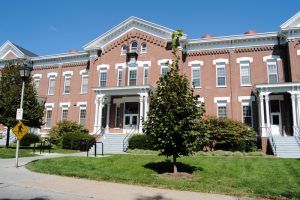
Today, the Fort Sidney Complex includes the Post Commanders Home built in 1871, a Double-Set of Married Officers Quarters, which now houses the Cheyenne County Museum, built in 1884, and the 1872 Powder House, all located now in a residential area of the town. To the southeast are the remains of the fort's rifle range. The restored buildings have been refurnished with authentic articles of the late 1800s and are listed in the National Register of Historic Places. The museum is located at

6th and Jackson Streets in Sidney, Nebraska.


© Kathy Weiser/Legends of America, April, 2008


Fort Sidney, Nebraska

Fort Sidney, Nebraska


<< Previous  1 2  Next >>

 From the Rocky Mountain General Store

Legends Exclusive Custom Products - Legends of America and the Rocky Mountain General Store now provide a number of exclusive products that you won't find anywhere else! At our Exclusive Custom Products Store, you'll find lots of crazy bumper stickers;

Old West prints, postcards, t-shirts and more; and our line of exclusive Route 66 products provides images on a number of items that you've never seen before! Click HERE to see the entire line.


Old West and cowboy products Old West custom products Route 66 Custom Products Old west prints, cards and calendars
 

                                                              Copyright © 2003-2008, www.Legends of America.com