|
Legends Home
Site
Map
What's New!!

American History
Ghost Towns
Ghostly Legends
Historic People
Native Americans
The Old West
Photo
Galleries
Roadside
Attractions
Rocky Mtn Store
Route 66
Travel
Destinations
Treasure Tales
Legends Blog
Free E-Newsletter
Facebook
Fanpage
Twittering

Contact Us
Please report
broken
links, missing pictures, or
other problems online by
clicking
HERE or send us
an
email. Thanks!
| |
| |
|
NEBRASKA LEGENDS
Nebraska Forts of the Old West |
|

|
|
<< Previous 1
2 Next >> |
|
Camp Sheridan
Fort
Atkinson
Fort Crook
Fort Hartsuff
Fort Kearny
Fort
Lisa
Fort McPherson
Fort Mitchell
Fort Omaha
Fort Robidoux
Fort Robinson
Fort Sidney
|

Crazy Horse and his band of Indians on their
way from Camp Sheridan to
surrender to
General George Crook
at Red Cloud Agency, Frank Leslie's
illustrated Newspaper, June, 1877.
This image available for
photographic prints and
downloads
HERE!
|
|
Camp Sheridan and Spotted Tail Indian Agency (1874-1880) -
In 1873, the Brule
Sioux, under the leadership of
Spotted Tail, moved from their prior agency near Fort Randall, Dakota
Territory to northwest
Nebraska, and finally to an agency overlooking
Beaver Creek, near present-day Hay Springs. The agency was composed of
storehouses, an issue building, a carpentry shop, a sawmill, stables, and
other structures. To guard the agency, Camp Sheridan was established as a
tent camp in the fall of 1874 about one mile from the Spotted Tail Agency.
Permanent facilities were constructed in the spring of 1875 consisting of
over thirty frame and brick structures. Following removal of the Brule to
the Rosebud Agency in
South Dakota, activity declined and Camp Sheridan
was abandoned by the army in 1880.
Fort Crook
(1894-Present) - Although plans were drawn for the 1888 establishment
of Fort Crook (now Offutt Air Base) at Bellevue,
Nebraska, no
meaningful construction commenced until 1894. Situated along the
Missouri
River, the fort was first used as a dispatch point for Indian conflicts
on the Great Plains. The fort was named for Major
General George Crook, a
Civil War
veteran and Indian Fighter.
The first infantry
troops arrived on June 28, 1896. The fort became the
Troops from Fort Crook fought during the
Spanish-American War when the 22nd Regiment, under Charles A. Wikoff, were
dispatched to Cuba. The regiment suffered heavy casualties in the Battle
of El Caney. Only 165 of the 513 regiment members survived with most
succumbing to tropical diseases after the battle.
In 1918 arrival of
the 61st Balloon Company elevated the post to an airfield. In 1921 landing
strips were graded, and by 1924, it became known as Offutt Field. Both the
airstrip and army post grew in importance, until June 11, 1946 when Fort
Crook officially transferred to the 2nd Air Force, and on January 13,
1948, the entire complex was renamed Offutt Air Force Base.
Today, many of the
original buildings continue to stand on the active air force base.
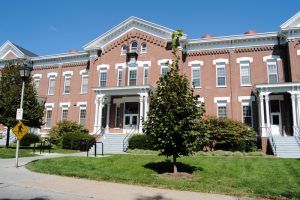
The fort's old
brick barracks, hospital, and other buildings are scattered around Offutt
Air Force Base, mixed with more modern structures. The
oldest surviving portion of Fort Crook is the parade grounds and
surrounding red brick buildings that were constructed between 1894-96.
These structures are still in active use today as squadron
headquarters, living quarters for high-ranking generals
(Generals Row), and
Nebraska's oldest operational jail.
The base, located south
of Bellevue,
Nebraska is the headquarters of the U.S.
Strategic Command and the Air Force Weather Agency.
Unfortunately, access to the base is
limited only
to members of the military and their official guests.
|
|
|
|

22nd Infantry Regiment on the
parade ground arrived at
Ft. Crook,
Nebraska, General's Row
in the background.
|
Fort Hartsuff
(1874-81) -
When white settlers began to
populate the North Loup Valley,
Sioux depredations at
Sioux
Creek in October, 1873 and at Pebble Creek in January, 1874
prompted the settlers to request military protection.
The fort, originally designated as "Post
on the North Fork of the Loup River," was established on
September 5, 1874. On December 9, 1874, the post was renamed
in honor of Major General George L. Hartsuff. In addition to
protecting the settlers, the fort was also responsible for
overseeing the
Pawnee Indian Reservation, in present Nance
County. The fort was composed of nine major buildings, built
of concrete and stone, which helped them withstand the passage
of time.
|
|
The fort's major military
engagement came at the Battle of the Blow Out in April of
1876. The action resulted in the death of First Sergeant
Dougherty when troops commanded by Lieutenant Heyl routed a band of hostile
Sioux. The
transfer of the
Pawnees
to Indian Territory, the Army's push of the
Sioux into the
Dakotas, and the ensuing influx of settlers into the region
ended the need for the post and it was abandoned in 1881.
After the Army departed, farmers utilized some of the
buildings. In 1961, the property was acquired by the State of
Nebraska and today has been restored as it was when
soldiers patrolled the Loup and Cedar River valleys and
pioneered a new trail to the Black Hills gold fields in the
1870s. The Park and surrounding district was named to the
National Register of Historic Places in 1978. Today, the park
provides a Visitor Center, several restored buildings, and
interpretive displays. It is located in Valley County, on an
unimproved road, about three miles northwest of Elyria,
Nebraska.
Continued
Next Page
|
|
<< Previous 1
2 Next >> |
|
From the Rocky Mountain General Store
Great American Bars and Saloons
by
Kathy Weiser,
Owner/Editor of Legends of America
-
Kathy Weiser's first venture into the publishing world takes you into the
many watering holes of America's past, particularly the numerous
saloons
that sprouted up during our nation's
Wild West
days. This great
photographic review displays hundreds of
vintage photographs from
California
to
Arizona, the mining camps of
Colorado, all the way to New
York and its turbulent days of
Prohibition.
Hardcover, 2006, 224 Pages.
Signed by the author!!
|
| |
|