
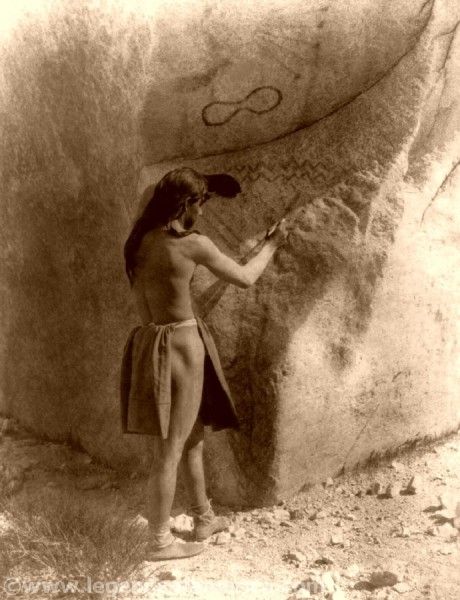
Paviotso Paiute making petroglyphs. 1924 by Edward S. Curtis.
The term “Paiute” was subject to considerable confusion in the 1800s. In common usage, it was applied at one time or another to most of the Shoshonean tribes of western Utah, northern Arizona, southern Idaho, eastern Oregon, Nevada, and eastern and southern California. The generally accepted idea is that Paiute means “water Ute” or “true Ute.”
John Wesley Powell stated that the name belonged exclusively to the Corn Creek tribe of southwest Utah, but was extended to include many other tribes and was employed as a convenient divisional name for the tribes occupying southwest Utah, the southwest part of Nevada, and the northwest part of Arizona.
Concerning the Indians of Walker River and Pyramid Lake reservations, who constitute the main body of those commonly known as Paiute, Powell claimed that they were not Paiute but another tribe that he called Paviotso. He stated:
“The names by which the tribes are known to white men and the department give no clue to the relationship of the Indians. For example, the Indians in the vicinity of the reservation on the Muddy River and the Indians on the Walker River and Pyramid Lake reservations are called Pai or Pair Utes. Still, the Indians know only those on the Muddy by that name. In contrast, those on the other two reservations are known as Paviotsoes, and speak a very different language, but closely allied to, if not identical with, that of the Bannock.”
The Indians of Walker River and Pyramid Lake claimed the Bannock as their cousins and said they spoke the same language. The various small bands had little political coherence and no recognized head chief. The most influential chiefs among them were Winnemucca and Natchez. As a rule, they were peaceful and friendly toward the whites. However, in the early 1860s, they came into collision with miners and emigrants several times, and the whites themselves frequently provoked hostility.
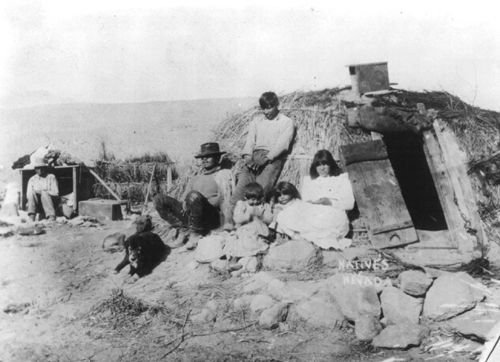
Paiute family and wikiup.
The Northern Paiute were more warlike than those of the South, and many took part in the Bannock War of 1878. Because the great majority of the Paiute (including the Paviotso) were not on reservations, many of them being attached to the ranches of white men, it was impossible to determine their population. Still, it was estimated at 6,500-7,000.
As a people, the Paiute were peaceable, moral, and industrious, and were highly commended for their good qualities. By their willingness and efficiency as workers, they made themselves necessary to the white farmers, which enabled them to supply themselves with good clothing and many of the comforts of life, while on the other hand, they steadily resisted the vices of civilization, so that one agent spoke of them as presenting the “singular anomaly” of improvement by contact with the whites. Another authority said:
“To these habits and excellence of character may be attributed the fact that they are annually increasing in numbers, and that they are strong, healthy, active people. Many of them were employed as laborers on the farms of white men in all seasons, but they were especially serviceable during the time of harvesting and haymaking.”
Aside from their earnings among the whites, they derived subsistence from the fish of the lakes, jackrabbits, small game of the sage plains and mountains, and piñon nuts and other seeds, which they ground into flour for bread. Their ordinary dwelling was the wikiup, or small, rounded hut, of tule rushes over a framework of poles, with the ground for a floor and the fire in the center, and almost entirely open at the top. Strangely enough, although appreciating the advantages of civilization so far as relates to good clothing and such food as they can buy at the stores, they manifested no desire to live in permanent houses or to procure the furniture of civilization, and their wiki-ups were almost bare of everything excepting a few wicker or grass baskets of their weaving.
Two more famous chiefs of the Paiute were Big Bill, who aided Mormon John D. Lee in the Mountain Meadows Massacre in southern Utah in 1857, and Wovoka, a medicine man who originated the Ghost Dance.
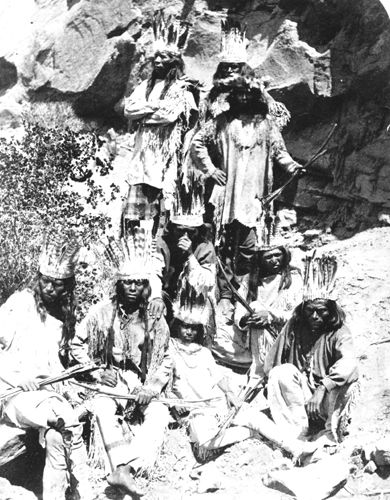
Paiute, 1873.
Today, the Paiute live on several reservations, including the Fallon Indian Reservation, Pyramid Lake Indian Reservation, Summit Lake Indian Reservation, and Walker River Indian Reservations in Nevada; the Fort Hall Indian Reservation in southeast Idaho; and the Fort Bidwell Indian Reservation in California, as well as several other colonies sprinkled throughout the West.
By Frederick Webb Hodge, 1906. Compiled and edited by Kathy Alexander/Legends of America, updated March 2026.
About the Author: This is an adaptation of Frederick Webb Hodge’s 1906 Handbook of American Indians. Though the context remains largely the same, some words, phrases, and the order of the material have been changed to correct grammar and spelling and to make this old document easier for the modern reader.
Also see:
Native Americans – First Owners of America